How Digital Supports B2B Go-To-Market Strategy
The success of a B2B go-to-market campaign hinges on engaging buyers in the digital spaces where they research, evaluate, and decide.
 8 Min Read
The launch deck says one thing. The website says another. The campaign leads with a different benefit, while sales tells a different version of the story. The strategy is sound, yet buyers never experience it as one cohesive effort.
Digital channels support a go-to-market strategy when the website, content, search, campaigns, and lead nurturing all reinforce the same market position to buyers.
This happens when B2B digital marketing is handed the job of executing the go-to-market (GTM) strategy after the key decisions have already been made.
Planning those channels alongside the strategy gives each one a job in helping buyers understand the offering and evaluate its value. The strategy buyers experience is the one they encounter where they research, evaluate, and decide.
Why Digital Has Become Part of the B2B Go-To-Market Strategy
B2B buyers research, compare, and validate information through digital channels before and between sales conversations. A technical buyer evaluating an unfamiliar solution might start with a search result, move to a product page or technical article, and consult specifications or application examples before speaking with a salesperson.

Gartner's 2026 research found that 67% of B2B buyers prefer a rep-free experience. The survey included 646 B2B buyers and was conducted in August and September 2025.
Digital does not replace product, pricing, sales, distribution, or other GTM decisions. It carries those decisions into the places where buyers research, evaluate, and respond.
Those decisions need to account for what buyers must learn from the website and content before sales joins the conversation. Otherwise, the company leaves buyers to fill in the gaps themselves.
Carry GTM Requirements Into the Market

Each digital channel performs a different job for the go-to-market strategy, but the buyer experiences the result as one company.
A digital ecosystem connects those jobs into a single market position. The strategic job comes first. The channel serves that job.
| GTM Requirement | Digital Role |
| Reach the intended market | Search, content, paid media, social, PR |
| Communicate positioning | Website messaging, product pages, campaigns |
| Explain complex value | Technical and educational content |
| Support independent research | Search visibility, website architecture, resources |
| Build confidence | Applications, proof, case studies, technical evidence |
| Move buyers toward action | Relevant CTAs, forms, contact paths |
| Sustain engagement | Email, automation, retargeting |
| Support sales | Product information, sales enablement content |
| Connect response to pipeline | CRM integration, attribution |
| Measure response | Analytics, lead tracking, campaign measurement |
Kao Collins, an industrial inkjet ink supplier, used this approach when it launched SIGMA, a solvent-based ink for HP Specialty Printing Systems.
SIGMA addressed a specific production problem. Ink dried in exposed nozzles during pauses, leaving operators to wipe or purge them before printing resumed. The product allowed longer pauses before nozzle drying while still drying quickly on the printed surface.
The launch brought PR, trade advertising, social media, technical content, PPC, paid social, and a product page together around that product story.
Technical content explained the application and performance benefits. Trade advertising introduced the product and directed prospects to the digital experience.
The product page continued the explanation rather than starting a new conversation.
The launch brought PR, trade advertising, social media, technical content, PPC, paid social, and a product page together around that product story. Technical content explained the application and performance benefits. Trade advertising introduced the product and directed prospects to the digital experience. The product page continued the explanation rather than starting a new conversation.
Each channel gave buyers another way to evaluate the same product promise. Without that shared purpose, adding channels creates more places for the strategy to lose its meaning.
Make Product Value Easier to Find and Understand
Search, websites, and content carry product value into the questions B2B buyers ask during independent research.
A buyer does not always start with a product name. The starting point might be a production problem, an application requirement, a performance target, or a business objective. The digital experience needs to connect that question with the relevant product value.
Kao Collins' X-BAR illustrates this challenge. X-BAR is a high-speed industrial print module designed for OEMs, integrators, and print service providers. Kao Collins needed to explain complex hardware while making the business value clear to visitors arriving from different entry points.
The X-BAR website placed business benefits on every page rather than assuming visitors would enter through the homepage. Prominent calls to action invited visitors to schedule a demonstration. Technical information explained the product, while headlines and supporting copy kept the business benefit visible.
 Those decisions served buyers arriving with different questions. An OEM could enter seeking information about the hardware and still see business value. An integrator could arrive on a technical page and find a path toward a demonstration.
Google’s guidance on AI search says SEO fundamentals remain relevant to AI Overviews and AI Mode. For AI visibility and GEO, the GTM implication is that buyers still need findable content that explains the product's value.
When specifications exist without context, content has no clear connection to the product, or product pages leave buyer questions unanswered, the value proposition loses force before a sales conversation begins.
Give Buyers a Relevant Next Step
The website provides each buyer with the next step for the task at hand.
A technical buyer checking compatibility needs specifications. An executive weighing an investment needs a business justification. A prospective customer evaluating an application needs evidence. A buyer ready to discuss fit needs access to the sales team.
Gartner describes B2B buying as a set of revisited buying tasks rather than a linear path. Buyers may return to research, compare information, involve other members of the buying group, and revisit earlier questions before reaching a decision.
That makes a fixed funnel an incomplete picture of B2B digital behavior. The strategic requirement is progression, but progression does not require one prescribed path.
The X-BAR experience illustrates this distinction. Visitors could encounter product information and business benefits on different pages while still finding a path toward a demonstration. The website supported the next decision without requiring every visitor to follow the same sequence.
A demo invitation gives ready buyers entry to sales. Technical content gives others a way to resolve questions before making contact. Both belong in the same experience.
Stay Present Through Long B2B Buying Cycles
Email, automation, and retargeting extend the GTM strategy into periods when buyers keep researching, but sales are not in the room.
A buyer might read a technical article about an application, leave the website, discuss the issue with an engineering colleague, and return later to investigate a related product or specification.
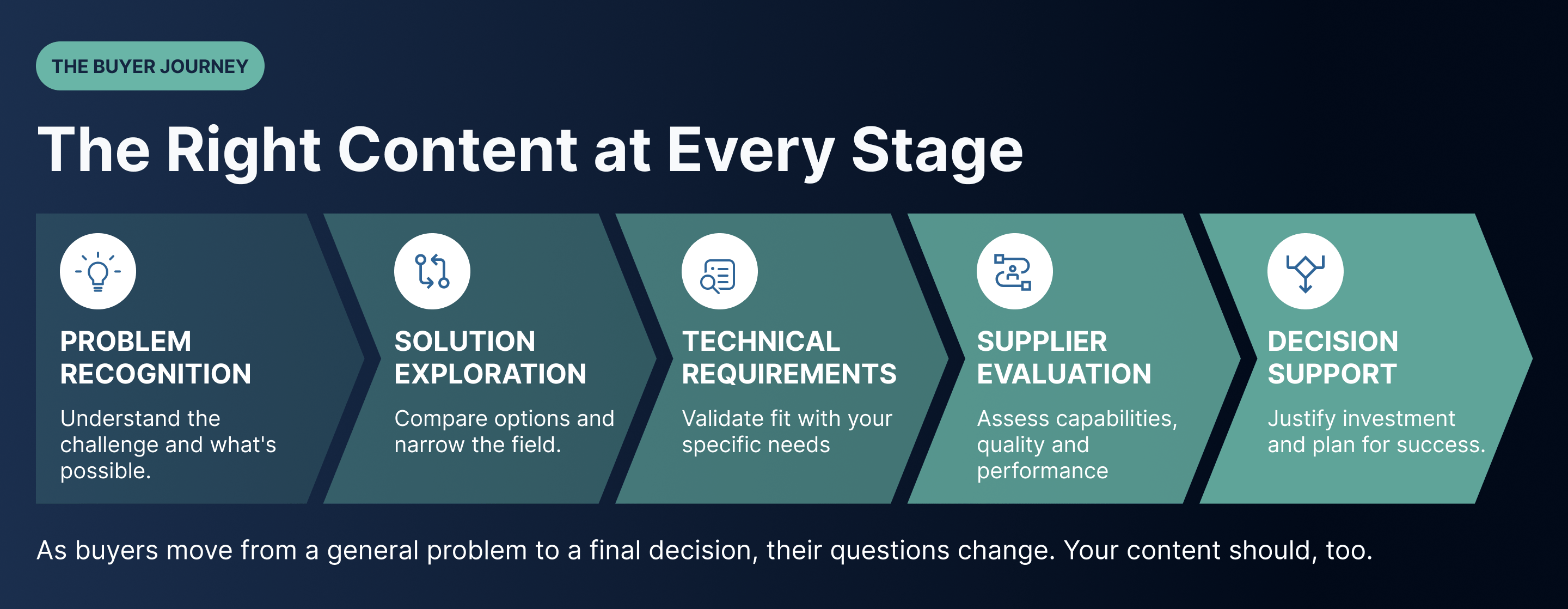
For example, after a buyer reads technical content about printing on difficult substrates, a relevant follow-up email connects that question with application information, product performance, or technical evidence. That gives the buyer information needed for the next decision while keeping the original product position intact.
Gartner's 2025 survey found that 73% of B2B buyers actively avoid suppliers that send irrelevant outreach. Continued contact earns its place by answering what the buyer is trying to learn.
Nurture provides continuity to the GTM strategy during those periods. It helps buyers continue the decision process without losing the thread of the original product story.
Connect Buyer Engagement to Sales and Pipeline
CRM integration carries the buyer's recorded activity into the sales conversation, giving sales more than the fact that someone submitted a form.
Consider a buyer who arrives through a campaign, visits a product page, reads technical content, returns later, and submits an inquiry. CRM data brings together the recorded source of the response, the product or application that drew interest, and the content the buyer engaged with before making contact.
Without that context, a salesperson has a starting point for discussing the application the buyer researched, clarifying a technical question, or providing evidence related to the product that prompted the inquiry.
Gartner's research on buyer preferences reinforces the distinction between information gathering and sales involvement. Buyers tend to favor digital self-service for general information and learning, while they turn to sellers for contextual guidance on whether a solution fits their needs.
Digital does not create the opportunity by itself. It gives the broader GTM system information that can help sales engage at the point where human input adds value.
Without that connection, marketing may see a conversion, sales may see a new contact, and neither sees the research behind the inquiry.
Measure Response Against GTM Objectives
Measurement closes the loop between digital response and the next go-to-market decision.
A campaign can generate traffic, clicks, impressions, form submissions, or engagement without showing whether it supported the business objective behind the launch.
The useful question is what those signals reveal about the GTM strategy.
If the objective is market reach, search visibility, and a qualified audience response provide evidence. If the objective is product consideration, engagement with product information and application content provides another signal. If the objective is lead generation, CRM activity and opportunities provide a closer commercial connection.
Attribution helps associate activities and channels with business outcomes, but it does not, by itself, establish causation. Google distinguishes attribution from experiments that test whether advertising produced additional conversions. The value comes from connecting available evidence to the question the GTM strategy needs to answer.
The SIGMA launch provides an example. Trade advertising used a unique URL to connect an offline promotion with a digital response. That made visits associated with the ad visible. It did not establish how many sales the ad caused.
The next decision might concern the audience, the product explanation, or the channel investment. Measurement has strategic value when what the company learns changes the next GTM decision.
What a Connected Digital GTM System Looks Like
A connected digital GTM system gives the marketing leader a clearer line between the strategy approved inside the company and the experience buyers encounter outside it.
The X-BAR launch shows how audience needs, product value, website experience, and conversion can work together. SIGMA shows how multiple channels can convey a single product benefit across different buyer contexts.
For the marketing leader, the result is a consistent account of the product’s value, useful context for sales, and evidence for the next decision.
Buyers have the information to evaluate the offering, wherever they enter the conversation.
Audit Whether Digital Carries the Strategy
An audit measured against GTM objectives helps the marketing leader identify where buyers lose the product story and decide what to tackle first. Explore DBS's Digital Audits.
Common Questions About Digital's Role in B2B Go-To-Market Strategy
Digital carries the GTM strategy into the places where buyers research, evaluate, and respond. Websites, search, content, campaigns, email, and other digital experiences express the company's positioning, product value, and commercial priorities across the buying journey.
No. A B2B GTM strategy includes decisions about the market, product, pricing, sales, distribution, positioning, and commercial objectives. Digital supports those decisions by carrying them into the buyer experiences where research and evaluation take place.
When digital enters after the GTM strategy is complete, the channels responsible for reaching buyers may have little influence over how that strategy will be experienced in the market. Bringing digital into the strategy earlier helps connect the market position, buyer needs, product value, digital experiences, and measurement.
Digital keeps relevant product information and the company's market position available between sales conversations. Content, email, automation, retargeting, product information, and other digital experiences support buyers as they research, involve stakeholders, compare alternatives, and return to the buying process.
Measurement should connect digital response to the objective behind the GTM strategy. Depending on the objective, useful signals can include qualified audience response, engagement with product and application information, lead activity, CRM data, opportunities, and campaign response. The purpose is to use those signals to inform the next GTM decision, rather than report digital activity in isolation.
Related Posts