Comparing Google AI Overviews vs. AI Mode
Rankings are holding. Clicks are slipping. The difference between Google Search's two AI-powered experiences may explain both. AI Overviews get you found, but AI Mode gets you on the shortlist.
 10 Min Read

Many B2B marketing teams are seeing a puzzling pattern: The website's organic rankings in Google remain stable, but organic traffic from Google is slipping.
Those missing clicks are increasingly being intercepted by Google's AI-generated answers before buyers ever reach a website. AI Overviews summarize information directly within search results. AI Mode keeps buyers inside a conversational research session without returning to traditional results pages. In either format, the click to your website may never happen now.
This changes more than SEO. It changes how expertise is demonstrated, how authority is established, and where competitive differentiation begins.
The problem is that many organizations treat AI search as a single channel. It isn't. Google now offers multiple AI-powered search experiences that serve different research behaviors and may draw from different sources.
For B2B companies with long sales cycles and complex buying committees, that distinction matters. A prospect may discover a category through an AI Overview, evaluate vendors in AI Mode, and build internal justification before visiting a supplier's website.
Organizations that understand those behaviors can develop content for the entire research process. Those that don't may continue optimizing for rankings while buyers conduct more of their research elsewhere.
Google AI Overviews: Built for Discovery, Not Evaluation
For many users, AI Overviews are the most visible sign that the Google Search experience has changed.
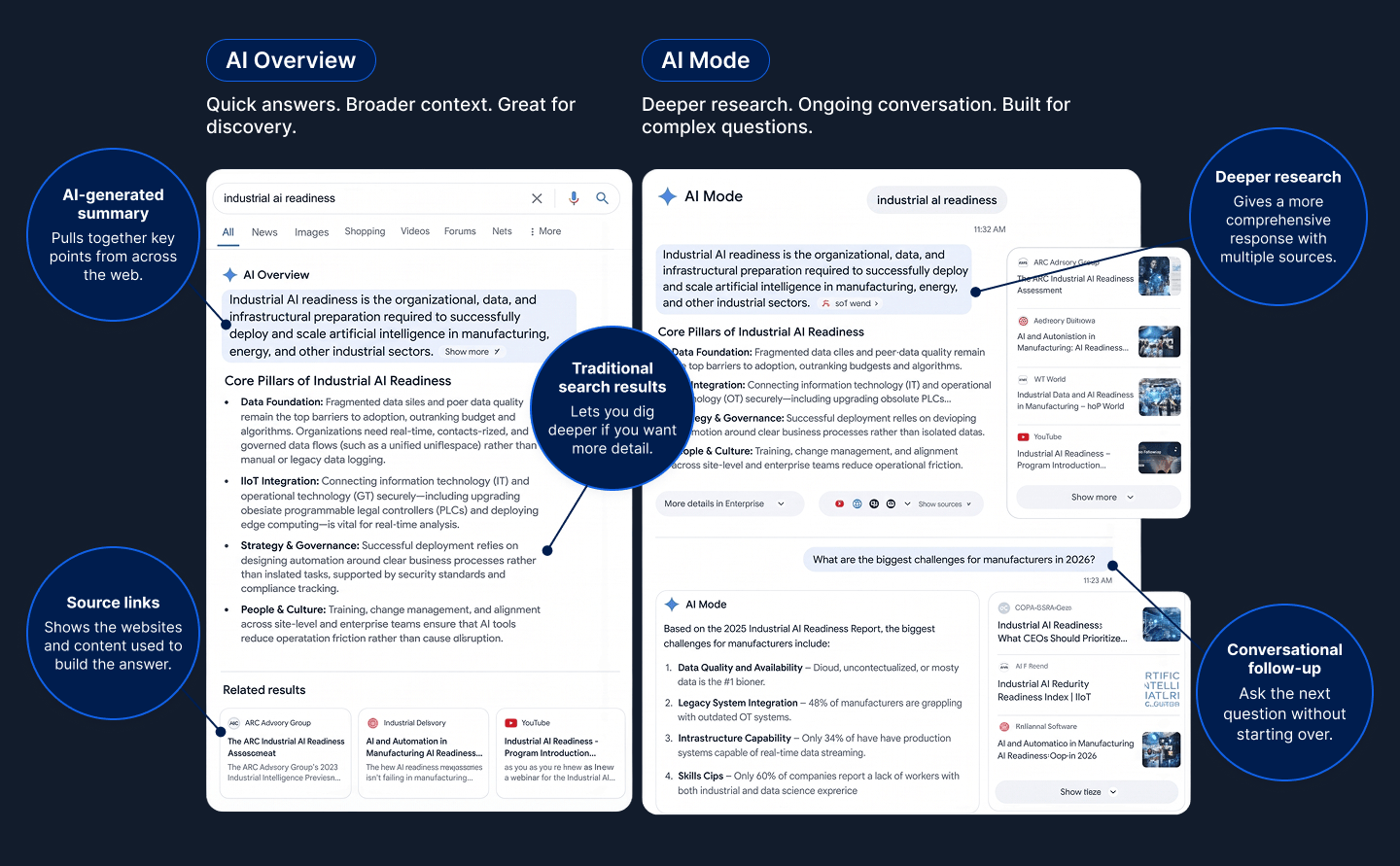
When Google determines that an AI-generated summary would add value to a query, it displays a synthesized response within the results page, often above traditional listings. The response draws on multiple sources and includes links for users who want to explore further.
AI Overviews appear automatically within standard Google Search, placing them directly within the search experience people already use.
For queries that can be addressed with a concise summary, AI Overviews reduce the effort required to understand a subject. Users encounter them most often when learning an unfamiliar concept, clarifying industry terminology, comparing basic definitions, or identifying where to begin a deeper investigation.
- Learning about a new concept
- Understanding industry terminology
- Comparing definitions
- Gathering background information
- Identifying where to continue their research
- That convenience also changes how organizations earn visibility.
Traditional SEO typically assumed that buyers would click through to a website before engaging with its explanation. AI Overviews can reverse that sequence. Buyers receive a synthesized answer before deciding whether to visit any source. Their first impression of an industry, technology, or supplier may therefore come from Google's presentation of the available information rather than an organization's website.
For B2B companies, this represents a meaningful shift. Visibility is no longer measured only by ranking position. It also includes whether an organization’s pages appear as supporting sources within an AI-generated response.
AI Overviews often play a discovery role in the buyer journey. Someone researching industrial automation, investigating a manufacturing process, or seeking an overview of a healthcare regulation can quickly establish a baseline understanding before exploring individual sources in greater depth.
AI Overviews primarily serve as a starting point in standard Search. Users who want to ask follow-up questions, compare options, or investigate a subject more deeply may move into AI Mode, which is designed for continued exploration.
An engineer evaluating collaborative robotics, for example, might begin with an AI Overview explaining the technology. Comparing implementation strategies, assessing suppliers, estimating return on investment, or validating technical claims would typically require additional research beyond that initial summary.
For organizations with complex sales cycles, that distinction is significant. AI Overviews can influence early awareness, but they are less suited to the sustained, multi-step evaluation required to determine a vendor shortlist.
Observation
Many B2B organizations still measure organic search primarily through rankings and clicks. AI Overviews raise another question: Do your pages appear as supporting sources as buyers form their initial understanding of the topic?
Google AI Mode: Designed for Research, Comparison, and Shortlists
If AI Overviews accelerate discovery, AI Mode is designed for deeper research.
AI Mode is Google’s dedicated conversational generative Search experience. Users can enter it directly, or transition into it by asking a follow-up question from an AI Overview. AI Mode carries context between questions, allowing each new prompt to build on the previous exchange.
Instead of repeatedly entering separate searches, users can refine their questions and investigate increasingly specific aspects of a topic without having to start over.
For B2B buyers, this format mirrors how purchasing decisions unfold across the B2B sales cycle.
In other words, a manufacturing executive evaluating industrial automation, an organization assessing new business technology, or a procurement team comparing enterprise software rarely makes a decision based on a single search.
These buyers move through stages of discovery, technical evaluation, vendor comparison, stakeholder alignment, and business justification. AI Mode’s multi-sequence format supports and aligns with that progression more than AI Overviews do.
In turn, the content suited to the AI Mode research process does more than answer one isolated question. It addresses and links to related topics, explains technical considerations, compares alternatives, and demonstrates expertise that withstands scrutiny.
This represents an important shift in how websites establish topical authority. Traditional SEO strategies often organized pages according to individual search keywords. Now, AI Mode can use multiple related searches and sources to answer a complex question, making broader topic coverage more useful during evaluation.
A single article may introduce a concept, but a connected body of useful content gives buyers more opportunities to encounter an organization as their questions become more specific.
For complex B2B purchases, differentiation often occurs during evaluation rather than discovery. Buyers aren’t just searching for the fastest answer. They need enough credible information to make a purchase decision and justify it internally to executive stakeholders and decision makers.
Insight: AI Mode does not replace page-level SEO. It increases the value of having related content and resources that support buyers as their questions become more specific and refined.
Three Google Experiences, Three Roles in the B2B Buyer Journey
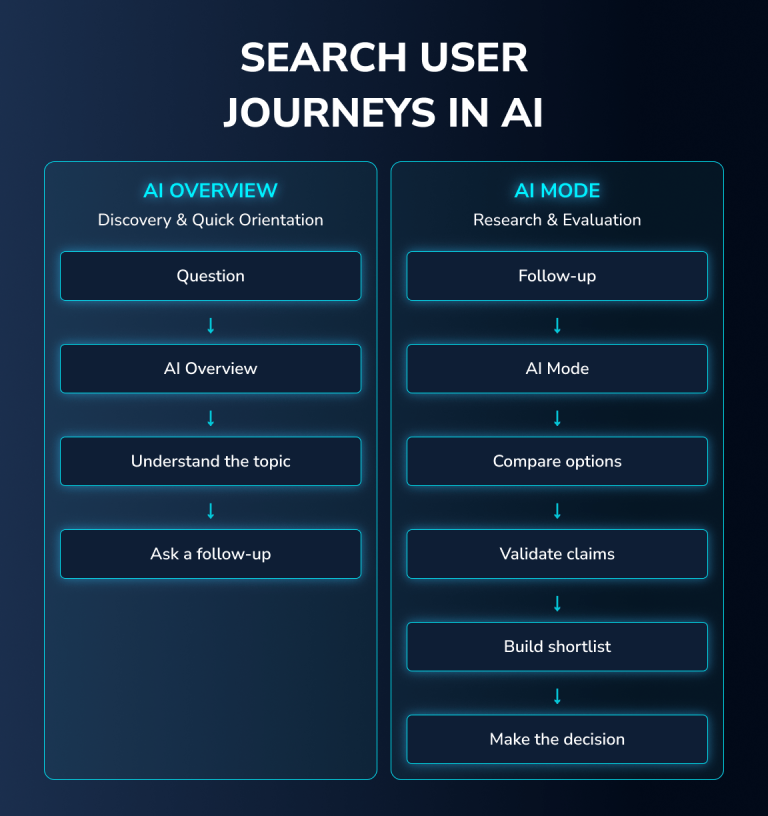
The most important distinction between AI Overviews, AI Mode, and Gemini is not the technology itself. It is the role each plays in Google’s AI search ecosystem.
AI Overviews usually provide a quick entry point. AI Mode supports deeper research and evaluation. Gemini supplies the models used to power both experiences.
The boundaries are not absolute. Google now allows users to ask follow-up questions from an AI Overview and continue the conversation in AI Mode while retaining context.
The comparison graphic summarizes their primary roles.
Where Does Gemini Fit?
Gemini is Google's family of AI foundation models. It powers AI Overviews, AI Mode, the Gemini app, Gemini Live, and Deep Research. It is not a separate search experience. It is the intelligence layer running underneath the experiences buyers already use.
A useful way to think about it: Gemini provides the models. AI Overviews and AI Mode are the search experiences built on those models.
For B2B organizations, the underlying model is less important than how buyers interact with each experience. The strategic question is not how to optimize for Gemini. It is how to publish content that remains authoritative wherever Gemini-powered experiences surface it.
Three Google Experiences, Three Roles in the Buyer Journey
AI Overviews and AI Mode are the two search experiences B2B buyers interact with directly. Gemini is the model platform powering both.
Understanding the distinction clarifies why optimizing for one experience does not automatically optimize for the other.
| AI Overviews | AI Mode | Gemini Models | Gemini Models |
|---|---|---|---|
| Primary Role | Quick answers and discovery | Research and evaluation | Model family powering Google AI products and features |
| User Intent | Understand a topic quickly | Investigate, compare, and refine information | Not applicable at the model level |
| Interaction | AI-generated answer in Search with a transition into AI Mode | Multi-turn conversation with context | Depends on the product or feature |
| Research Depth | Concise starting point | Progressive and detailed | Depends on the implementation |
| Follow-Up Questions | Yes, by continuing into AI Mode | Yes | Depends on the product or feature |
| Useful Content Types | Explanations, definitions, and concise background information | Detailed guidance, comparisons, implementation considerations, and decision-support content | Not applicable at the model level |
| Primary Business Value | Visibility during early research | Visibility during deeper evaluation | Provides AI capabilities used in Google products |
For B2B organizations, the strategic takeaway is straightforward. Discovery creates awareness, while evaluation shapes buying decisions.
Because users can move directly between the two experiences, content should accommodate both quick orientation and deeper investigation.
Organizations that cater to both needs are better positioned to remain visible throughout the buyer journey than those focused solely on rankings and clicks.
Perspective: Most B2B content strategies were built to win one search results page, not three different AI-powered experiences competing for the same buyer's attention.
Suggested next step: Mapping which stages of the buyer journey a site's existing content actually supports, and which stages have nothing behind them, is usually the fastest way to find where visibility is quietly leaking.
Four Questions That Reveal Whether Your AI Search Strategy Is Working
Understanding the distinction is not the finish line. The more important question is whether the content strategy reflects how buyers actually research and evaluate solutions. Four questions reveal where most strategies fall short.

Are We Optimizing for Discovery, Evaluation, or Both?
AI Overviews typically provide quick orientation, while AI Mode enables deeper research and comparison. A content strategy that emphasizes only awareness may miss the stage where buyers compare options, validate claims, and build internal confidence. A strategy built only for awareness hands the evaluation stage to competitors who showed up with more.
Does Our Content Support a Complete Research Journey?
Buyers rarely make complex decisions after reading one page. They ask follow-up questions, compare alternatives, and test their assumptions. Content should provide enough depth and context to remain useful throughout that process. Content that stops at the first answer stops where the shortlist begins.
Are We Publishing Isolated Pages or Building Connected Coverage?
Strong individual pages and rankings still matter. However, AI Mode can draw from multiple related searches and sources when responding to a complex question. Content centered on related buyer questions is, therefore, more useful during extended research than disconnected pages built solely to target individual keywords. Disconnected pages answer one question. Connected coverage earns the research session.
Are We Measuring Visibility and Business Influence?
Organic traffic remains an important metric, but it tells only part of the story. Marketing leaders should also review visibility within Google’s generative AI features, where Search Console reporting is available, as well as referral traffic, on-site engagement, conversions, and feedback from sales teams on how buyers conduct research. Rankings measure where you appear. Influence measures whether it matters.
These questions will not produce an AI search strategy on their own. They reveal whether an organization's current approach accounts for the way B2B buyers increasingly search for information, evaluate it, and make purchasing decisions.
Search Has Changed. Content Strategy Must Follow.
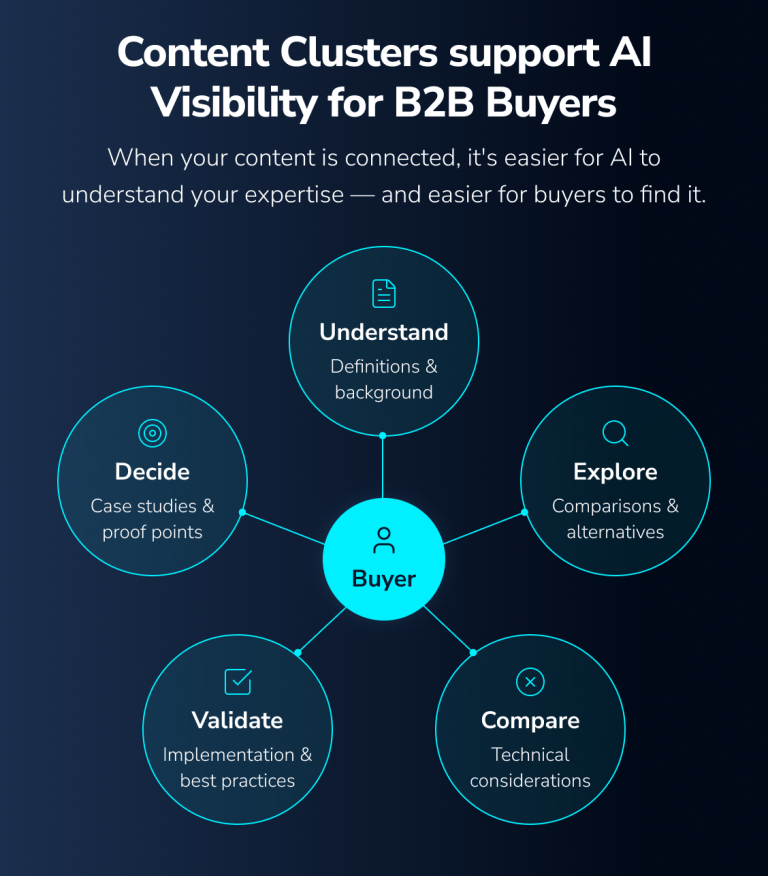
Google's AI search experiences are altering how buyers encounter and assess expertise. Organizations that build content solely to earn rankings may retain visibility in traditional results without appearing during AI-assisted research.
The aim isn’t to chase individual AI features. It is to publish a connected body of useful content that helps buyers understand a topic, evaluate alternatives, and make informed decisions.
Search technology will keep changing. Buyer behavior changes more slowly. Buyers still need expertise they can trust, information that holds up under scrutiny, and evidence they can use to justify a decision internally. The organizations that consistently provide those things do not just rank. They get selected.
Is Your Content Ready for AI-Assisted Search?
Traditional SEO remains essential to digital visibility. Marketing leaders must now determine whether their content also supports discovery, research, and evaluation within Google's AI-powered Search experiences.
Your content may already be performing in traditional search. The question worth asking now is whether it is built to perform where B2B buyers are doing their research.
A DBS AI Search Readiness Assessment examines content architecture, topical authority, technical SEO, and buyer journey coverage to identify where visibility is strong and where gaps are costing you ground.
Contact our team to schedule an assessment.
AI Search Strategy: The Questions Most B2B Teams Cannot Answer Yet
AI Overviews provide AI-generated snapshots within standard Google Search. Users can ask follow-up questions from an AI Overview and continue the conversation in AI Mode.
AI Mode is Google’s dedicated conversational Search experience designed for more extensive research, comparisons, and follow-up questions. The primary difference is research depth and interaction style. AI Overviews deliver a quick synthesized answer. AI Mode supports an extended research session where follow-up questions build on previous responses, context carries forward, and buyers can investigate vendors, compare options, and validate assumptions without restarting.
No. AI Mode is part of Google Search. Standard results remain available, while AI Mode provides a conversational format for more complex research. Users can enter AI Mode directly or move into it from an AI Overview.
Gemini is Google's family of AI models. Different Gemini models power products and features that include AI Overviews, AI Mode, the Gemini app, Gemini Live, and Deep Research. Gemini provides the underlying models rather than serving as another Search experience.
AI Overviews can satisfy some informational needs directly within the results page, reducing the need to click even when a page’s ranking has not changed. AI Mode may also change more research into a conversational experience where sources and links are presented differently.
However, teams should not automatically attribute every traffic decline to AI. Changes in demand, search-result layouts, click-through rates, competitors, seasonality, and technical performance should also be investigated.
Organizations should continue following foundational SEO practices while publishing useful, authoritative content that answers the questions buyers ask throughout the purchasing process.
Content audit framed around the complete buyer journey, from discovery through vendor selection, is the fastest way to identify where AI search visibility is strong and where gaps exist.
Related Posts