Why Accessible Websites Earn More Visibility in AI Search Results
AI did not invent a new standard for organic website visibility, but it did make web accessibility a competitive advantage.
 9 Min Read
For years, website accessibility was framed as a matter of compliance, inclusive design, and legal obligation under standards such as WCAG and the ADA.
That framing was correct, and it still is.
Here is what nobody could have known: the code under the hood that makes a site usable by screen readers is the same code that makes it readable by AI.
Semantic HTML. Proper heading hierarchy. Labeled navigation. The elements built for accessibility are now the elements that determine whether AI systems can find, trust, and cite a site at all.
Organizations chasing AI visibility today are often looking for something new to build. Many already did. The ones that didn't are closer than they think.
A more practical starting point is accessibility. Many practices that make a website usable for assistive technologies also make its content and controls easier for machines to parse.
AI Didn't Invent Accessibility. It Just Validated Its Benefits.
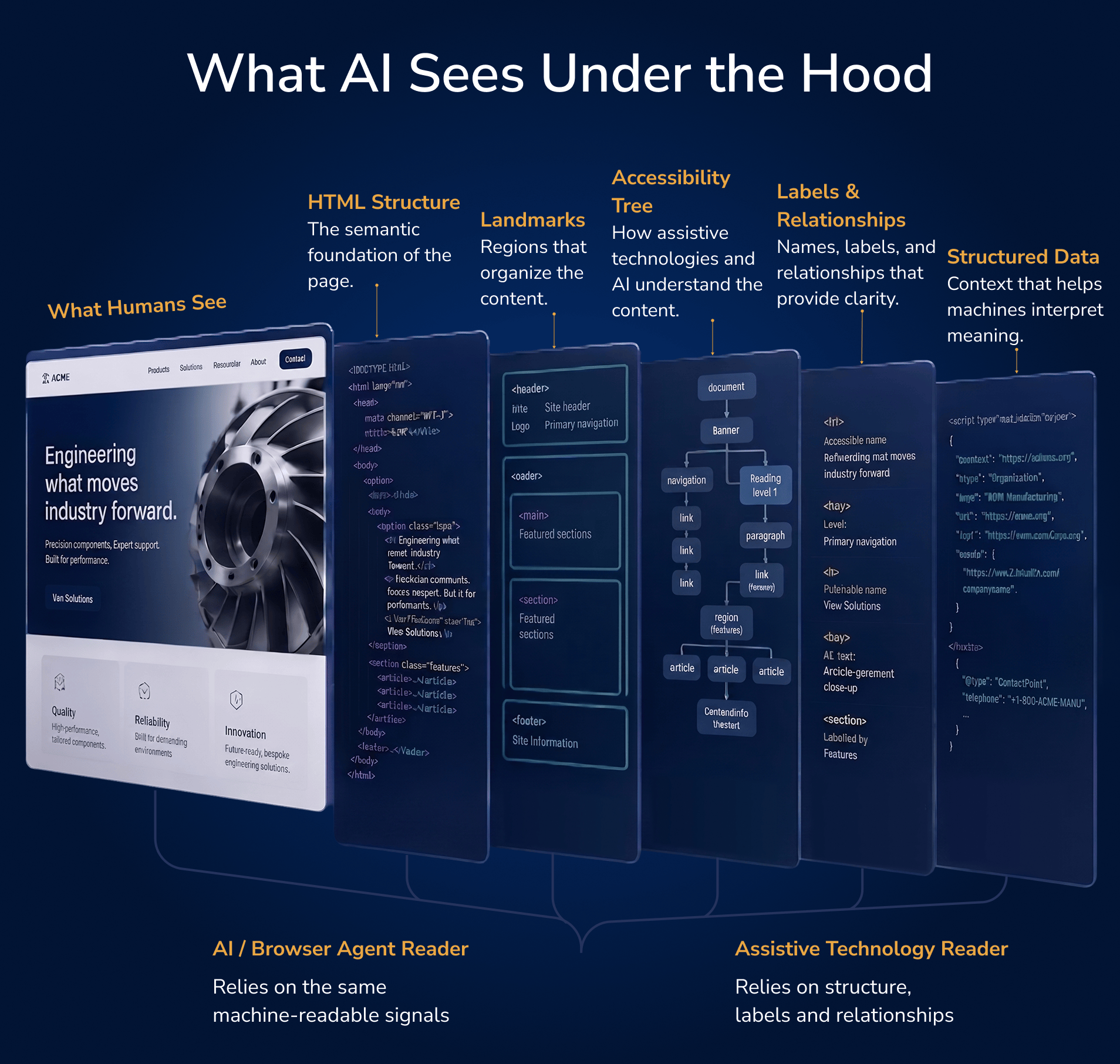
AI systems don’t experience websites exactly as people do. Some can process screenshots and visual layouts, but many crawlers and browser-based agents still depend highly on machine-readable structure to identify content and controls.
The accessibility tree is a structured representation generated from a webpage’s underlying code and accessibility semantics. It exposes information such as the roles, names, states, and relationships of page elements to assistive technologies.
Screen readers have relied on this structure for years. Some browser agents now use it to identify and interact with website content and controls.
When a page uses a logical hierarchy, descriptive links, accessible navigation, and meaningful alternative text, those signals reduce ambiguity for both assistive technologies and browser agents. They make the page’s purpose, controls, and content relationships programmatically available.
How AI Agents ‘Read’ Information
Rather than relying solely on visual appearance, browser agents may use signals like
- Semantic HTML and document landmarks
- Logical heading hierarchy
- Meaningful labels and accessible names
- Descriptive links and alternative text
- Relationships between content and controls
- The accessibility tree
Lighthouse has long included accessibility audits as one measure of website quality. Chrome’s newer Agentic Browsing audits now assess a subset of accessibility factors that affect machine interaction, including names and labels, tree integrity, and whether interactive content appears in the accessibility tree.
That doesn’t mean accessibility guarantees visibility in AI-generated search. It means the same semantic foundation that serves assistive technologies can also make a website easier for browser agents to navigate.
The message is straightforward.
Google didn’t introduce a separate structural standard for agents. Its guidance applies long-standing accessibility practices to a new class of website users.
Perspective
Accessibility didn't become important because of AI. AI exposed why semantic structure has always mattered. Organizations that understand this connection build websites that are easier for both people and machines to interpret.
Related reading: How to Get Your Business in AI Search Results
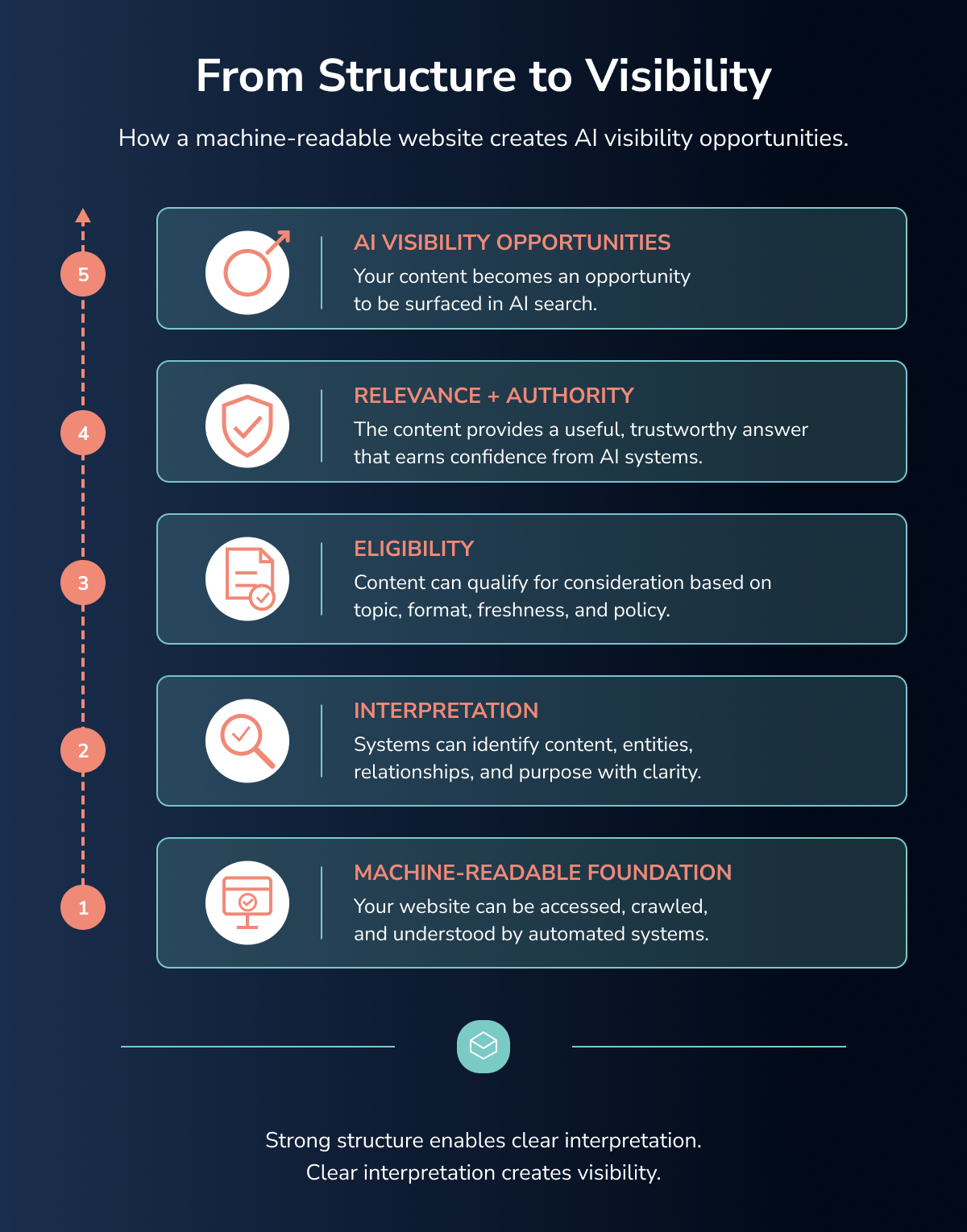
The AI Visibility Stack
Discussions about AI search visibility often concentrate on the outcome without explaining what makes a website machine-readable.
Accessibility isn’t the only factor in AI visibility. Content must also be crawlable, relevant, authoritative, and eligible to appear. But accessibility belongs near the bottom of the stack because a page’s structure affects how reliably machines can interpret its content and interactions.
The model below places these elements in order, from website structure to visibility.
AI systems don’t experience websites exactly as people do. Some can process screenshots and visual layouts, but many crawlers and browser-based agents still depend highly on machine-readable structure to identify content and controls.
The accessibility tree is a structured representation generated from a webpage’s underlying code and accessibility semantics. It exposes information such as the roles, names, states, and relationships of page elements to assistive technologies.
Screen readers have relied on this structure for years. Some browser agents now use it to identify and interact with website content and controls.
When a page uses a logical hierarchy, descriptive links, accessible navigation, and meaningful alternative text, those signals reduce ambiguity for both assistive technologies and browser agents. They make the page’s purpose, controls, and content relationships programmatically available.
Many organizations begin their AI search strategy by asking questions such as
- How do we appear in AI Overviews?
- Should we implement llms.txt?
- What AI optimization tools should we use?
- How do we increase visibility in ChatGPT or Perplexity
Those questions target the top of the stack.
A more useful question comes first.
Can automated systems already reliably access, interpret, and navigate our website?
If not, higher-level tactics can’t compensate for the underlying structural gaps.
That’s why accessibility has become a strategic business issue, not only a compliance requirement. It establishes the machine-readable structure organizations need before investing in additional search tactics.
The goal is not to optimize for AI first. It’s to build a website that people and automated systems can navigate and understand.
Once the website has that structure, investments in SEO, content strategy, schema, and AI search optimization have more to work with.
There isn’t a standalone AI ranking factor called accessibility. The advantage lies in interpretability. Semantic structure, descriptive labels, and accessible navigation reduce ambiguity for automated systems.
That distinction changes where organizations should begin. Before adding new AI tactics, determine whether the website is already easy for machines to access, navigate, and interpret. That shift can expose structural gaps that higher-level tools won’t resolve.
Perspective
AI optimization works best when the underlying website is already machine-readable. Before investing in new tactics, determine whether your site's structure supports how modern search systems access and interpret information.
Building an AI-Ready Website Starts With the Foundation
An accessibility and AI Readiness Assessment turns that principle into a practical review of the website’s structure. It asks whether automated systems can access, navigate, and interpret the site before additional tactics are added.
The assessment examines whether that structure is applied throughout the website. Instead of examining isolated pages or an accessibility score alone, it reviews how templates, navigation, information architecture, and reusable components work together as one machine-readable system.
The objective isn’t simply a higher accessibility score. It’s a coherent website structure that people can navigate and that automated systems can parse.
After identifying gaps, prioritize changes that can be applied through templates and reusable components rather than fixing pages individually.
| Website Structure Practice | What It Gives AI Systems |
| Semantic HTML | Exposes roles and context |
| Logical heading hierarchy | Indicates content order and relationships |
| Structured navigation | Makes navigation paths and controls identifiable |
| Descriptive links | Communicates the destination and purpose |
| Alternative text | Provides text alternatives for meaningful images |
| Reusable templates | Makes repeated structures easier to recognize |
| Consistent content standards | Reduces variation in structure, labels, and recurring patterns |
These changes serve several business priorities at once.
Each initiative draws on many of the same architectural decisions.
The Same Structural Work Pays Off Five Times
- Website accessibility
- Traditional SEO
- AI search visibility
- User experience
- Long-term maintainability
Durable web standards also make it easier to adapt as search technology evolves without chasing every new optimization trend.
What This Means for Complex B2B Organizations
The connection between accessible structure and AI interpretation is particularly relevant for manufacturers, healthcare organizations, financial services firms, and other companies managing complex websites.
Common Features of Complex B2B Websites
- Large product catalogs
- Technical documentation
- Resource libraries
- Regulated content
- Multi-contributor publishing environments
The challenge is rarely a lack of expertise.
More often, valuable information is spread throughout the website, but templates that vary between sections, weak content hierarchy, and disconnected navigation make that expertise difficult for automated systems to find and interpret reliably.
How Accessibility Gaps Affect AI Readiness
Visibility rarely disappears overnight. Accessibility gaps often persist in templates and content, adding to the structural work required for AI readiness.
Common AI Visibility Roadblocks
- Automated systems have more difficulty identifying the purpose of a page and its content relationships.
- Accessibility and technical issues repeat through templates and reusable components.
- SEO and content teams spend more time compensating for structural problems.
- Important information may be omitted or misinterpreted in machine-generated outputs.
- Website changes become harder to govern as contributors and templates multiply.
These outcomes aren’t caused by one missing feature. They stem from structural decisions embedded throughout the website. As AI takes a larger role in search and website interaction, its effects become harder to overlook.
For complex B2B organizations, accessibility should no longer be viewed only as a compliance project. It forms part of the digital infrastructure behind discoverability, governance, usability, and long-term adaptability.
Accessibility and the Shift to AI Search

AI has changed how buyers discover information. It hasn’t changed what makes information understandable.
Organizations that invested in accessible websites were building more than inclusive digital experiences. Their websites also functioned as structured information systems that people could understand, and machines could interpret.
And companies that delayed accessibility aren’t facing an entirely new requirement. They are addressing structural issues that have always affected website quality.
AI agents have made those issues harder to ignore.
Assess Before You Optimize
Before investing in additional AI tactics, evaluate whether the website provides automated systems with sufficient structure to reliably interpret its content and interactions.
An Accessibility and AI Readiness Assessment can identify gaps in semantic structure, accessibility, information architecture, and machine interpretability. It can then set priorities for accessibility, SEO, and AI visibility within a single plan, rather than treating them as separate initiatives.
AI search will keep changing. Accessible, machine-readable structure remains useful regardless of which platform or tactic comes next.
Perspective
Most organizations don't need another AI tool. They need to understand whether their website provides the structural signals modern search systems depend on. That evaluation often reveals opportunities that no optimization platform can create on its own.
Questions About Accessibility and AI Search Visibility
Not directly. There’s no documented evidence that accessibility is a citation factor or that an accessible page is guaranteed to appear in AI-generated results.
However, AI systems and browser agents can use many of the same structural signals that accessibility depends on: semantic HTML, heading hierarchy, descriptive labels, and, for some agents, the accessibility tree. A page that is difficult for assistive technology to parse may also present barriers to browser agents. Citation depends on additional factors such as relevance, authority, indexability, and the platform’s selection process.
It isn’t the same as traditional SEO, but it relies on many of the same fundamentals: crawlability, semantic structure, useful content, and internal linking.
AI search introduces different ways of retrieving, synthesizing, and presenting information. It hasn’t introduced an entirely separate website standard.
Start with the foundation, not the feature. Evaluate the site’s semantic HTML, heading hierarchy, navigation, content architecture, and other accessibility elements before experimenting with additional AI-search tactics.
Structured data can add context where relevant, but it can’t compensate for weak website structure. Google doesn’t use llms.txt for Search, so it shouldn’t be treated as a starting requirement. Adding tactics at the top of the stack won’t resolve problems in the foundation beneath them.
“Trust” is an imprecise way to describe it. Semantic structure and descriptive labels make a page’s roles, hierarchy, and content relationships available in machine-readable form.
An ambiguous structure can make extraction and navigation harder, particularly for browser agents. Structure can aid interpretation, but it doesn’t guarantee that a page will be retrieved, summarized, or cited.
The underlying connection is the same, but the effects can be more extensive. Manufacturers, healthcare organizations, and financial services firms typically manage large volumes of technical documentation, regulated content, reusable templates, and multi-contributor publishing environments.
Because the same template or content pattern may appear on hundreds of pages, one structural problem can affect a much larger portion of the website. Addressing it at the template or component level can resolve the issue throughout the site.
An assessment that examines accessibility and machine interpretability together is a useful starting point.
Lighthouse results and the accessibility tree can reveal structural issues, but neither can predict AI visibility on its own. Automated testing should be combined with manual review of semantic HTML, navigation, headings, labels, alternative text, templates, crawlability, and content architecture.
Related Posts