How SEO and AI Search Visibility Generates More B2B Leads
More B2B buyers are choosing vendors using AI‑driven search, which concentrates visibility into a few trusted names. Becoming one of them is now a revenue strategy.
 21 Min Read
Organic B2B leads are flat or falling, even though your Google rankings still look solid. Why? Over 80% of Google searches now end without any click to a website. Buyers get answers directly from AI platforms like ChatGPT, Bing Chat, and Google’s AI results.
Today, these AI engines often name only one vendor as the trusted answer, while everyone else stays invisible.
Why Owning AI Search Visibility Is the No. 1 Organic Growth Lever
AI-driven search has changed how buyers discover vendors, making visibility inside answer engines a primary growth driver instead of a nice-to-have SEO add-on. Adapting to AI-driven search isn’t optional.
Analysts predict AI-powered search will drive over 20% of B2B organic traffic by the end of 2025. Winning those AI recommendations yields pipeline gains that traditional SEO rarely delivers.
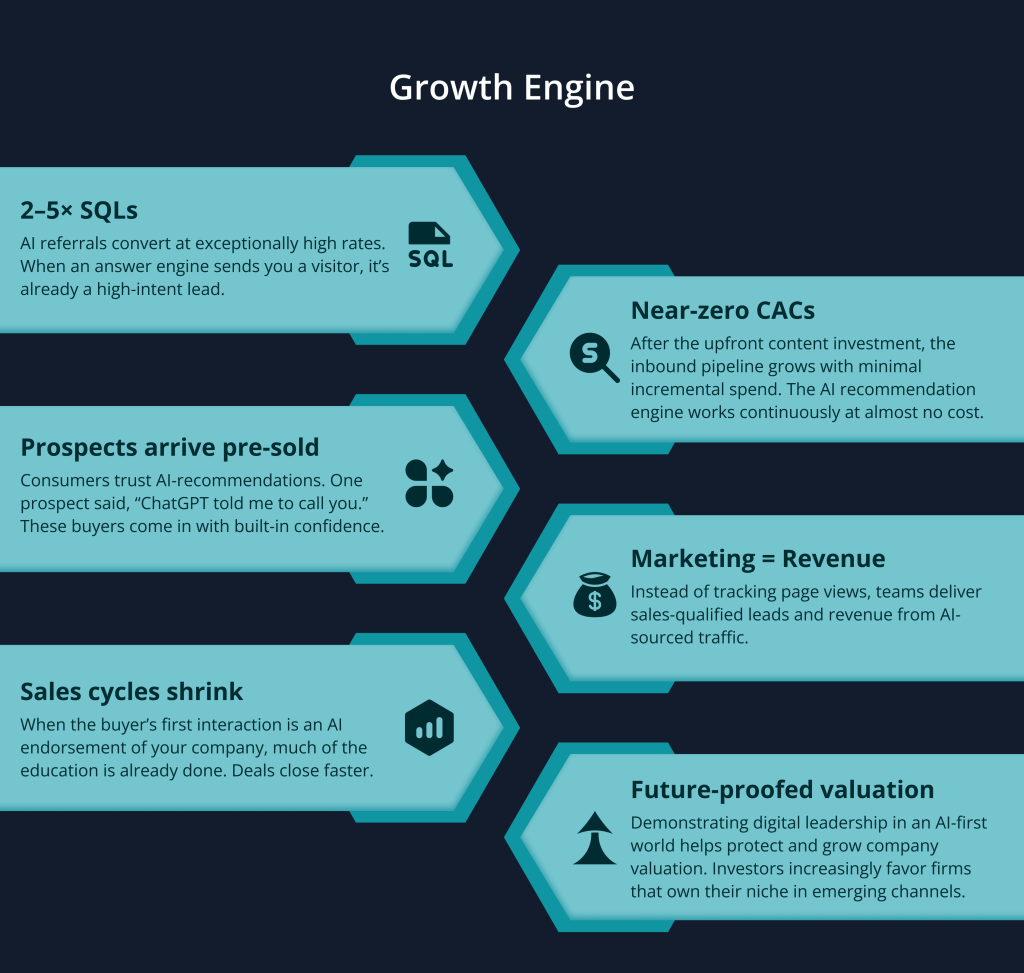
- 2–5× more sales qualified leads (SQLs) than classic SEO. AI referrals convert at exceptionally high rates. When an answer engine sends you a visitor, it’s already a high-intent lead.
- Prospects arrive pre-sold. Almost half of consumers trust AI-recommended brands. One prospect said, “ChatGPT told me to call you.” These buyers come in with built-in confidence.
- Sales cycles shrink from 8-10 touches to 2-3. When the buyer’s first interaction is an AI endorsement of your company, much of the education is already done. Deals close faster.
- Near-zero customer acquisition costs (CACs) once the engine runs. After the upfront content investment, the inbound pipeline grows with minimal incremental spend. The AI recommendation engine works continuously at almost no cost.
- Marketing ties directly to revenue. Instead of tracking page views, teams deliver sales-qualified leads and revenue from AI-sourced traffic.
- Future-proofed valuation. Demonstrating digital leadership in an AI-first world helps protect and grow company valuation. Investors increasingly favor firms that own their niche in emerging channels.
The Problem: Your SEO Playbook Is Silently Killing Pipeline
Many B2B teams are still running an SEO model that worked a few years ago, but now actively limits lead generation in an AI-first search environment.
-
Traffic and leads fall despite stable rankings. You might rank no. 1, but if no one clicks, it doesn’t matter. In Google’s AI answer results, organic click-through rates on informational queries have dropped to less than 1%. A ranked link that once brought 100 visits may now bring just one or two. Fewer clicks mean fewer leads.
-
AI answers questions before the click happens. Buyers increasingly get what they need from AI-generated summaries and chat responses. Many purchasing decisions now happen inside AI platforms before a user ever visits a site. The traditional “click for the answer” model is fading.
-
Gated content stays invisible to AI. If your best content sits behind forms or logins, AI systems can’t read or cite it. AIs won’t fill out forms or pass paywalls. From an AI’s perspective, gated content doesn’t exist.
-
Competitors get cited for real buyer questions. If you haven’t published open answers to the questions prospects actually ask, AI engines will surface someone else. Every unanswered question hands visibility to a competitor or third-party publisher.
-
Hidden insights train AIs to recommend others. AI models learn from what’s available. If your expertise isn’t accessible, the models learn from competing sources and begin treating them as the authority.
Start Your Evaluation
Request a Free Audit of your Site and 3 Competitors
AI Has Concentrated Visibility Into a Few Trusted Names
Before a B2B buyer ever talks to sales, their AI assistant has already narrowed the field to a small group of vendors who keep appearing. Frequent citation now serves as a credibility signal, and vendors who do not surface early rarely make the shortlist.
-
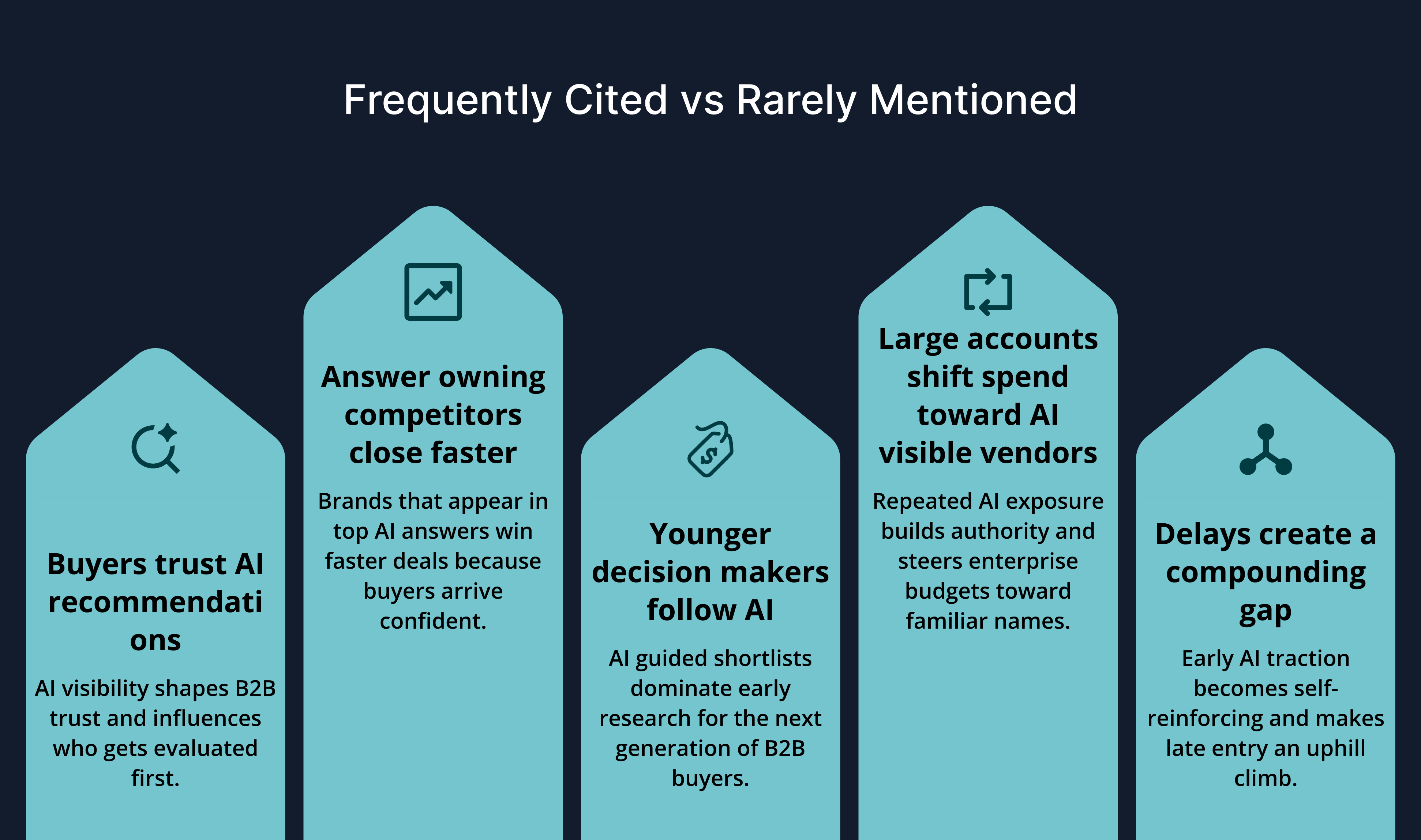
Buyers trust AI recommendations. Nearly 44% of consumers already trust AI-recommended brands, often more than paid ads or traditional rankings. An AI endorsement carries credibility that ads can’t match.
-
Answer-owning competitors close faster. When AI funnels a ready-to-buy prospect your way, sales cycles compress. These deals often close at higher price points because buyers arrive already convinced.
-
Younger decision-makers rely on AI-named vendors. About 85% of procurement professionals aged 25–34 use AI tools in supplier research, compared with 23% of those aged 55–64. The upcoming cohort of engineers and procurement officers trust what the AI suggests. If you’re not mentioned, you’re often not considered.
-
Large accounts require shift spend. Enterprise buyers notice authority signals. If AI assistants repeatedly surface the same vendor, that vendor gains mindshare. We’re already hearing of budget shifting toward the name that “keeps coming up on ChatGPT.”
-
Delays create a compounding gap. Each month of inaction gives competitors more time to feed AI models with content and data. In one industry study, just five brands captured 80% of AI-generated top answers in a B2B category. Once those positions harden, they’re difficult to dislodge. Waiting until 2027 risks facing entrenched incumbents that AI systems already trust.
The Strategic Shift Toward AI Authority
Leading B2B marketing teams are already changing their mindset. They’ve stopped being mere traffic chasers and refocused on becoming the authority that AIs turn to.
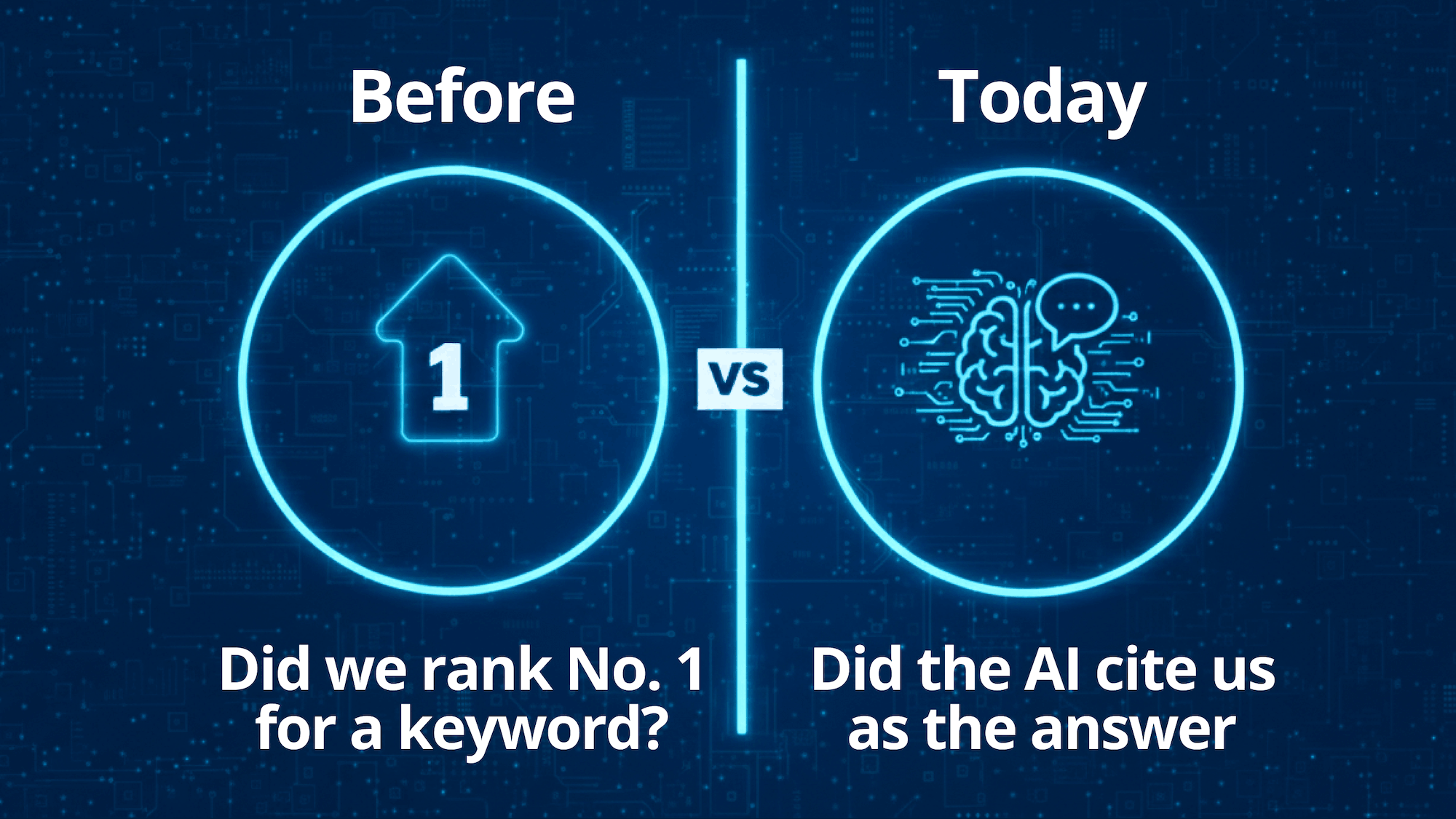
Success is no longer measured by “Did we rank No. 1 for a keyword?” but by “Did the AI cite us as the answer?”
This shift requires a different approach to content and SEO:
-
Provide value directly to the AI. Forward-thinking firms are freely sharing proprietary insights in formats AIs can digest. Instead of obsessing over driving every visitor to the site, they ensure the AI has the best information from their content.
-
Proprietary data becomes a marketing asset. Companies that used to hoard their data for sales meetings are publishing it openly. Detailed test results, reliability stats, and ROI case studies are ungated. This gives AI engines evidence to cite. The result is prospects coming in already convinced. Some firms report prospects saying, “Your data on X in the AI answer impressed us, we need to talk.” The first sales call starts at a later stage because the AI handled much of the early education.
- Trust beats clicks. These companies aren’t worried if an AI answer replaces some blog clicks. They care that the AI names them as an authority. With B2B buyers completing 70–80% of their journey before speaking to sales, being the cited authority means that early preference is for you, which leads to shorter sales cycles.
5 Essential Pillars to Become the AI-Cited Authority
Every major AI engine now acts as a gatekeeper in the B2B buying journey. Before a prospect reaches your site or your sales team, the chatbot assistant has already scanned the landscape and decided which vendors look credible and worth shortlisting.
Becoming the AI cited authority means shaping how these systems read your company and your proof. It starts by making your organization unmistakable and consistently machine-readable across the web.

Pillar 1: Own the Exact Questions Buyers Ask the AIs
Start by mapping out the specific high-intent questions your target buyers pose to AI engines. These are the 50–150 critical questions that signal a need. Include concrete data, step-by-step explanations, or clear examples. Write in the question’s language and structure.
FAQ-style pages help because AI models trigger on natural-language questions. If you own the best answer, the AI is inclined to cite your content.
Pillar 2: Publish Open, Data-Rich Technical Gold
For AIs to cite you, they must see and trust your content. Update your strongest technical assets and make them rich with real data. For example, charts, reliability numbers, and performance comparisons. AIs only cite what they can access and verify. Publishing your data prevents a competitor’s open data from filling the gap.
Pillar 3: Make Your Company an Unmistakable Entity
AI algorithms identify entities and relationships. You need to ensure your company is an unambiguous, well-defined entity in the machine’s view, closely linked to your expertise.
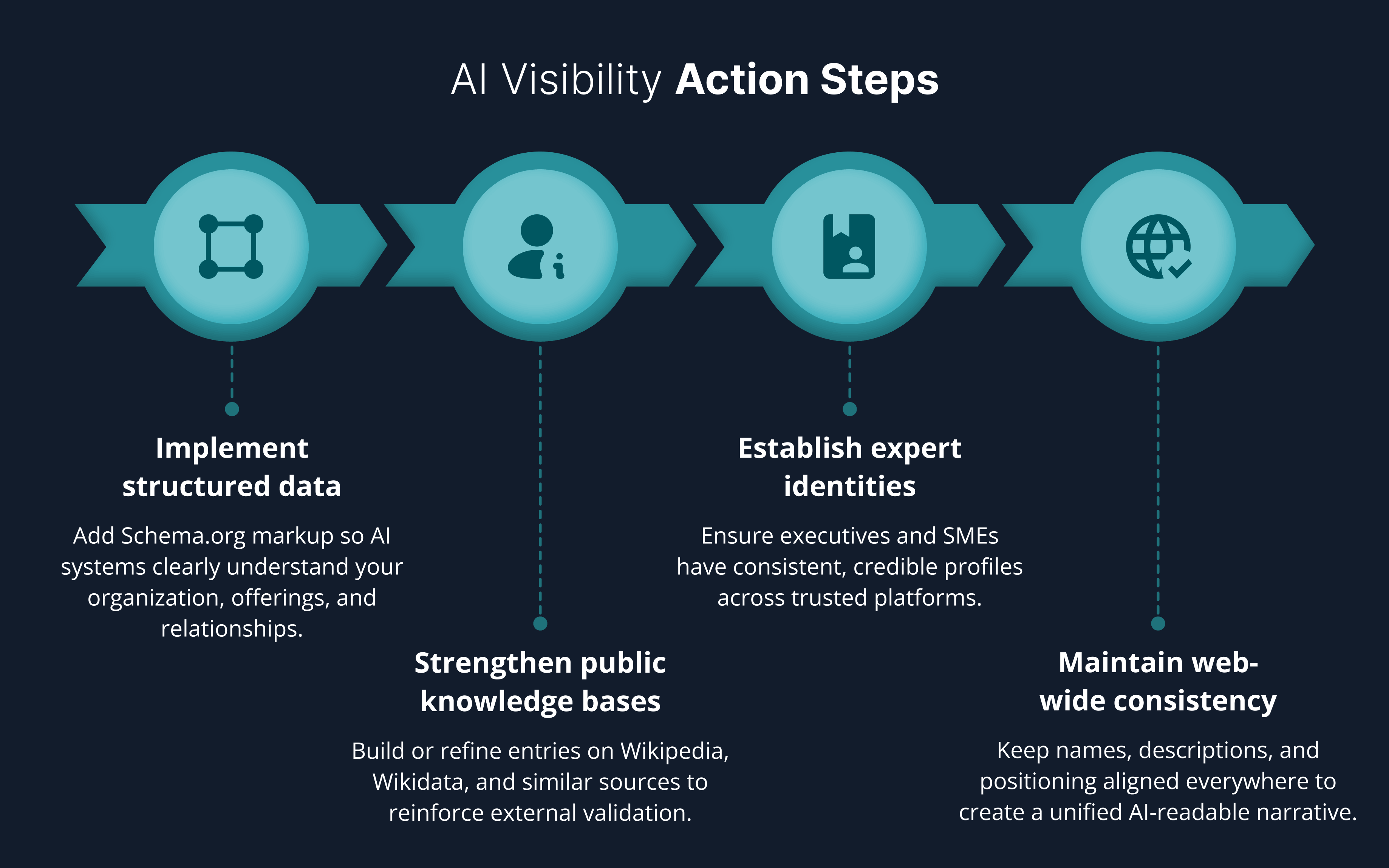
Key Steps
-
Implement structured data across your site. Use Schema.org markup for your organization,
products, services, and leadership. It provides AI systems with explicit context about who you are and how your offerings relate to each other.
-
Strengthen your presence in public knowledge bases. Create or enhance entries on sources AI models rely on, such as Wikipedia and Wikidata. These act as external validation layers.
-
Establish clear expert identities. Ensure your executives and subject-matter experts have consistent profiles across trusted sites, linking human credibility to your brand.
- Maintain consistency across the web. Your company name, descriptions, and positioning should align everywhere they appear so that AI can find a corroborated narrative.
Pillar 4: Win Citations Across All Major AI Engines
Don’t focus on just one AI platform. In 2025–2026, the big four are Google’s AI overview, ChatGPT, Perplexity, and emerging tools in your niche. Buyers use different engines at different stages, so you need visibility across the board.
Each platform surfaces answers differently. Understanding how they select and cite sources is critical because good content alone isn’t enough. What earns citations in Google’s AI Overview isn’t always what earns citations in ChatGPT or Perplexity.
The table below shows how major AI search platforms decide which sources to mention and what to optimize for:
| AI Platform | How It Chooses Sources | What Wins Visibility |
|
Google AI Overview (SGE) |
Extends classic Google ranking logic into AI answers | Strong E-E-A-T signals, authoritative backlinks, clean schema, trusted domains |
| ChatGPT (with browsing) | Pulls from top-ranked pages and well-known, credible sources | Solid SEO fundamentals, reputable links, clear explanations, recognized brands |
| Perplexity | Actively cites multiple sources per answer | Concise, factual passages that directly answer questions; quotable data |
| Google Gemini and next-gen models | Blend conversational answers with citations | A mix of authority, structured data, clarity, and evidence-rich content |
The key insight is that there’s no single AI optimization tactic. Winning requires satisfying multiple citation systems. Some platforms reward authority signals, others reward clarity and direct answers.
Optimize for each platform without neglecting any. Ensure your content appears cleanly in Google’s AI results, monitor how ChatGPT pulls from your site, and submit your website to Bing’s index. Participate in reputable communities that AI systems often reference.
Track AI visibility across platforms. Nearly 30% of B2B buyers now start research with an AI chatbot, and about 39% primarily use AI tools for search. If a VP of Engineering asks Perplexity for top options and you’re missing, it’s effectively the same as not appearing in Google.
Pillar 5: Unified Revenue Ownership of AI Citation Share
AI citation share is a new B2B metric that tracks the percentage of high-intent buyer questions where your brand is cited or recommended by AI engines.
Make AI citations share a company-owned KPI. If AI-driven discovery influences the pipeline, responsibility for visibility must sit with revenue leadership.
Being cited by AI isn’t achieved by content alone. Marketing leads SEO and publishing, but Product and Engineering supply the data AIs can reference. Executives and subject-matter experts add expertise through patents, talks, and bylined insights. Sales provides real buyer questions. Customer success contributes reviews and proof points.
A shared goal, such as “We want to be cited in 50% of the top 100 buyer questions,” drives alignment. Teams focus on authoritative answers and evidence that earns AI citations.
The Team That Makes It Happen
Owning AI visibility is not a marketing side project. It requires a team that can shape how AI systems interpret your company, publish the proof those systems rely on, and measure the impact on the pipeline.
These roles form the core engine that builds and protects your AI citation share.
-
AI Search Strategist - Aligns SEO, content, and platform requirements.
-
Technical Content Engineer - Produces authoritative, data-backed answers.
-
Entity and Schema Architect - Ensures AI systems can identify the company as a trusted entity through knowledge graphs and structured data.
-
Proprietary Data Owner - Supplies performance data and benchmarks that AIs can cite.
- Revenue Operations and AI Visibility Lead - Tracks AI citation share, ties citations to pipeline, aligns marketing and sales around outcomes.
The Top Dog: What Success Looks Like
When you become the AI-cited authority in your category, your impact shows up everywhere buyers make decisions. The shift is visible in your pipeline, in how confidently prospects arrive, and in how the market evaluates your leadership.
These are the signals that you’ve become the default choice.

-
2–5× increase in organic pipeline contribution, with higher close rates.
-
40–60% of new opportunities mention an AI recommendation. Buyers reference seeing your brand in AI answers during discovery.
-
Sales teams focus on high-value deals. Buyers arrive informed and confident.
-
Marketing is tied directly to revenue. AI visibility efforts contribute to the pipeline and wins.
-
Customers view you as the trusted leader. When AI consistently recommends you, buyers assume you’re the safe choice.
- Digital maturity improves valuation. Demonstrating leadership in AI-driven discovery strengthens competitive position and investor perception.
The Internal Shift: New Mindsets That Win
Winning in an AI‑first search environment requires a cultural shift in how your team thinks about content, authority, and visibility.
The companies that break away from the pack have embraced mindsets like these.
-
From ranking No. 1 to being the one AI names as the answer.
-
From more content to better answers to exact questions.
-
From gating everything to opening the insights AIs cite.
-
From SEO as marketing’s job to authority as everyone’s responsibility.
- From waiting and seeing to acting before competitors secure those positions.
You Don’t Have to Do This Alone
Teams don’t need to solve this in isolation. A phased approach with experienced partners can accelerate early progress.
Companies that try to build the plan internally often move too slowly. Taking action now helps secure your brand’s place as a trusted authority and capture revenue from AI-driven discovery.
Let’s Discuss Your Goals
Secure Your Position in AI Search Before Someone Else Does.
FAQs
AI search visibility means your brand shows up as a recommended vendor inside AI engines like ChatGPT, Google’s AI results, Perplexity, and Gemini. These systems answer buyer questions directly and often highlight only one or two trusted companies. When AI cites your brand, you gain early credibility, attract higher intent traffic, and generate stronger pipeline impact even if your traditional SEO rankings stay the same.
AI models rely on accessible, verifiable information. They favor companies with clear entity signals, structured data, consistent brand information, and open technical content that answers real buyer questions. If your expertise, data, and explanations are easy for AI systems to read and validate, you’re far more likely to be cited as the recommended vendor.
Classic SEO depends on earning clicks from ranked pages, but most informational searches now end inside AI summaries. If buyers get their answers directly from an AI assistant, they may never visit your website, even if you rank No. 1. B2B teams that rely only on keyword rankings often see declining organic leads because AI engines absorb the early-stage research that used to drive traffic.
AI engines prioritize content that is open, data‑rich, and written in the same language buyers use when asking questions. Detailed technical explanations, reliability data, performance comparisons, and clear step‑by‑step guidance give AI systems the evidence they need to cite your brand. Gated content, thin blog posts, and generic marketing copy rarely earn AI recommendations.
When a buyer sees your company recommended by an AI assistant, they enter the sales process with built‑in trust. This leads to shorter sales cycles, higher close rates, and more sales‑qualified leads. Many B2B teams report that prospects now reference AI recommendations during discovery, which signals that AI visibility is becoming a direct driver of pipeline and revenue.
Related Posts