The Booth Isn't Enough for B2B Buyers Anymore
B2B buyers research, evaluate, and eliminate vendors online long before the first in-person sales conversation. Does your website support that journey better than your competitors?
 8 Min Read

The trade show floor has always been expensive. What changed is that it stopped being worth it in the same way.
Jet fuel has roughly doubled since late February 2026, triggered by the conflict in the Middle East. Rising travel costs and changing B2B buyer behavior are forcing companies to rethink the ROI of trade shows. Buyers now complete vendor research and shortlist evaluation online before speaking with sales.
U.S. airfares are up nearly 21% year over year as of April. On United's Q1 2026 earnings call, Chief Commercial Officer Andrew Nocella told analysts exactly what that means for anyone hoping prices come back down: "The longer the price of fuel remains in this range, and the longer consumers pay these prices and airlines get used to this revenue stream, the more likely it is to stick."
Ouch.
That is not a forecast. That is an airline executive telling the market, on the record, that higher fares are the new baseline for air travel.
The Global Business Travel Association surveyed over 500 corporate travel managers in April 2026. Their CEO, Suzanne Neufang, summarized what organizations are doing in response: "A more deliberate and carefully managed approach... adapting to rising costs, operational friction and escalating geopolitical tensions."
More deliberate. More carefully managed.
In plain language: Travel expenses are becoming harder to approve, harder to justify, and subject to a level of CFO scrutiny that didn't exist two years ago.
“Show me the ROI.” That request is now part of every conversation surrounding business travel and events, and "we always go to this show" is no longer a viable justification.
For B2B companies whose sales pipelines depend on booth traffic and handshakes, this is not a temporary inconvenience. It is a structural shift, accelerating another one that began five years ago.
Cue the COVID flashback.
COVID Moved B2B Procurement Online. It Hasn't Moved Back.

The pandemic shut the tradeshow calendar for nearly two years. The shows came back. Buyer behavior didn't revert.
Two years without tradeshows had taught B2B buyers to research, evaluate, and shortlist vendors independently. They became good at it.
Today, B2B buyers complete most of their vendor evaluation before they contact anyone. In a March 2026 survey of 646 B2B buyers, Gartner found that 67% prefer a rep-free buying experience.
Alyssa Cruz, Senior Principal Analyst in the Gartner Sales Practice, named the implication directly: "B2B buyers are progressing through critical buying tasks in more autonomous ways, and sellers can't rely on static collateral to carry influence in those moments."
Static collateral. That is what most B2B websites are.
The tradeshow booth was the dynamic version: staff who could read the room, answer objections, and adjust in real time. For years, the booth compensated for websites that were essentially brochures.
Now that compensation costs more, requires more justification, and reaches fewer buyers than it used to.
The buyers didn't wait. They moved their evaluation to wherever they could get the information they needed: search, peer reviews, industry content, and company websites.
The companies built for that process are winning. The ones treating their websites as digital business cards are losing deals they never knew existed because the buyer found someone else before contacting them.
See where your website stands. No cost. No pressure. We’ll evaluate your site and three competitors.
Your Website Determines Whether You Make the B2B Shortlist

Buyers build their shortlist before they contact anyone. That is where the deal is won or lost.
By the time a prospect calls your sales team, they already know who else is on their list. They have read your case studies or noticed you don't have any.
They tried to find your pricing structure, or decided your vague "contact us" page signals something they don't like. They compared your team page to a competitor's.
That entire process happens on your website. Or it doesn't, because they found a competitor whose site answered the questions your site didn't, and you never made the list.
The data backs this up. DBS Interactive audited 504 CNC manufacturer websites in 2026 using Google's Lighthouse tool, measuring page speed, accessibility, web standards, and search readiness.
Only 41 of 504 sites scored "Good" for page speed. Nearly 25% scored "Poor." The slowest sites took more than 40 seconds to load on mobile.
These are the sites buyers land on during independent research. A prospect who can't get a product spec page to load in three seconds isn't waiting.
As Steve Fowler, Client Marketing Director at DBS Interactive, put it: "They're already on a competitor's site."
And increasingly, that research doesn't start with a search engine. Tools like Claude, ChatGPT, and Gemini now influence B2B vendor shortlists more than vendor websites do.
A company that doesn't surface in those answers is invisible when the shortlist is built.
That is not a prediction. That is where buyers are already operating.
Buyers research without you. Show up stronger. We can help you.
What Rising Travel Costs Mean for B2B Trade Show Strategy
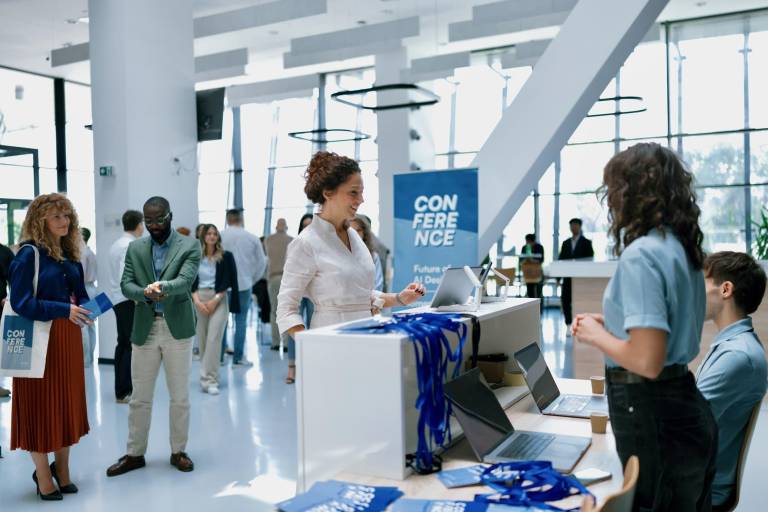
For B2B manufacturers and healthcare companies, the fall conference calendar is where a significant share of the annual lead pipeline gets built. The biggest shows draw tens of thousands of buyers, sellers, and decision-makers under one roof, and for many companies, they represent the single largest marketing and sales investment of the year.
IMTS, the International Manufacturing Technology Show, lands in Chicago this September, drawing more than 114,000 buyers and sellers from over 112 countries. HLTH, the healthcare industry's premier business strategy conference, follows in November in Las Vegas, with more than 12,000 attendees, over 4,300 of them C-suite.
These are real events with real value.
They are also expensive ones.
A single show costs $30,000 to $80,000 or more to participate in, before fuel surcharges push airfare another 20% above last year's levels.
Delta CEO Ed Bastian told analysts on the Q1 2026 earnings call that his airline will "meaningfully reduce" capacity "with a downward bias until we see the fuel situation improve," which means fewer seats and continued upward pressure on fares.
Relief is not coming on a schedule anyone can budget around.
Here is what that budget is actually buying.
The booth traffic a company gets at IMTS is not random. It is largely a product of the digital presence that preceded the show.
Buyers arrive knowing exactly which booths they want to visit. The companies with credible, content-rich sites are the ones they seek out. The ones with an anemic digital presence wait for foot traffic that is already going to competitors.
They never know what they didn't get.
The research shaping who gets on the shortlist for those September conversations is happening right now.
SEO and AEO Are Now Core B2B Sales Infrastructure
Search and AI are now primary top-of-funnel discovery channels. Full stop.
Search optimization puts you in front of buyers when they are actively searching the web. GEO (generative engine optimization) puts you in front of them when they ask AI tools for recommendations.
Neither is a marketing tactic. Both are sales infrastructure.
That distinction matters, because sales infrastructure gets funded and protected by stakeholders and decision-makers with little hesitation. Marketing, meanwhile, often gets cut when budgets tighten.
Weak Digital Visibility Is Quietly Killing B2B Pipelines

Buyers who can't find what they need during independent research do not call to ask.
They find a competitor and move on.
That attrition becomes invisible in most sales reporting. It doesn't appear as a lost deal. It doesn't appear at all.
The company that “lost” the deal never knew it existed.
Organizations that built a strong digital presence before these market pressures hit are not feeling the squeeze as much.
That's because their sales pipeline no longer depends on whether a CFO approves the next conference. Their sales team is engaging prospects who are already familiar with their capabilities and convinced they're worth talking to.
That resilience didn't happen by accident. It happened because those companies stopped treating digital presence as a response to disruption, and started treating it as protection against the next one.
Pandemics. Recessions. Tariffs. Geopolitical conflict.
There will always be something adding friction to in-person sales and marketing strategies.
The companies that weather these disruptions and emerge even better than before are the ones that built a strong digital foundation to generate a pipeline when the in-person channel becomes expensive, complicated, or closed entirely.
B2B companies building that foundation now will be harder to displace when the next disruption hits. The ones waiting for conditions to stabilize are betting on a calm that doesn't come.
Want a pipeline less dependent on trade shows and travel approvals? Let's talk.
FAQs
A redesign addresses how a site looks and how it's built. It doesn't address whether the content answers the questions buyers ask during independent research, whether the architecture allows AI tools to surface the right pages, or whether proof points are positioned where evaluation happens.
The test isn't whether the site looks good. It is whether a buyer who has never heard of your company can arrive from a search, find what they need to shortlist you, and do that without a sales conversation.
Referrals get buyers to your door. Your digital presence is what they find when they walk through it. Buyers referred to a company that still conducts independent research before engaging. They verify the referral against what they find online.
A weak digital presence can undermine a warm referral just as effectively as it can prevent a cold one.
Frame it as sales infrastructure, not a marketing expense.
A site that qualifies prospects, addresses objections, and drives decisions operates around the clock without a travel expense report. Compare that to the full cost of tradeshow participation, and the ROI question changes shape.
The issue isn't whether to invest in digital. The question is whether the current allocation reflects where buyers are actually evaluating.
Answer engine optimization is the practice of structuring content so AI tools surface your company in response to relevant buyer questions.
GenAI tools are now the number one source influencing B2B vendor shortlists, cited by 17.1% of buyers, ahead of vendor websites and peer recommendations.
(https://research.g2.com/cmos-2025-buyer-behavior-report-research-g2)
SEO establishes presence in search results. AEO establishes presence in AI-generated answers.
Both matter. Neither is optional.
No. But the balance needs to shift.
The companies getting the most from IMTS and HLTH are the ones whose digital presence does the pre-show shortlisting work that generates qualified booth traffic and makes follow-up productive.
The tradeshow extends a digital relationship. It does not replace the need for one. The shows that produce results are the ones where the company is already known.
Related Posts