
Great Digital Agencies Make Industrial Websites Act Like Revenue Systems
Experienced B2B digital agencies get more ROI from industrial websites by aligning design and UX with revenue math, buyer behavior, and operational systems.
 4 Min Read

These recurring technical, architectural, and performance patterns determine how high-stakes B2B websites, search visibility, and digital systems drive measurable revenue impact:
- Revenue math comes before design. Agencies that define lead quality thresholds, conversion economics, and value events upfront build sites that can be held accountable to deal outcomes. Those that start with aesthetics or traffic targets cannot.
- In regulated markets, website inaccuracy is an operational risk. When specs, certifications, and validation data are wrong or hard to find, buyers stall and deals break. Technical accuracy is a risk control function, not a content quality concern.
- ROI is only measurable when the right events are tracked. CRM systems need to capture RFQs, spec downloads, CAD requests, and configurator activity as distinct value events. Without that integration, attribution collapses into session counts and it becomes more difficult, if not impossible, to audit what influences your pipeline.
- Flat architectures degrade as product lines and buying surfaces expand. Industrial SEO must handle deep product hierarchies, certification structured data, and AI-surface discoverability simultaneously. Scalability is a precondition for sustained visibility, not an upgrade to consider later.
- When disciplines optimize in isolation, the site fragments. Cross-functional alignment across design, content, and development is a governance requirement. Technical conversion needs get overridden by aesthetic preferences when teams aren't unified around the same revenue outcomes.
- Sites not measured against pipeline outcomes drift toward vanity performance. Quarterly reviews tied to spec engagement, RFQ conversion, and deal influence are what separate sites that sustain revenue contribution from those that eventually require replacement.
For B2B companies, digital investment often behaves like capital expenditure: Leadership expects measurable effects on pipeline, efficiency, and risk.
The problem? Traffic-first and design-first approaches to website projects often fail under that scrutiny.
Put another way, getting more website visits doesn’t matter as much if the visitors are unqualified. And a better-looking site doesn’t always shorten validation cycles.
What's the Business Role of the B2B Website?
B2B websites are (or that is, they should be):
- A revenue instrument bound directly to pipeline contribution
- A system that reduces sales and engineering workload
- A control layer governing technical and regulatory accuracy
In manufacturing, healthcare, and insurance services, the website functions as operational infrastructure. Treating it as anything less creates needless risk for the business, which the right agencies can flip into opportunities for driving customer satisfaction and business growth.
How Top Agencies Deliver ROI From B2B Health, Manufacturing, and Industrial Websites
Top-performing agencies follow a repeatable model grounded in revenue logic, buyer behavior, and operational constraints.
This is how they turn complex buying environments into consistent pipeline impact.
1. Revenue Math Determines ROI
High-performing teams start with revenue math before a single wireframe exists.
They define pipeline targets tied to deal economics, forcing the site to justify its investment. That grounding reduces reliance on vanity metrics and enables self-service technical validation, easing sales engineering pressure.
The result is a website that behaves like a revenue system.
Lead Quality Thresholds
Lead Quality Thresholds
- Technical fit and application readiness - Regulatory and compliance requirements - Buyer role across engineering, clinical, procurement, and quality
Conversion Economics for Long Sales Cycles
Conversion Economics for Long Sales Cycles
- Cost per lead relative to deal size - CAC and LTV - Payback periods in high-value contracts
Revenue-Accurate Attribution
Revenue-Accurate Attribution
- RFQs, spec downloads, and consult requests tracked as value events - Mid-funnel technical engagement measured
2. Engineering Discoverability Across Buying Surfaces

Industrial buyers don’t rely on a single channel. They move across search, AI tools, supplier portals, paid listings, organic results, social, and internal workflows.
Top agencies account for that reality and build visibility across all of them. All of these channels ultimately push the buyer toward a high‑performance website that resolves the goals, motivations, and pain points that drove the initial click.
Key Execution Areas
- SEO architectures that handle deep product structures
- Structured data exposing certifications and specs in AI outputs
- PPC focused on RFQs, demos, and engineering consults
- Content paths aligned to technical research behavior
This creates a demand engine that reflects how buyers actually search and evaluate.
3. UX That Reduces Technical and Regulatory Friction

Conversion barriers in these markets aren’t emotional. They’re technical, regulatory, and organizational.
High-performing teams design around those constraints.
UX Patterns That Work
- Clear pathways for engineers, clinicians, procurement, and compliance
- Organized presentation of specs, tolerances, and validation data
- Assets that enable multi-stakeholder review
- Interfaces that address safety, compliance, and continuity concerns
The outcome is faster evaluation, fewer bottlenecks, and lower deal risk.
4. Content That Supports Sales and Shortens Cycles
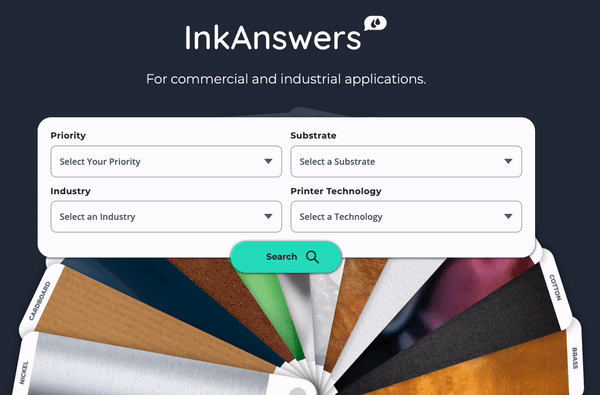
Content is treated as a working tool inside the sales process.
Effective teams build resources that reduce friction during evaluation and validation.
Assets That Move Deals Forward
- Product comparisons, spec sheets, and qualification guides
- Plain explanations of complex or regulated products
- Materials sales teams can use mid-deal
- Account-based content for industries like pharma, aerospace, and med-device
In healthcare specifically, accuracy and validation carry more weight than volume.
5. Systems Integration That Makes ROI Measurable
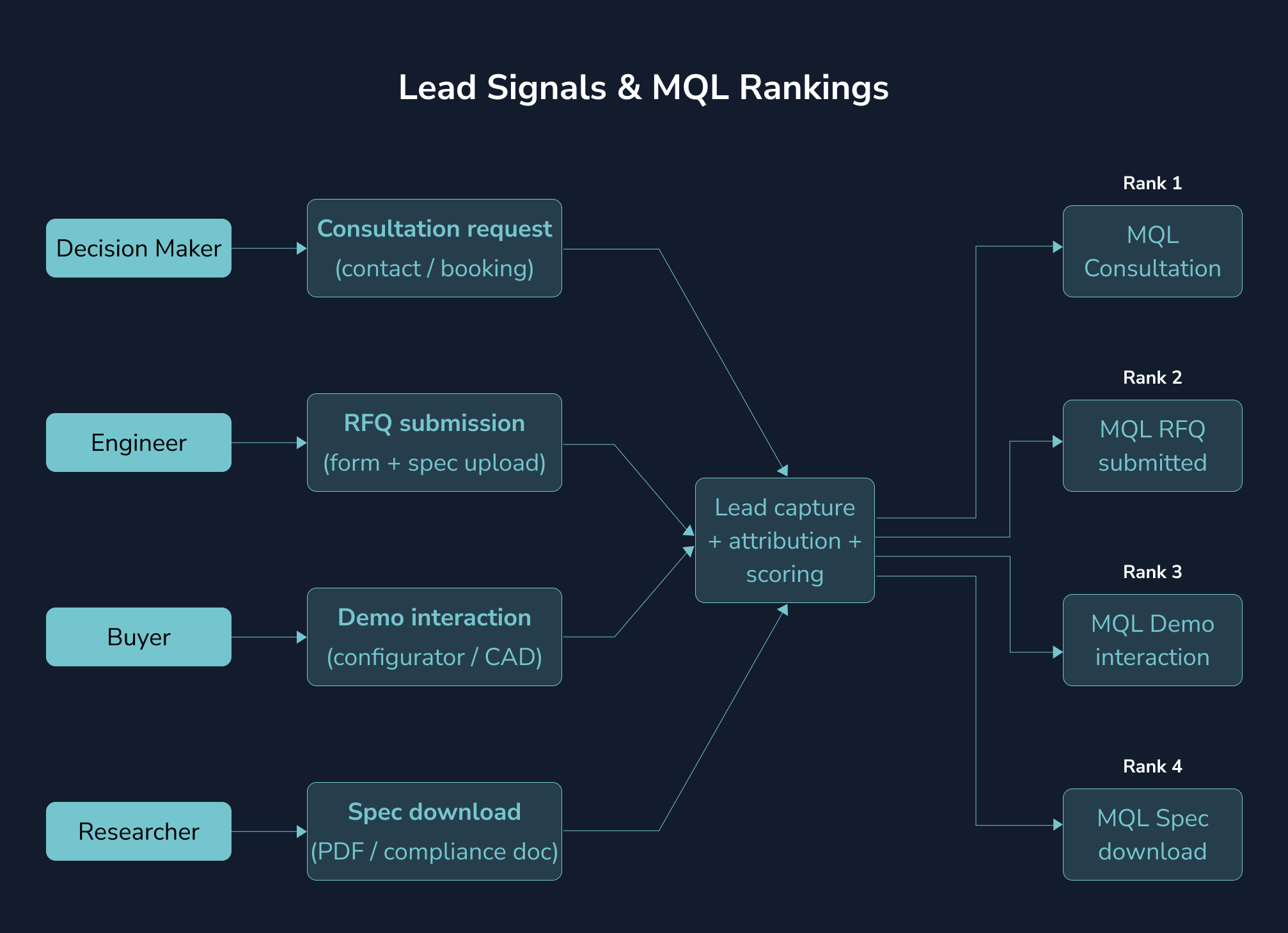
ROI breaks down when systems don’t connect.
Disciplined teams treat integration as a baseline requirement.
What That Looks Like
- CRM capture of RFQs, demos, spec downloads, and consultations
- Automation aligned to long sales cycles, instead of short-term lead volume
- Multi-touch attribution reflecting industrial buying behavior
- Tracking for CAD downloads, configurator usage, and compliance requests
Without this, reporting becomes guesswork.
6. Continuous Measurement and Optimization
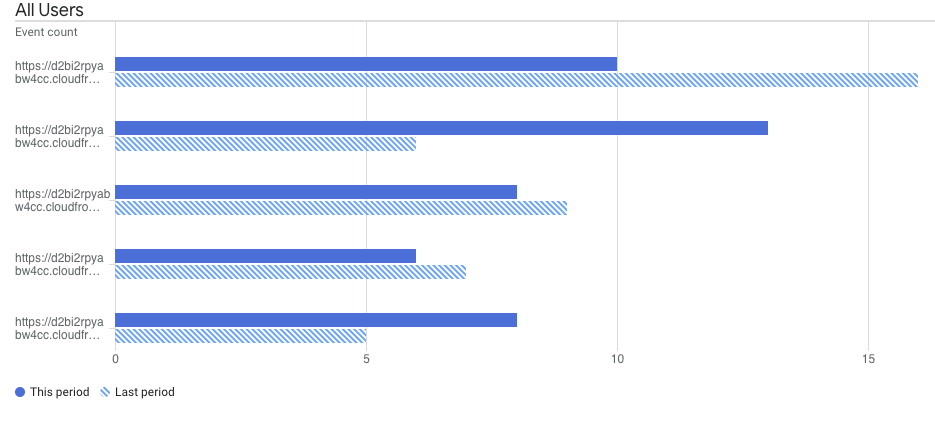
High-performing websites aren’t launched and forgotten.
They’re continuously refined against pipeline outcomes.
Execution Discipline
- Quarterly reviews anchored to pipeline contribution
- CRO focused on RFQs, spec engagement, and demo conversion
- Search visibility audits by product, capability, and certification
- Reporting that connects activity to deal influence
This makes ROI more predictable rather than occasional.
7. Revenue Alignment Across Teams
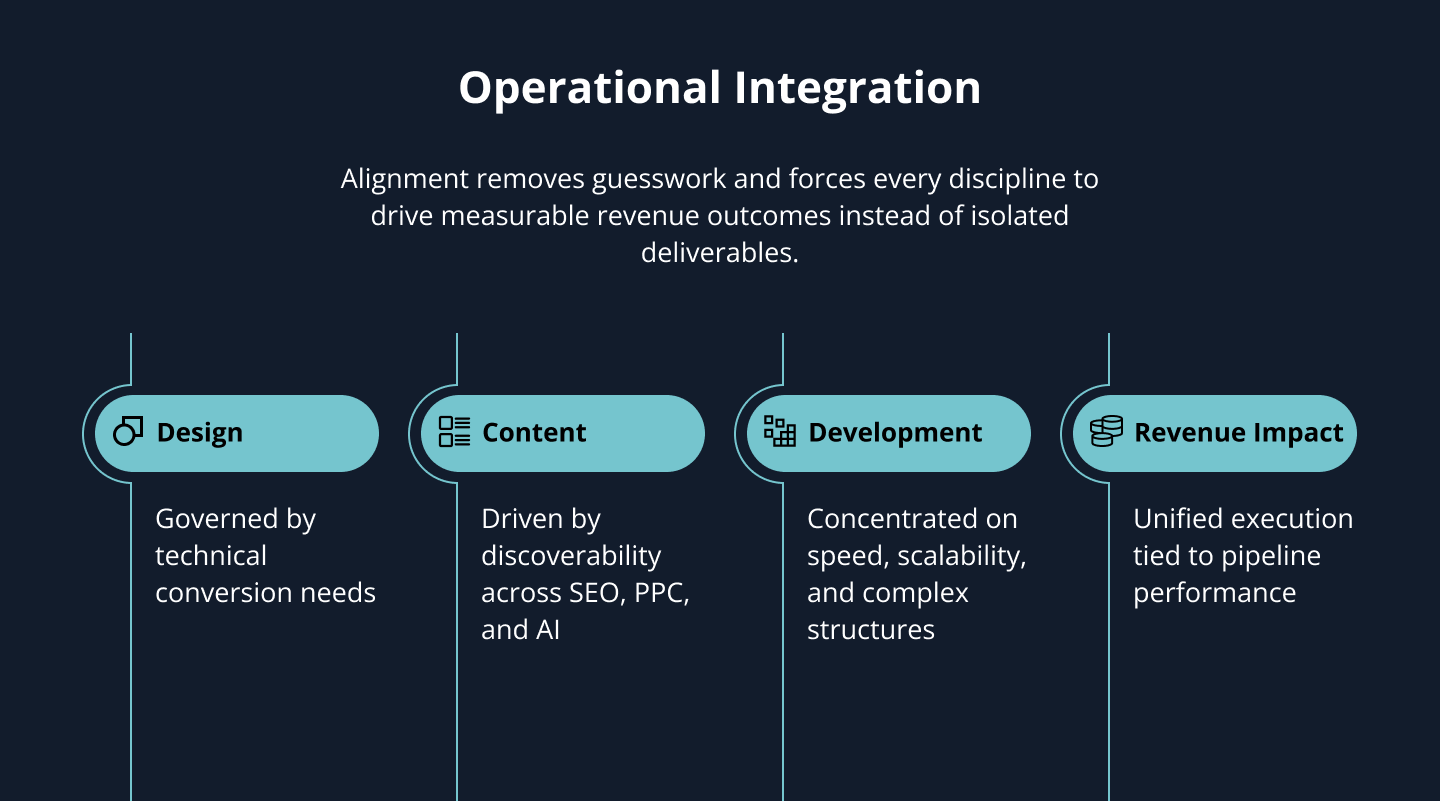
Cross‑functional alignment strengthens performance by unifying every team around measurable revenue contribution.
- Design decisions governed by technical conversion needs
- Content driven by discoverability across SEO, PPC, and AI
- Development concentrated on speed, scalability, and complex structures
When these disciplines move together, the website operates as a single system linked to pipeline performance.
Common Failure Modes Executives Recognize Immediately
Executives recognize these patterns because they reveal whether an agency can support revenue operations. Each failure signals weak discipline, poor alignment, or a lack of operational maturity.
- KPIs tied to traffic instead of pipeline
- Content that increases volume without improving clarity
- SEO that ignores real buying behavior
- CRM setups that miss RFQs and technical engagement
- Visual redesigns that fail to reduce validation or compliance friction
When an agency lacks process discipline, these failures stack quickly and distort revenue visibility. Executives read them as signs of weak alignment and unreliable execution. In regulated markets, the cost rises because buyers depend on accuracy, traceability, and validation.
What Executives Should Demand From a High-ROI Agency
Serious organizations expect proof before engagement.
- Revenue modeling before design concepts
- Demonstrated understanding of industrial buying behavior
- Consistent execution across UX, content, systems, and measurement
- Experience working within compliance-driven environments
Results come from disciplined execution.
For organizations in healthcare, manufacturing, and industrial markets, this discipline is what separates websites that look modern from those that materially impact growth, efficiency, and risk.
In regulated, high-value B2B environments, websites operate as revenue, efficiency, and risk systems.
Elevate Success
What outcome do you need your website to drive next?
Important Questions About Website ROI in Complex B2B Buying
Because most traffic lacks technical fit, compliance readiness, or intent. More volume increases friction and cost.
Visual updates don’t reduce validation time or decision risk. Performance improves when technical evaluation is supported.
In these markets, they function as part of the operational stack, linked to revenue and efficiency.
Content without technical accuracy or stage alignment creates confusion and slows decisions.
Through RFQs, spec downloads, consultations, and their influence on pipeline progression.
Because they’re built for short-cycle models and miss technical engagement signals.
No. It exposes weak structure faster than it fixes it.
Revenue modeling, pipeline targets, buying behavior, and measurement tied to long-cycle deals.
Related Posts