CNC Website Performance in 2026: What 500+ Lighthouse Audits Reveal
Most CNC industry websites fail modern standards for speed, accessibility, and technical quality. The data shows how these gaps affect visibility, leads, and cost.
 33 Min Read

Most CNC Companies Still Struggle to Meet Digital Performance Standards
Benchmarking data from DBS Interactive reveals persistent gaps in page speed, usability, search readiness, and technical quality across CNC industry websites, with a widening divide between companies that have invested in their digital presence and those that have not.
A website that loads slowly, fails basic security standards, and frustrates users trying to navigate it costs a CNC company business.
B2B buyers now research vendors almost entirely online before making contact. The website is the first sales call, and for most CNC companies, it’s not going well.

DBS Interactive, a full-service digital agency based in Louisville, Kentucky, audited 504 websites across the CNC manufacturing sector in 2026.
The sample included job shops, distributors, original equipment manufacturers (OEMs), and service and parts dealers.
The evaluation used Google's Lighthouse tool to score each site across four dimensions.
These included page speed and load time, usability and accessibility, search readiness, and adherence to current web standards. The full list of audited sites is linked to this report.
Two years ago, DBS ran the same study on approximately 200 CNC sites. Only one site scored "Good" across all four categories. The 2026 results do not show meaningful improvement.
The average page speed score moved from 57 to 58, and the proportion of sites in the "Poor" range remained roughly the same. The industry has not closed the gap.
Of the 504 sites tested in 2026, only 41 scored in the "Good" range for page speed. Sites that loaded slowly tended to score poorly on web standards and usability as well.
The two problems often share the same root cause. Many of these sites were built years ago and have not been seriously revisited since.
For CNC companies running paid digital advertising, the cost is direct. Google's Quality Score system ties ad placement and cost-per-click to how well a landing page loads and functions.
A slow, poorly built site costs more to advertise, converts fewer visitors, and drains the marketing budget.
About the 2026 Study
DBS Interactive conducted the 2026 study using Google's free Lighthouse tool to evaluate the mobile versions of each site.
Google's ranking algorithms prioritize mobile performance over desktop, making mobile scores the most relevant benchmark for organic search visibility.
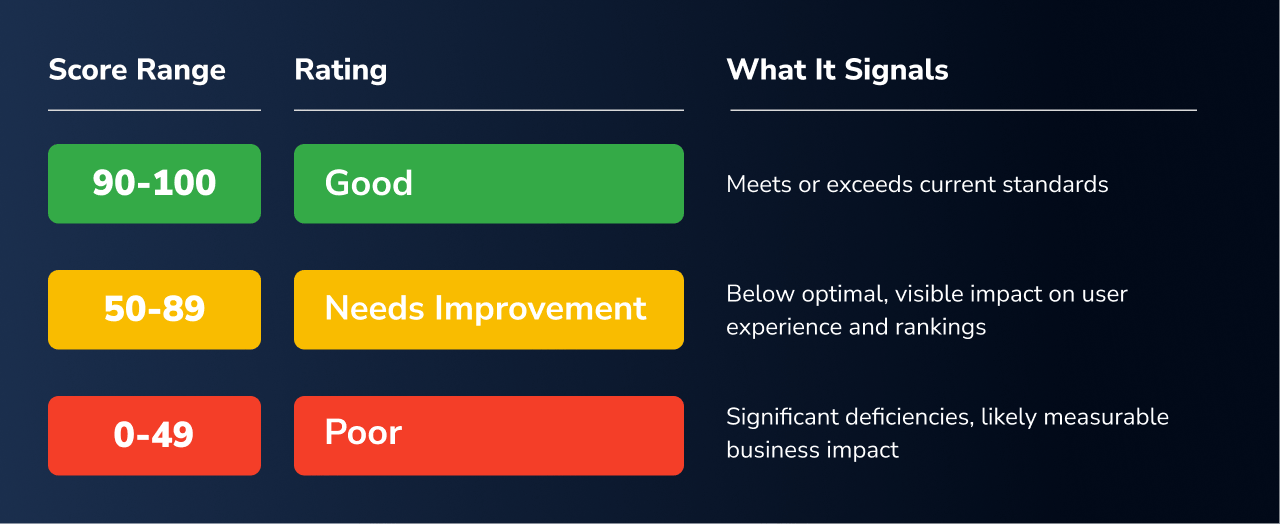
Lighthouse scores range from 0 to 100 and fall into three performance tiers.
"We run this study because the data tells companies something they cannot see by looking at their own website. The gap between what a site looks like and what it actually does for a business is often significant," said Cyndi Masters, CEO and Founder, DBS Interactive
10 Best CNC Websites
| Company | Performance | Accessibility | Best Practices | SEO |
|---|---|---|---|---|
| Valley Precision Machining | 93 | 97 | 96 | 91 |
| Wichita Machine Products | 90 | 91 | 96 | 92 |
| Sandusky Precision Machining | 99 | 96 | 100 | 100 |
| Morowat Global Ltd. | 99 | 96 | 96 | 100 |
| Machining USA, LLC | 93 | 90 | 96 | 100 |
| Methods Machines | 96 | 100 | 100 | 100 |
| Bison Machining, Inc. | 96 | 91 | 100 | 100 |
| Custom Machining Services, Inc. | 96 | 100 | 96 | 100 |
| Dynamic Machining X Manufacturing | 92 | 95 | 96 | 92 |
| PMi2 | 99 | 100 | 100 | 100 |
Download the complete list of 504 CNC companies
CNC Industry Websites in 2026: The Scorecard
None of the four categories averaged into the "Good" range at the industry level. Page speed was the weakest, averaging 58. SEO scored highest, with a median of 92.
That gap matters and is addressed in detail later, because the Lighthouse SEO score measures something much narrower than most companies assume.
| Metric | Average Score | Median Score |
|---|---|---|
| Page Speed | 58 | 60 |
| Accessibility | 76 | 86 |
| Web Standards | 72 | 79 |
| SEO | 80 | 92 |
The table below shows how the 504 sites are distributed across the three scoring tiers. Page speed produced the most severe result by far, with 124 sites in the "Poor" range and only 41 reaching "Good."
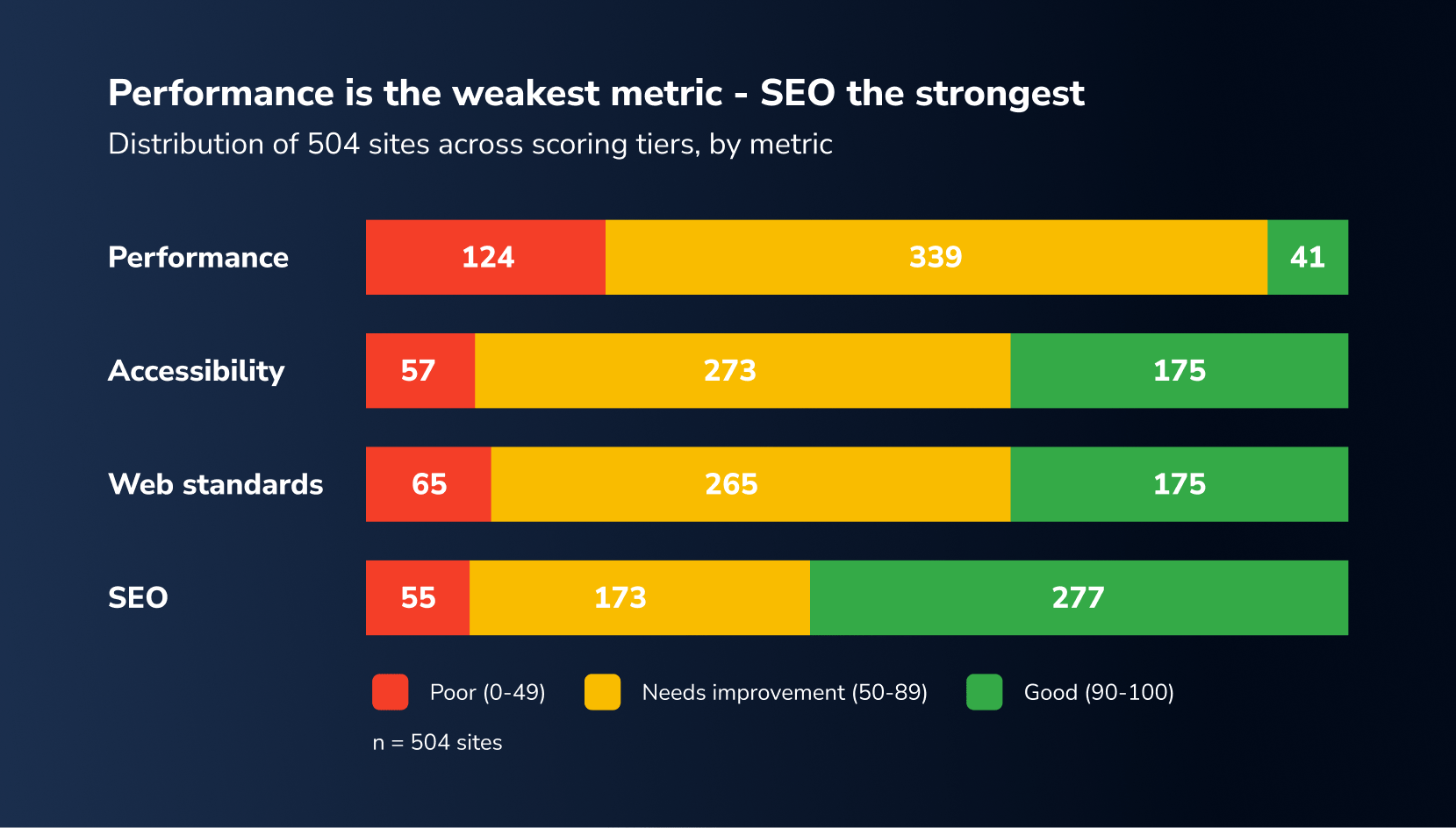
Those 124 sites scoring "Poor" for page speed were not just slow. When DBS examined their scores across all four categories, every metric declined.
DBS applied the widely used Pearson correlation coefficient to the full dataset and found a strong relationship between Performance (page speed) scores and web standards scores. In practice, when performance drops, adherence to modern development standards tends to decline.
| Metric | Avg. Score for Sites with Poor Performance |
|---|---|
| Best Practices | 40 |
| Accessibility | 48 |
| SEO | 51 |
The SEO score was the only metric that crossed into “Needs Improvement” territory at 51. While it is the highest score in this group, it still reflects a baseline level of optimization rather than strong performance.
The pattern points to a common root cause. These websites are typically built on aging infrastructure, with outdated codebases, limited optimization, and little post-launch iteration.
The result is not a single-point failure, but a systemic one, where speed, structure, accessibility, and search performance all degrade together.
Performance: Still the Industry's Weakest Metric
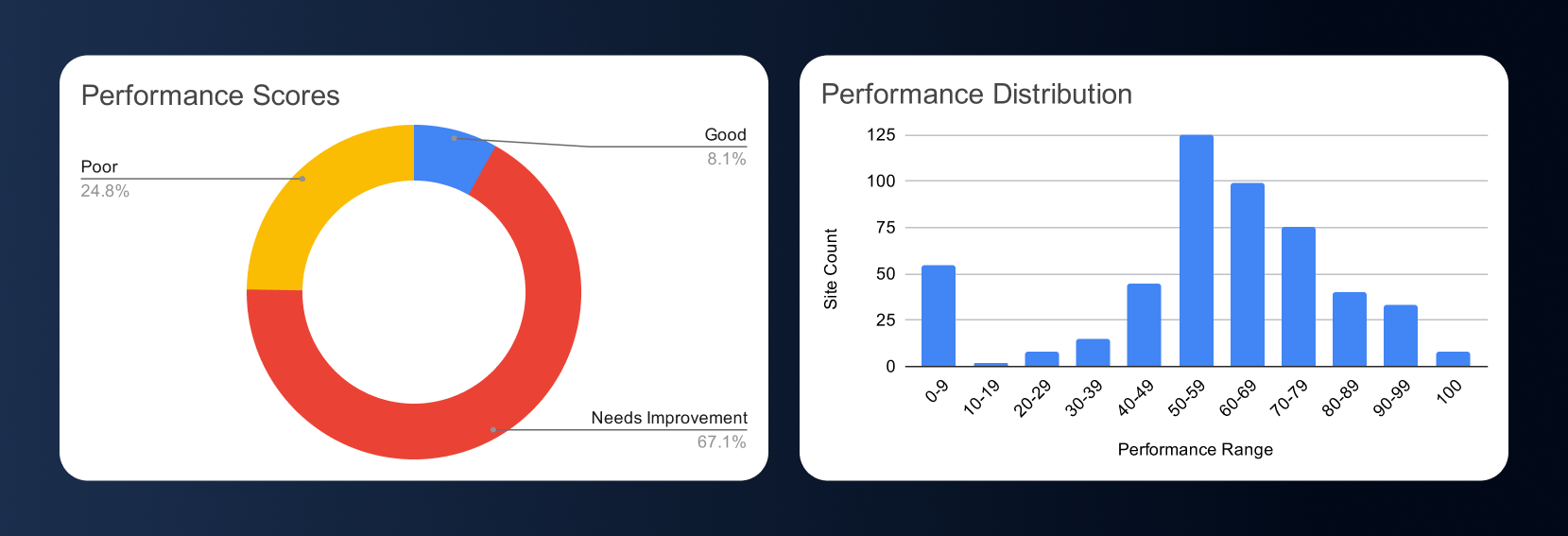
Page load speed is the first thing a prospect experiences when they arrive at a CNC company's website. Google's own data shows that 53% of mobile visits are abandoned when a page takes longer than 3 seconds to load. Akamai research found conversion rates drop by 7% for every 100-millisecond delay.
In the 2026 CNC cohort, 141 of 504 sites loaded slower than 4 seconds on mobile. Of those, 116 loaded slower than 6 seconds. The slowest sites in the dataset took more than 40 seconds to load.
The Lighthouse page speed score draws on three loading measures. These include how quickly content first appears on screen (First Contentful Paint), how smoothly the page loads (Speed Index), and when a user can begin interacting with the page (Time to Interactive). Together, these are the signals Google groups under Core Web Vitals, confirmed ranking factors for organic search.
Fifty‑four sites, nearly ten percent of those tested, produced errors during the audit. When Lighthouse cannot complete a test, it usually indicates deeper technical problems, such as unstable servers, broken scripts, or an infrastructure so outdated that the site cannot render reliably.
A site that cannot complete a basic performance audit is not just slow; it is broken. It is at risk of downtime, indexing failures, and reduced visibility in both organic and AI‑driven search.
Deep Dive | The Business Costs of Poor-Performing Websites
How AI Overviews Treat Slow or Technically Weak Sites
AI Overviews in Google and other AI search tools pull from pages that load quickly, follow current technical standards, and are easy for crawlers to interpret.
When a site scores low on performance or web standards, it’s less likely to be selected as a source. In practice, this means a competitor with a faster, more stable site is more likely to appear in the AI‑generated answer box, even if both companies offer similar services.
A slow CNC website is not only harder for buyers to use. It is also less likely to be cited or summarized by AI systems that influence how B2B buyers discover vendors. →
For companies running Google Ads, poor page speed affects more than organic rankings.
Landing page experience feeds directly into Quality Score, Google's internal rating that determines ad placement and cost per click. A slow site pays more per click, earns lower placement, and converts fewer visitors.
AutoAnything, an e-commerce subsidiary of AutoZone, cut page load times in half and saw conversions increase by 9%. The company operates in retail, but the behavior is consistent. Users decide quickly whether a site is worth their time, and that applies in B2B contexts as much as consumer ones.
"Milliseconds matter in precision machining. The same is true on your website. A prospect who can't get your product specs loaded in three seconds isn't waiting. They're already on a competitor's site," said Steve Fowler, Client Marketing Director, DBS Interactive
What High-Performance CNC Sites Have in Common
- Page load time under 3 seconds on mobile
- Optimized and compressed images in modern formats (WebP)
- No render-blocking JavaScript or CSS in critical load paths
- Efficient server response times with caching in place
- Minimal use of third-party scripts that delay interactivity
- Core Web Vitals scores reviewed and acted on regularly
Performance and Best Practices Fail Together — This Is a Structural Problem
The 2026 data make one structural finding clear. Poor page speed and poor adherence to web standards are not independent problems. They are symptoms of the same condition.
DBS applied the Pearson correlation coefficient to load time and web standards scores across all 504 sites. The relationship was strong. When one score is low, the other almost certainly is too.
For the 124 sites scoring "Poor" for page speed, the average web standards score was 40, placing that group firmly in "Poor" territory across both metrics.
The root causes are consistent across the dataset.
3 Conditions Behind Most Failing Sites
- Website infrastructure built on platforms or code that predates current standards
- Development completed without performance or security as explicit requirements
- No ongoing technical maintenance, audit process, or monitoring after launch
The Best Practices component of Lighthouse checks whether a site uses HTTPS, serves images correctly, uses current JavaScript libraries and APIs, and adheres to modern HTML standards. Among these, HTTPS is the most immediately consequential. Without it, modern browsers display a security warning indicating the connection is not secure.
When a browser flags a site as insecure, the visit often ends immediately.
For a CNC company trying to earn a procurement manager's confidence during vendor evaluation, that becomes a credibility problem that no amount of good content can overcome.
"When a site scores poorly for performance and best practices simultaneously, we're not looking at a list of fixes. We're looking at infrastructure that was built without current standards as the goal and hasn't been revisited since," John Golden, Lead Developer, DBS Interactive
Deep Dive | Speed Wins: Why Fast Websites Earn More Visibility in the Age of AI
One Score, Three Failures — What Correlated Failure Looks Like
- Sites scoring below 49 for Performance averaged 40.07 for Best Practices. The same group averaged 47.61 for Accessibility. All three metrics decline together.
The root cause is rarely a single issue. It is typically aging infrastructure or development that did not prioritize standards.
Fixing one area often improves others. Performance optimization and best practices improvements share many of the same technical interventions.
|
41 Sites Scored Good Score > 90 |
124 Sites Scored Poor Scoring < 50 |
339 Needs Improvement Scoring 50–89 |
141 Load > 4 Seconds On mobile |
Web Standards and Security: What 65% of CNC Sites Are Getting Wrong
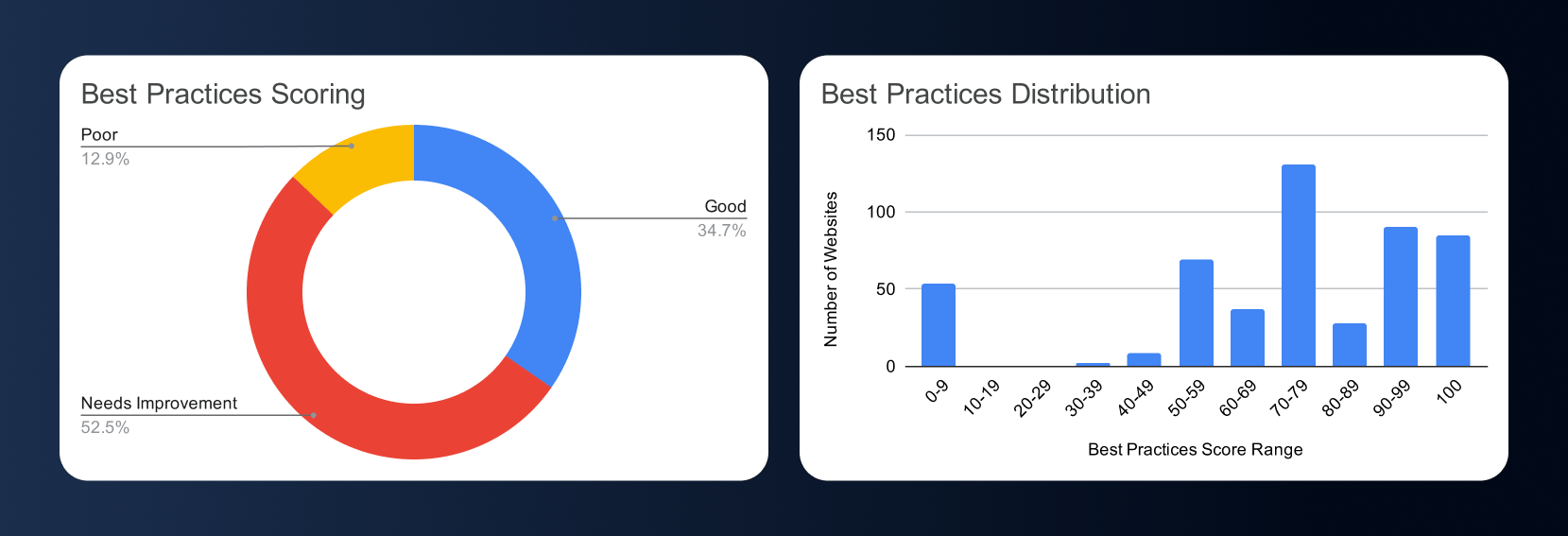
Beyond page speed and accessibility, 65% of the sites in the 2026 study did not meet the broader web standards criteria measured by Lighthouse. The Best Practices category evaluates whether a site is built to current technical specifications.
These include secure connections, correctly sized images, current JavaScript libraries and APIs, and valid HTML structure. These are not advanced requirements. They are the baseline for a professionally maintained website in 2026.
HTTPS is the most visible failure point. Without it, modern browsers, including Chrome, Safari, Firefox, and Edge, display a security warning telling visitors the connection is not secure. For a procurement manager evaluating vendors, that warning typically ends the visit.
A CNC company asking a buyer to overlook a browser security alert is asking for more trust than the site has earned.
The less visible failures carry their own cost. Outdated JavaScript libraries create security vulnerabilities. Incorrectly sized images slow load times and degrade the mobile experience. Missing HTML doctypes cause browsers to render pages inconsistently.
None of these failures announce themselves to the site owner. They accumulate quietly while the site continues to appear functional on the surface.
There is also an indexing dimension. Search engines and AI-driven tools evaluate web standards compliance as a signal of site quality. A site running on deprecated code and outdated libraries is not just a security risk. It signals to search bots that the content may not be worth prioritizing.
The strong correlation between page speed and web standards scores in this dataset confirms that these failures rarely travel alone.
A site with a poor web standards score almost certainly has a page speed problem as well. They share the same root cause and typically require the same type of remediation.
"When a site scores poorly for page speed and web standards at the same time, we are not looking at a list of fixes. We are looking at infrastructure that was built without current standards as the goal and has not been revisited since," John Golden, Lead Developer, DBS Interactive.
Deep Dive | Unlocking the Benefits of High Best Practices Scores in Lighthouse
Accessibility: Locked Out Users, Legal Exposure, and Rankings That Suffer for It
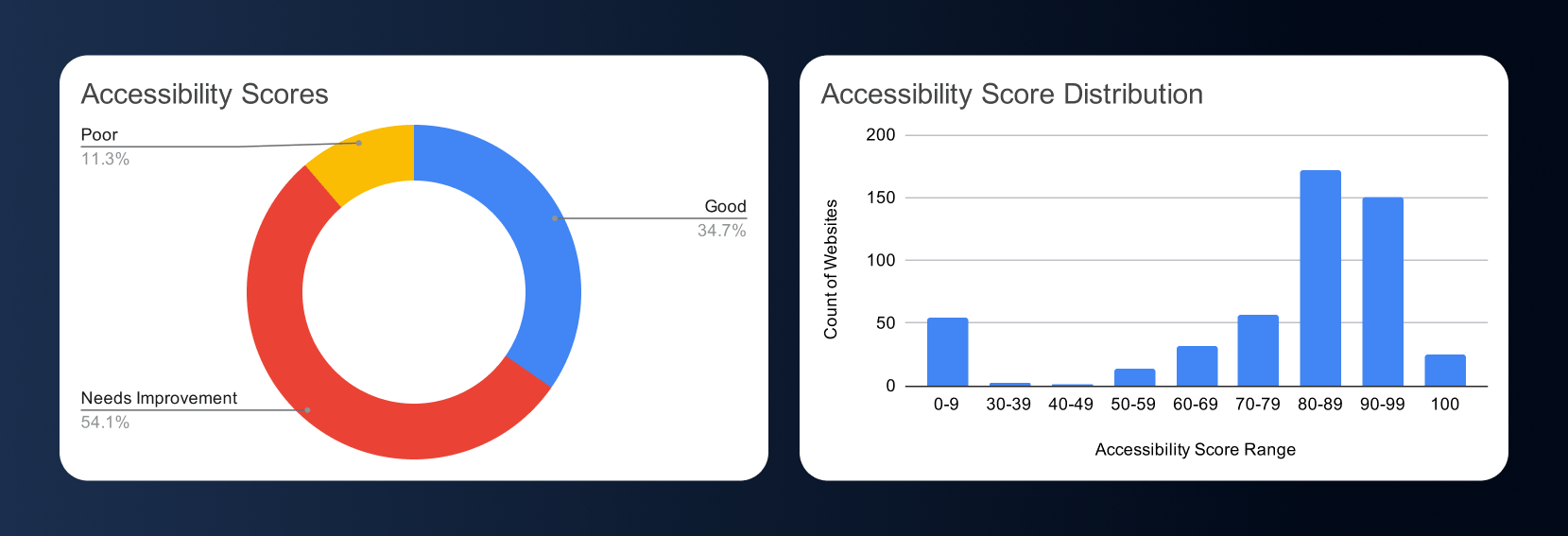
Of the four categories in the study, accessibility carries the most direct legal exposure. The Americans with Disabilities Act has been interpreted by courts to apply to websites. Sites scoring below 90 for accessibility carry documented exposure to ADA Title III litigation. In the 2026 CNC dataset, 330 of 504 sites scored below that threshold.
The lawsuit landscape is not hypothetical. Cases against Domino's Pizza, Target, and Harvard University established that website inaccessibility constitutes an ADA violation.
UsableNet, which tracks digital accessibility lawsuits annually, has documented consistent year-over-year growth in Title III filings. Manufacturing companies are not exempt.
The Accessibility component of Lighthouse tests for conditions that affect users. Missing alt text on images means a screen reader provides no information about visual content.
Poor color contrast means users with reduced vision, including aging engineers and experienced buyers who make up a significant portion of the CNC customer base, cannot read the page comfortably. Inaccessible form controls and broken keyboard navigation prevent users who cannot use a mouse from interacting with the site.
In the 2026 cohort, 57 sites scored "Poor" for accessibility, and 273 scored "Needs Improvement." Only 175 achieved a "Good" score. The average was 76.
Beyond legal exposure, there is a practical cost for search and indexing. Search engines and AI-driven tools operate on a “crawl budget.” They process a finite number of pages and signals before moving on.
A site with missing alt text, a broken heading hierarchy, and inaccessible navigation gives search bots a less usable structure and requires more effort to extract meaning.
Structurally accessible sites tend to be indexed more efficiently because both human users and search bots require content that is clearly labeled, logically structured, and easy to navigate.
"Accessibility is not a feature added at the end of a project. It is a fundamental requirement of building a website that works for the people who need to use it. Ignoring it is locking the door to a portion of your market," Cyndi Masters said.
Below 90 for Accessibility: What That Score Actually Exposes
- ADA Title III lawsuit exposure is documented at scores below 90
- WCAG 2.1 AA is the current legal and technical standard
- Common failures include missing alt text, poor color contrast, inaccessible form controls, and broken keyboard navigation
- Accessibility improvements frequently improve page speed and SEO simultaneously
- Search engines and AI tools use accessibility signals as quality indicators
Achieve Compliance and AI Performance
The SEO Score Is Not What Most Companies Think It Is
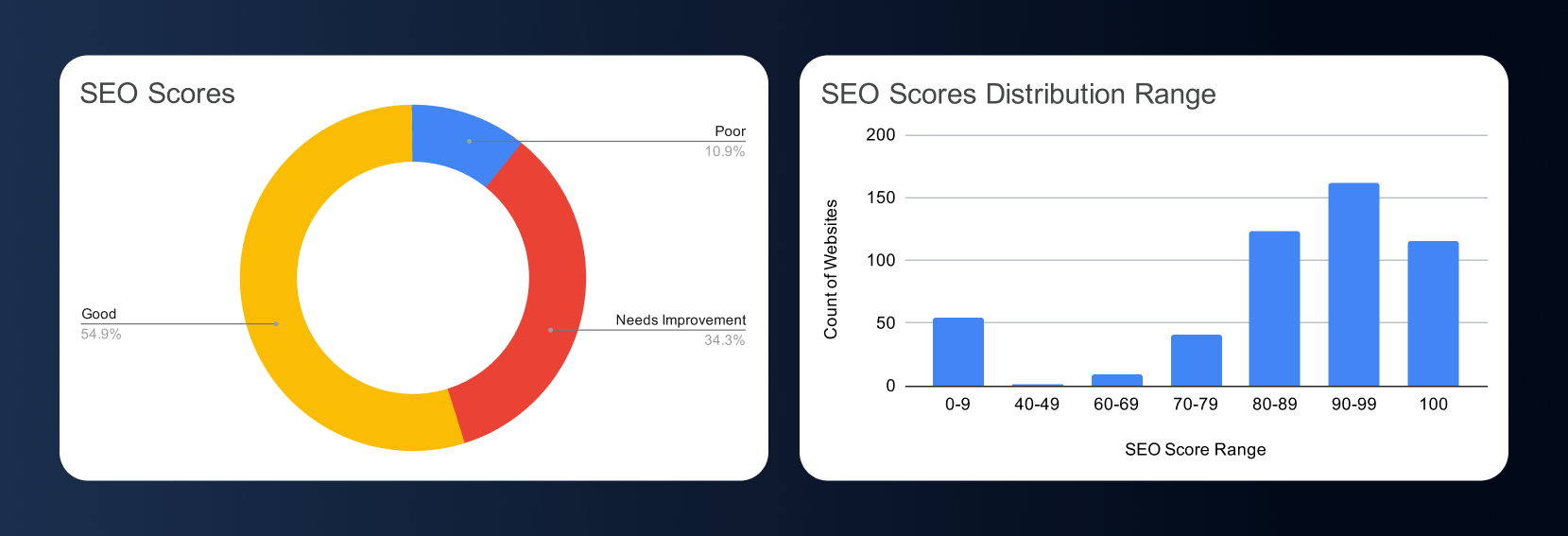
SEO was the highest-scoring metric in the 2026 study, with a median of 92, and 277 of 504 sites scored "Good." For a CEO or marketing manager reviewing the Lighthouse report, that number may seem reassuring. It should not.
| What Lighthouse SEO Measures | What Lighthouse SEO Does Not Measure |
|---|---|
| Presence of a meta description | Keyword targeting or buyer search intent |
| Crawlability and robots.txt configuration | Content quality, depth, or topical authority |
| Legible font sizes on mobile | Backlink profile and domain authority |
| Presence of a viewport meta tag | Whether the site ranks for terms that buyers search |
| Valid structured data | Competitive search landscape or share of voice |
The Lighthouse SEO score is a technical prerequisite checklist. It confirms that a page is crawlable, that meta descriptions are present, that the site renders on mobile, and that font sizes are legible.
It does not evaluate keyword strategy, content quality, backlink authority, or whether the site ranks for any term a prospective buyer actually searches.
The SEO median of 92 and the page speed median of 60 sit 32 points apart. That is the widest spread in the dataset. A strong SEO score may appear reassuring, but for most CNC companies, it masks a much larger search problem.
Google's algorithm and AI-driven tools, including Google's AI Overviews and third-party platforms such as Perplexity, evaluate a site's full technical profile when determining what content to surface.
Passing the SEO checklist means the site is eligible to compete. It does not mean the site is competing or winning.
"A good Lighthouse SEO score tells you the door to search is unlocked. It does not tell you anyone is walking through it." Steve Fowler, Marketing Director, DBS Interactive
The PPC and Mobile Multiplier: Poor Sites Cost More to Advertise
For CNC companies that supplement organic search with paid digital advertising, site quality is a budget efficiency issue. Google evaluates landing page experience as part of its Quality Score calculation, and Quality Score directly determines ad placement and cost-per-click.
A site with poor page speed scores is not starting from a neutral position in Google Ads. Lower Quality Scores produce lower ad placement, higher cost per click, reduced impression share, and weaker click-through rates. The same budget produces fewer results, not because the targeting is wrong, but because the site is working against the campaign.
The mobile dimension compounds this. Of the 504 sites in the 2026 study, only one was built as a Progressive Web App (PWA), an architecture designed for fast, app-like performance on mobile while remaining fully indexable by search engines.
One site out of 504. B2B buyers increasingly research vendors on mobile devices between meetings and at job sites. A site that takes six seconds to load on a phone is not competitive in that context.
What a Low Quality Score Is Actually Costing Your Ad Budget
- Lower ad placement. Ads appear lower on the results page, reducing visibility and click opportunity.
- Higher cost per click. Google rewards high-quality scores with lower CPCs. Low scores pay a premium.
- Reduced ad extension performance. Sitelinks, callouts, and structured snippets underperform when the landing page is weak.
- Lower impression share. Poor Quality Scores reduce the likelihood that ads are eligible to appear at all.
- Lower conversion rates. Even when clicks occur, a slow site loses the conversion, wasting the spend entirely.
What CNC Companies Should Do Next
The starting point is measurement. Google's Lighthouse tool is free, available in Chrome's Developer Tools or at PageSpeed Insights (pagespeed.web.dev), and returns results in under two minutes. The gap between what a leadership team assumes about its site and what the audit reveals is often the most useful data point a company can have.
What a Structured Improvement Program Addresses
- Run a full Lighthouse audit on the mobile version of the site. Mobile scores are what Google uses for ranking decisions. Instructions
- Establish a performance target of 90 or above across all four metrics. Scores in the 70s and 80s are not competitive for organic placement.
- Prioritize page load time under 3 seconds. Image optimization, modern formats such as WebP, and the elimination of render-blocking scripts are typically the highest-impact interventions.
- Confirm HTTPS is fully implemented with no mixed content warnings. This is a non-negotiable requirement for security and trust.
- Conduct an accessibility audit against WCAG 2.1 AA standards. Sites scoring below 90 for Lighthouse Accessibility carry legal and competitive risk.
- Treat the SEO score as a baseline check, not a measure of performance. A passing Lighthouse SEO score confirms technical prerequisites, but a separate keyword and content strategy is required to compete for meaningful search demand.
- If the site was built or last significantly updated more than three to four years ago, a technical infrastructure assessment is likely warranted, not just incremental fixes.
Given the correlated nature of performance failures, companies with Performance scores below 50 should approach improvement as an infrastructure decision.
Incremental patches on a structurally outdated site will not close the gap to the "Good" threshold.
The Digital Divide in CNC Is Widening
The 2026 study covers more than twice as many sites as the 2024 baseline, and the results are nearly identical. Most CNC companies have not treated their websites as technical assets requiring ongoing attention.
The consequence is an industry where a small group of companies has pulled ahead in search visibility, advertising efficiency, and lead conversion, while the majority remains on infrastructure that works against them.
The 41 sites scoring "Good" for page speed made different decisions. Those decisions are compounding. These companies may not be easier to find everywhere, but when they appear, they outperform.
The question for any CNC company that has not yet run a Lighthouse audit is straightforward. What does the score actually say?
"Addressing performance issues and improving accessibility ensures compliance with current standards and positions businesses for sustained success. The companies acting on this data now will be harder to catch later," Cynd Masters said.
The Next Layer of Evaluation Beyond Lighthouse
The Lighthouse results tell only part of the story. In 2026, a CNC company’s visibility depends on how well its site performs across traditional organic search and AI‑driven platforms such as ChatGPT, Claude, Perplexity, and Google’s AI Overviews. These systems evaluate speed, structure, accessibility, and content clarity before deciding which vendors to cite or summarize.
DBS Interactive provides a structured audit that goes beyond technical scoring.
The Evaluation
- How your site is interpreted, ranked, and cited across organic search engines and AI platforms.
- Whether your content is eligible for inclusion in AI‑generated answers.
- How your visibility compares to three direct competitors across organic and AI ecosystems.
- Where technical, structural, and content gaps are preventing your brand from being surfaced as a recommended vendor.
- Which improvements will have the highest impact on discoverability, credibility, and lead generation.
For CNC companies competing in a crowded market, this combined organic‑and‑AI visibility audit provides a clear picture of where the site stands today and what must change to become the vendor AI systems and buyers trust.
Related Posts