How Do You Know if Your Website is Built for AI Search?
Websites need clear information architecture, semantic structure, technical accessibility, trust signals, and interconnected expertise to maximize performance in AI search results.
 10 Min Read

Many organizations reach a breaking point with their website long before they admit it.
For one company, the turning point came when someone asked the question no one wanted to say out loud: “Do we actually know what our site says about us?”
The room went quiet.
This speaks to a larger and growing issue, where brands and organizations want more visibility in AI results, while the true challenge of getting placed in the right AI answers is often a matter of interpretation.
The reality is AI systems often struggle for the same reason humans do when a website’s structure doesn't communicate what the company actually does.
“Do we actually know what our site says about us?”
If AI systems can’t interpret your organization, they can’t confidently recommend it, retrieve it, or include it in generated answers.
For B2B organizations, that disconnect eventually shows up in the sales pipeline.
B2B brands have expertise worth sharing. What they often lack is a digital foundation that makes their expertise easy to understand and connect with the right concepts and markets.
Buyers increasingly encounter synthesized answers, AI-generated summaries, and recommendation engines before they ever visit a website directly. In that environment, expertise alone is no longer enough. It must be understandable at the infrastructure level.
That is where many organizations get stuck.
Quality vs. Quantity
The problem is rarely a lack of content. More often, it's fragmented structures, weak semantic relationships, inconsistent governance, inaccessible information, and disconnected systems that create obstacles for both humans and machines.
Organizations gaining visibility in AI results are not necessarily publishing more content or chasing the latest optimization tactic. And Google’s guidance increasingly reinforces this reality.
Instead, a brand's AI visibility grows from the same durable SEO fundamentals that have always supported discoverability, accessibility, and trust in search engines.
The fundamentals did not disappear. They didn't even change all that much. It's just that their importance increased.
The gaps that limit AI search visibility are now more structural than strategic. A site with clean semantic markup and a stable layout gets understood more easily by an AI agent the same way it's easier to understand for a human. A site without these qualities does not.
What Changed, and Why It Matters
Google has repeatedly reinforced that its AI-generated search experiences are built on the same core systems that have long shaped organic visibility: crawlability, semantic structure, accessibility, expertise, and content quality.
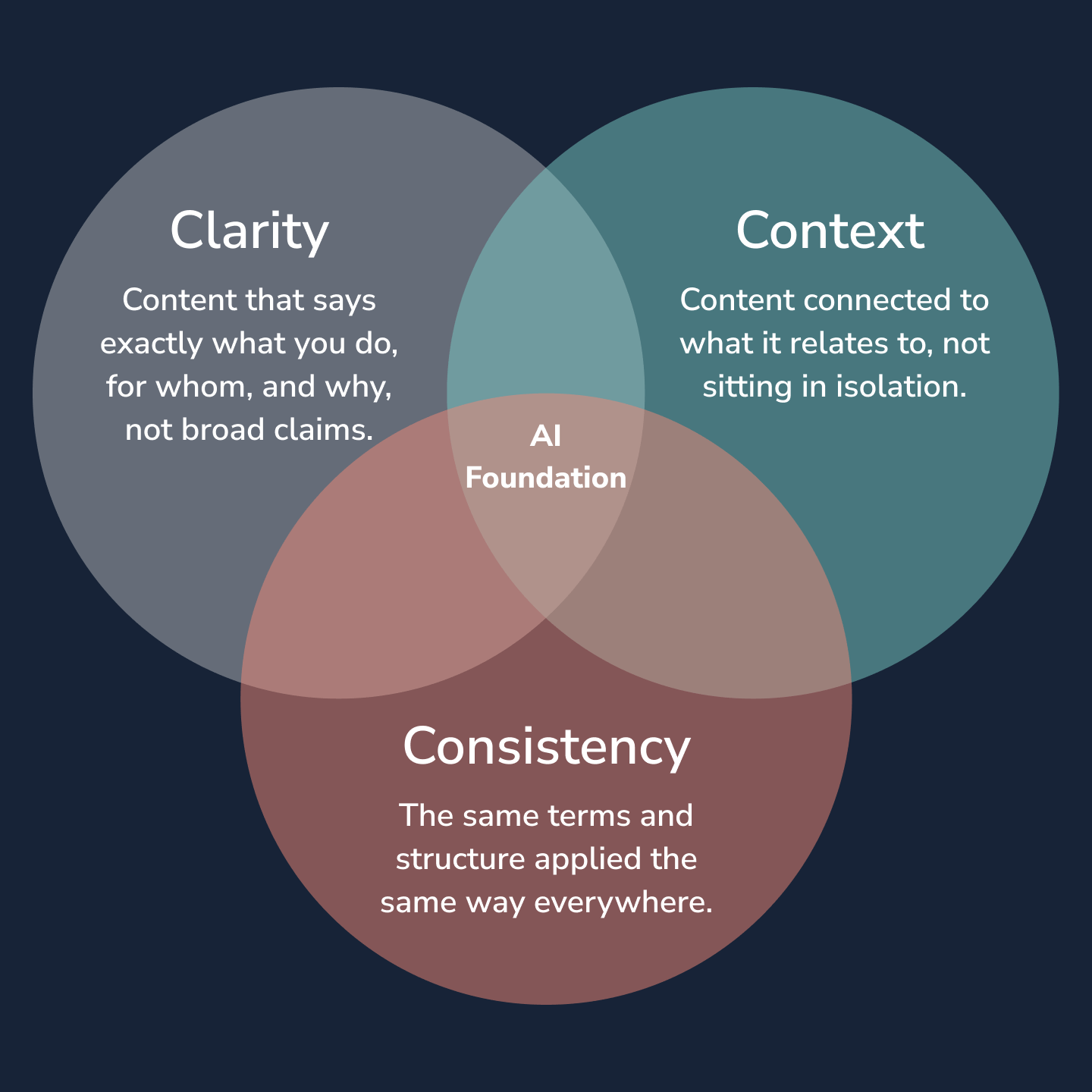
What changed is not the existence of those fundamentals, but rather the increased importance of clarity, context, and consistency across the entire digital ecosystem.
Traditional search engines often rewarded pages with content that matched a search user's query well enough. AI-driven systems, meanwhile, place greater pressure on whether an organization’s expertise is coherent, connected, trustworthy, and retrievable at scale.
This shift is less about new optimization tactics, and more about whether published expertise remains understandable when interpreted by machines.
That distinction matters because many organizations were never building around meaning in the first place. They were building around activity: more pages, more keywords, more campaigns, and more content production.
According to Steve Fowler, Director of Client Marketing at DBS Interactive, AI search has not replaced the fundamentals of SEO. Instead, it has raised expectations for how clearly organizations communicate their expertise.
"Organizations that have invested in connected knowledge, consistent URL and page structure, and trustworthy information from subject matter experts are finding themselves better positioned for AI search visibility because those same qualities make their expertise easier for both people and machines to understand," Fowler said.

AI systems expose the difference quickly.
A manufacturing company may have years of engineering expertise spread across disconnected PDFs, product pages, distributor resources, and technical documentation with little semantic relationship connecting them.
A healthcare organization may publish credible educational content while inconsistent authorship, weak sourcing practices, and fragmented governance quietly weaken trust and interpretability signals.
In both cases, the expertise is real.
The problem lies in the infrastructure surrounding it.
That is why AI visibility audits increasingly examine more than rankings or page performance. They evaluate whether the broader digital ecosystem presents expertise in a way AI systems can understand and confidently surface in generated answers.
The next sections examine the five areas where that clarity is typically strengthened or lost.
Where the Problem Actually Lives
AI systems do not struggle with organizations that lack expertise. They struggle with organizations whose expertise is difficult to interpret, validate, connect, and trust at scale.
That distinction aligns directly with Google's E-E-A-T framework: Experience, Expertise, Authoritativeness, and Trustworthiness.
In the days of traditional search, weak site structure could sometimes be compensated for with strong page-level optimization. In the age of AI-driven retrieval systems, the standard is higher.
Expertise must be easy to interpret, connected enough to contextualize, and consistent enough to trust across the entire digital ecosystem. When the signals surrounding that expertise become fragmented, contradictory, vague, or structurally weak, AI systems become less confident in surfacing your content in generated answers.
That breakdown typically occurs across five core areas:

Content Clarity and Semantic Structure
AI systems evaluate whether your content explains concepts in context, not just whether it contains relevant terms. Broad service pages with little operational detail, overlapping pages targeting nearly identical topics, and keyword-oriented writing that prioritizes ranking over understanding all create confusion.
The question isn't whether your content mentions the right topics. It's whether an AI system can determine what you do, who you do it for, and why someone should choose you.
Trust and Authority Signals
Google's quality framework centers on Experience, Expertise, Authoritativeness, and Trustworthiness (EEAT). AI systems rely heavily on those signals when deciding which sources to surface in generated answers.
Anonymous educational content, unsupported claims, outdated resources, and inconsistent positioning across departments weaken confidence in the source. Organizations in manufacturing and healthcare face even greater scrutiny, where accuracy, traceability, and sourcing aren't optional.
CMS Architecture and Technical Accessibility
Template structure influences machine interpretation more than many teams realize. CMS platforms that generate inconsistent markup, bloated templates that obscure content hierarchy, important information trapped in scanned PDFs, and JavaScript-heavy pages that render inconsistently all make content harder to process.
Semantic HTML doesn't need to be perfect. It needs to be consistent.
Content Governance and Publishing Operations
Visibility problems rarely appear overnight. They develop through decentralized publishing, inconsistent terminology, disconnected editorial standards, and unmanaged content growth.
When marketing and engineering publish overlapping content independently, when no one owns taxonomy standards, and when outdated pages accumulate without a review process, the result is a website that becomes increasingly difficult to interpret and trust.
UX and Information Accessibility
Navigation, scannability, and movement between related areas of expertise all affect how information is interpreted.
If visitors struggle to understand how your knowledge areas connect, AI systems will encounter many of the same obstacles.
Dense layouts, confusing navigation, and weak internal linking make it harder to discover relationships between topics.
These five areas don't operate independently. Weakness in one tends to cause problems in another.
A governance gap leads to inconsistent terminology. Inconsistent terminology weakens content clarity. Weak content clarity makes expertise harder to validate.
The outcome is not a lack of expertise. It is expertise that's difficult to surface.
A Five-Question Self-Audit
You don't need an outside audit to know where your foundation is weak. These five questions will surface it yourself, and they'll tell you more than a vanity metric ever could.
1. Can an AI system identify what your organization specializes in?
Check your core service or product pages. Do they explain your expertise specifically, or describe it in broad terms? "We deliver reliable automation systems for manufacturers" is a category description, not a differentiator. A page that explains your process, the problems you solve, and what clients can expect gives an AI system something concrete to reference. If your pages could belong to any competitor, pay attention.
2. Do your content areas connect logically?
Pull up two or three related pages. Do they link to each other, use consistent terminology, and allow visitors to move naturally between them? Isolated content is hard for both users and AI systems to connect.
3. Who owns your publishing standards?
This one reveals operational issues fast. Multiple teams, no shared editorial standards, no accountability for terminology, no process for retiring outdated content. Inconsistency becomes inevitable, and it shows up across the site.
4. Is your important content machine-readable?
If key expertise lives in scanned PDFs, image-heavy pages, or content that renders inconsistently across devices, that's an accessibility problem before it's an AI visibility problem. Fixing it solves both.
5. Do your trust signals hold up under scrutiny?
Review your educational content with fresh eyes. Is authorship visible? Are claims supported? Is it current? AI systems weigh trust signals systematically. Weak ones rarely trigger a penalty; they just quietly reduce trust.
What Your Answers Mean
Confident across the board? Your foundation is probably in reasonable shape. Several exposed? You now have a clearer picture of where to focus.
What a Strong Foundation Looks Like
Organizations that perform well in AI search usually share a few characteristics. None of them requires rebuilding everything from scratch.
Their content explains concepts in context rather than relying on broad marketing language.
A strong service page doesn't say, "We deliver results for manufacturers." It explains the problems it solves, how it solves them, and what success looks like in practice.
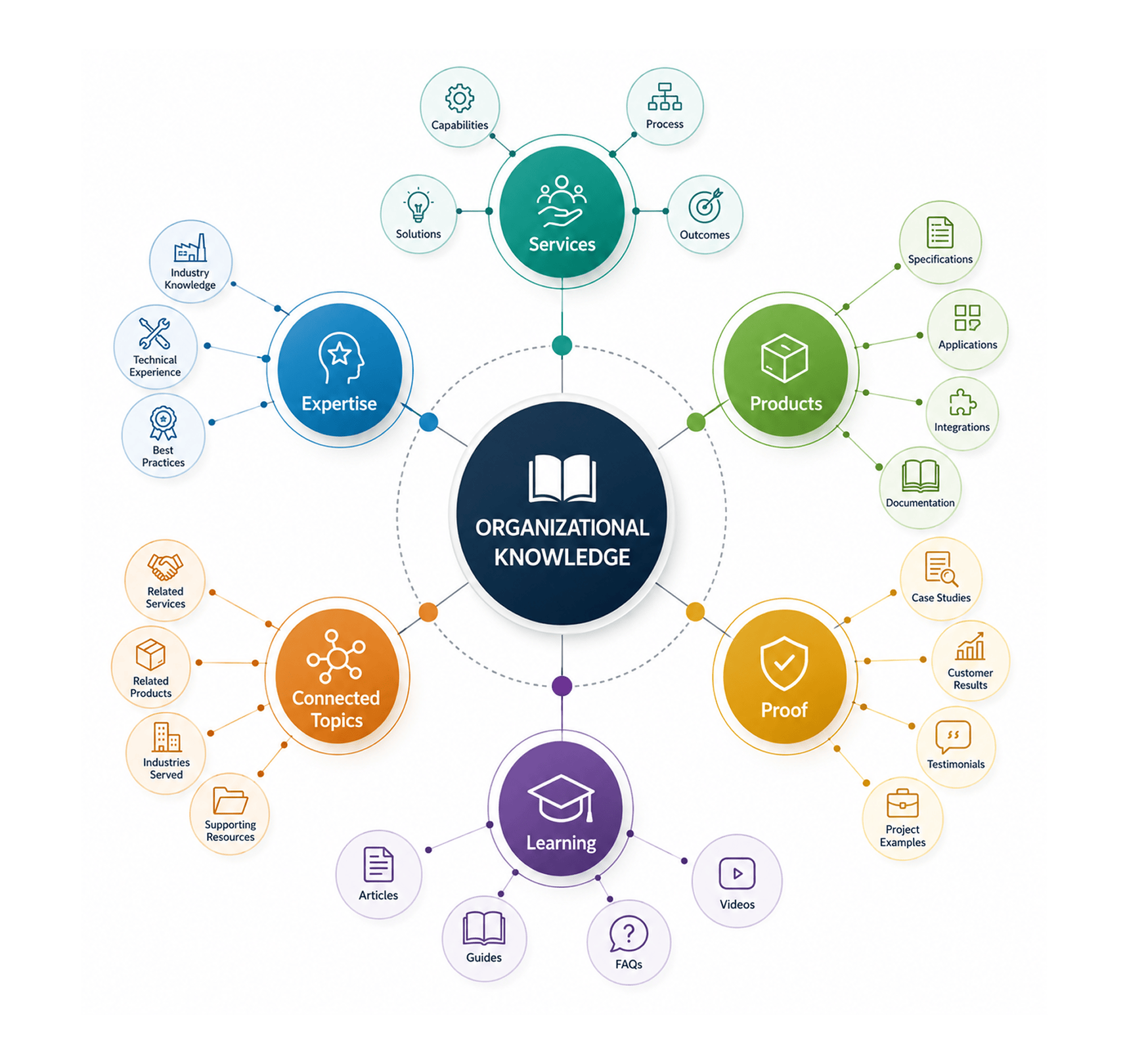
Their expertise areas connect. Product documentation connects to educational resources.
Service pages reference relevant case studies. Supporting content reinforces related topics.
Visitors can follow a logical path through the organization's knowledge rather than encountering isolated pages.
Their publishing operations are coordinated. Marketing, engineering, and subject matter experts use the same terminology.
Someone owns the standards. Content is reviewed regularly. The ecosystem feels cohesive rather than fragmented.
Their technical foundation makes information accessible. Critical content is machine-readable, not hidden inside PDFs or dependent on JavaScript rendering.
Templates follow consistent structural patterns. Internal linking reinforces relationships between topics.
Perfection is not the objective. Consistency is.
How EOSYS Fixed Its Foundation and Grew AI Citations 30%
A Visibility Problem Solved by Rebuilding the Foundation
EOSYS, a mid-market industrial automation company, had deep engineering expertise and years of valuable content. Fragmentation was the barrier, not authority.

Product information, technical resources, and educational content lived in separate parts of the site. They followed different structures, used different terminology, and seldom connected to one another.
Some areas performed reasonably well in traditional search. The deeper expertise that differentiated the company was much harder to connect, navigate, and discover.
The organization had the knowledge and experience. It wasn't presenting that expertise in a way that was easy to understand.
The work focused on improving site structure, consolidating overlapping content, making information easier to access, and creating stronger connections between related topics.
The results were measurable across both traditional and AI-driven search visibility.
The results were measurable across both traditional and AI-driven search visibility.
Performance Gains Over Six Months
- Average Google ranking position improved roughly 90%, moving from page three to page two, from position 29 to 15 (Google Search Console)
- AI citations increased 30% (SEMrush)
- User growth exceeded 200% in some targeted content clusters, more than 100% across several others (SEMrush)
As detailed in the EOSYS case study, those gains came from making the company's expertise easier to find, understand, and rely on.
The Path Forward
Improving AI visibility rarely requires a full rebuild. It starts by identifying the biggest obstacles and removing them one by one.
For most organizations, that means starting with the content that is most relevant to the buyers they want to reach. Strengthen those pages. Connect them to related expertise. Make trust signals visible. Confirm the technical foundation supports a consistent interpretation.
Then address the processes that allow fragmentation to build up as your content and teams evolve. Shared standards, coordinated publishing workflows, and clear ownership won't eliminate every problem, but they stop small issues from compounding into larger ones.
Organizations building durable AI visibility make it easier for people and machines to understand what they know, trust what they say, and navigate their expertise. That's a foundation problem. And foundation problems are solvable.
Content clarity, trust signals, technical accessibility, governance, and information architecture. See where yours stands.
What Clients Ask Us About AI Search and Their Website
Because expertise alone isn’t enough.
AI systems need to understand what that expertise is, how it connects to the rest of your content, and whether the surrounding signals reinforce it.
Years of valuable content spread across disconnected PDFs, product pages, and technical documentation often create gaps that make that harder.
It means the site's structure, content, and technical foundation make it easy for AI systems to interpret and retrieve information.
That includes clear topic coverage, consistent technical implementation, visible trust signals, coordinated publishing standards, and logical connections between related content.
A site can have strong expertise and still struggle if that expertise is fragmented.
Not as much as many people assume.
AI-driven search relies on many of the same fundamentals that have always influenced visibility, including crawlability, semantic structure, accessibility, and content quality.
What’s changed is the level of consistency and cohesion required across the entire website.
Templates that generate inconsistent markup, obscure content hierarchy, or rely heavily on JavaScript can create problems before AI systems even reach the content itself.
The same is true for important information locked inside scanned PDFs.
Semantic HTML doesn't need to be perfect. It needs to be consistent.
Without shared standards, different teams often describe the same topics in different ways.
Content overlaps. Terminology drifts. Outdated pages remain live.
Over time, a website that once felt coherent becomes harder for both people and AI systems to understand.
Related Posts