How a Digital Agency Reduces Cost, Risk, and Time to Value
Learn about the economics and execution benefits driving the shift towards agencies with elite digital capabilities.
 7 Min Read

These insights reflect the recurring technical, architectural, and performance patterns that determine how high‑stakes B2B websites, search visibility, and digital systems drive measurable revenue impact.
1. Process & System Integrity Insight
A stable digital program depends on a cross‑functional operating model where strategy, content, UX, and analytics operate in parallel, allowing execution to move continuously without the bottlenecks that slow small internal teams.
2. Risk & Safety Insight
Shifting digital work to an agency reduces continuity risk by removing single‑point dependency on individual hires and ensures regulated content, accessibility, and accuracy standards are maintained through established review workflows.
3. Data & Architecture Insight
Agencies create a unified measurement and tooling environment where analytics, SEO platforms, UX testing tools, and automation systems work together, giving leaders clear attribution and reliable insight into what drives performance.
4. Variability, Scalability, or Modularity Insight
A modular agency model scales with demand, expanding or contracting resources as campaigns shift, seasons change, or new priorities emerge, without the fixed‑cost drag or underutilization that limits internal teams.
5. People, Governance, or Adoption Insight
Specialists across search, content, UX, and analytics maintain shared knowledge and coordinated workflows, ensuring execution continues even when individuals change and preventing the skill gaps that weaken in‑house programs.
6. Strategic Alignment Insight
Treating an agency as a variable, performance‑driven partner aligns digital investment with revenue outcomes by reducing cost, compressing timelines, and accelerating time‑to‑value in ways internal teams cannot replicate.
A digital agency is not a luxury. It’s a disciplined financial decision with measurable upside. Digital channels require specialized skills and expensive tools.
Agencies provide access to that expertise at a fraction of the cost of assembling the same capabilities in-house. Many mid-market companies find an agency to be 3–5× more cost-efficient once salaries, benefits, software, and turnover are considered.
The reality is that a digital agency functions like fractional access to a full digital department, without the full-time payroll, idle capacity, or operational risk.
The In-House Cost Trap
Building an internal digital team introduces fixed costs that remain regardless of workload. Salaries, benefits, and overheads continue even when campaigns slow.
For example, a mid-market company hiring four or five core marketing roles can expect annual spend in the high six figures, including compensation, benefits, and overhead.
An agency, by contrast, usually operates on a predictable monthly retainer that can adjust as needs change. The comparison below illustrates the difference between an in-house team and an agency partner.
Cost Category | In‑House Team (Mid‑Market) | Agency Partner |
| Salaries and benefits (4–5 roles) | $550K–$700K | Included |
| Tools and software (SEO, analytics, UX, design) | $15K–$30K | Included |
| Training and recruiting | $20K–$40K | Included |
| Management overhead | $30K–$50K | Included |
| Total annual cost | ~$615K–$820K | ~$150K–$250K |
The difference is substantial. It explains why outsourcing often makes financial sense. Research supports this. Around 63% of small businesses report cost savings of up to 30% by outsourcing marketing rather than maintaining a full in-house team.
For broader digital programs, savings can be higher. A LinkedIn analysis observed that companies often spend two to three times less by outsourcing marketing compared with hiring full-time staff.
Hidden costs further widen the gap. Onboarding, staff turnover, and underutilization reduce return on investment. Marketing talent is particularly mobile. Average CMO tenure is roughly 18 months, leading to frequent hiring cycles and lost momentum.
During gaps or transition periods, internal teams absorb downtime while payroll continues.
An agency converts many of these fixed costs into variable expenses. Clients pay for active output through a retainer, not for idle capacity.
See how your current setup compares. Get a quick, no‑pressure audit.
The Financial Logic of Partnership
When you evaluate an agency through a financial lens rather than a marketing lens, the structural advantages become obvious. The model reduces fixed costs, compresses timelines, and removes operational risk in ways internal teams can’t replicate.
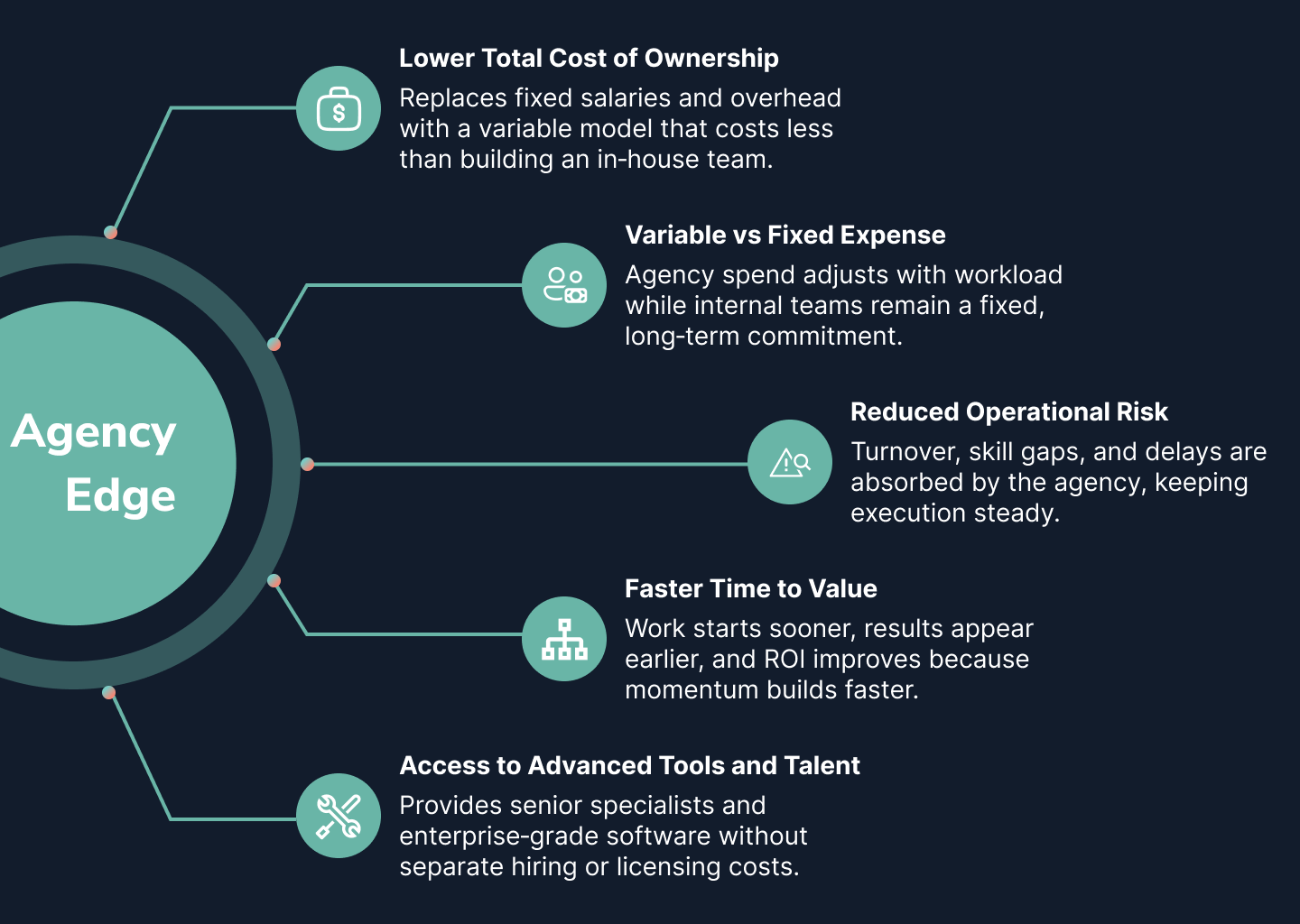
Viewed this way, a digital agency turns marketing into a managed service.
Many mid-market firms adopt this approach to avoid overextending small teams or carrying the cost of a full department.
Instead, they rely on an external partner to maintain execution, control spend, and limit operational exposure as budgets tighten.
Why One or Two Hires Rarely Work
Some organizations attempt a minimal in-house approach by hiring a single digital generalist or a small two-person team. This usually underperforms.
Digital marketing is cross-functional. No individual can maintain depth across SEO, UX, content, and performance measurement simultaneously. Gaps in any one area weaken overall results.
- Limited bandwidth: One person can’t execute SEO, content, design, and analysis at a professional standard simultaneously. Focusing on one area comes at the expense of others.
- Skill gaps: No single hire covers every discipline. Weaknesses in even one function reduce overall marketing returns.
- Continuity risk: If a sole marketer quits or takes an extended leave, execution stops. There’s no redundancy.
Agencies address these issues by distributing responsibility across specialists. Clients gain access to a coordinated team.
At DBS, for example, specialists in search, content, UX, and analytics operate as a unit. Work continues even when individual contributors change, and knowledge remains within the team.
What You Actually Get When You Hire an Agency
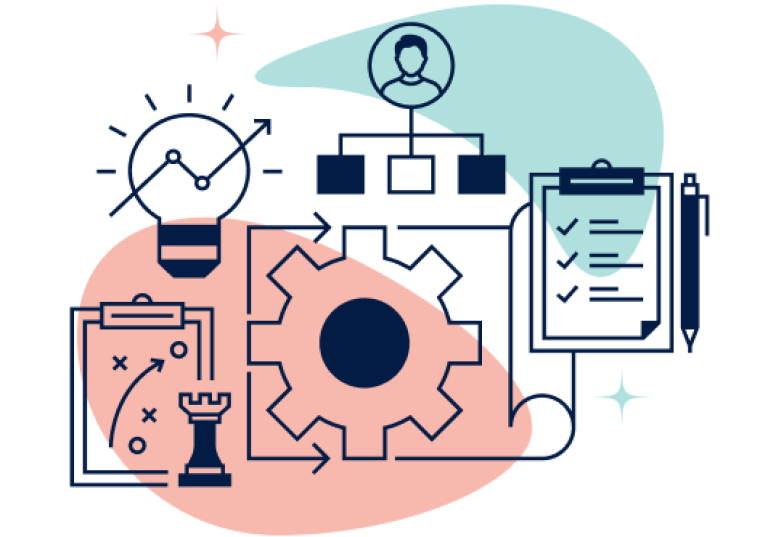
What you’re really hiring is a fully built marketing department, including strategists, creators, analysts, and technologists, already trained, already coordinated, and already equipped with the tools and processes that drive measurable performance.
- Strategy and planning. Senior strategists define priorities and prevent budget waste by setting direction based on data.
- Website and user experience. Designers and UX specialists ensure sites convert traffic efficiently and function reliably.
- Content and SEO. Specialists expand search visibility and topical relevance through structured content and optimization.
- Analytics and reporting. Analytics track performance, interpret user behavior, and show where investment produces returns.
The impact comes from how these disciplines align and reinforce each other in execution.
Role | Function | Value | Team Interaction |
| Project Manager | Defines priorities and direction based on data and goals → | Aligns all team members and prevents waste | Manages timeline and tasks for UX, content, SEO, analytics, dev |
| UX Strategist | Designs conversion‑ready structures and flows → | Improves usability and conversion efficiency | Translates strategy into user flow, defines content and SEO placement, and sets dev specifications |
| Graphic Designer | Creates visual systems, layouts, and brand expression → | Elevates clarity, trust, and engagement | Drives hierarchy with UX, strengthens content impact, delivers dev‑ready assets |
| Content Writer + SEO and GEO Strategist | Produces structured content, search optimization, and AI‑ready answers → | Expands visibility, relevance, and AI surface area | Aligns with UX structure, executes strategy, and responds to analytics signals |
| Backend / Frontend Developer | Builds, integrates, and maintains site functionality and technical foundations → | Delivers reliability, speed, accessibility, and Google‑defined best‑practice compliance | Implements UX/design, optimizes for SEO and AEO, and maintains strong technical performance |
The Tooling Advantage
Agencies also bring access to enterprise-grade software that many mid-sized companies can’t easily justify or fully use on their own.
A basic marketing technology stack covering SEO, analytics, UX, accessibility, and automation can cost tens of thousands of dollars per year. Professional platforms like Ahrefs or Moz range from roughly $1,000 to over $10,000 annually. Design and prototyping tools add further per-user costs.
Accessibility auditing and automated testing tools commonly fall in the $5K–$15K per year range. These figures exclude the time required to implement and maintain them.
When working with an agency, companies effectively share this tooling. Software costs are spread across multiple clients, with access included in the retainer.
Risk and Utilization: The Hidden Financial Levers
Marketing decisions often focus on visible costs, but operational risk and staff utilization are also critical. These elements determine the true return on marketing spend. Comparing an in-house team with an agency partnership shows how differently each model handles continuity and workload.
Agencies Provide Operational Continuity
In-house marketing teams are disrupted when key staff resign or take extended leave. If an SEO manager quits, rankings and campaigns can stall for months while recruitment and onboarding take place.
Agencies are built to absorb this risk. Work continues when individuals change because responsibility is shared across a team. Execution doesn’t halt due to turnover, and institutional knowledge stays intact.
Agencies Don't Charge for Downtime
In-house teams inevitably experience downtime. Campaigns move in phases, seasons fluctuate, and salaries continue regardless of workload. Agencies operate at consistently high utilization by distributing staff across multiple clients.
Clients pay for active work on their account. Downtime is absorbed internally by the agency, and resources can be reassigned until demand increases again. When activity spikes, agencies can expand capacity quickly without requiring permanent hires. This model reduces waste and improves efficiency, ensuring spending depends on output.
Faster Results and Measurable ROI

Speed is a meaningful variable in marketing performance. Agencies shorten execution time because teams and processes are already in place. Projects can launch in weeks rather than months, without recruitment delays or prolonged onboarding.
For companies, this means outcomes are realized sooner, sometimes an entire quarter earlier than with a newly built-in-house team.
Agencies also work in parallel. While one specialist develops a page, another prepares content, and a third configures analytics. This overlap removes bottlenecks common in small internal teams. Campaigns go live faster, data arrives earlier, and decisions can be made based on performance.
Earlier results improve return on investment and create momentum that compounds with time.
Agencies: The Smarter Model for Companies That Want to Move
The evidence points in one direction. An agency partnership reduces total cost, removes operational fragility, and accelerates the timeline between investment and return. For marketing leaders and business owners who need to perform without overbuilding, agencies are the structurally sound choice.
The companies that move the fastest and achieve goals sooner are not the ones with the largest in-house teams and internal resources.
They are the companies that match the right agency engagement model to their goals early, protect their budget from idle capacity and turnover risk, and focus internal resources where they create the most leverage.
That is what a well-structured agency relationship delivers. Not a vendor. A functioning marketing operation, already built, already coordinated, and accountable to your outcomes.
If you want a partner that reduces cost, risk, and time‑to‑value, let’s build the model together.
Executive FAQs on Agency Value, Cost Efficiency, and Digital Performance
A digital agency replaces fixed payroll with a flexible model. You pay for active work instead of carrying salaries, benefits, and overhead during slow periods.
Digital work spans search, content, UX, analytics, design, and measurement. One or two people cannot maintain depth across all of these areas at the same time.
Internal teams pause when someone resigns or takes leave. Agencies keep work moving because responsibility is shared and knowledge is not tied to one person.
Professional SEO, analytics, UX, and testing tools are expensive and require expertise. Agencies spread these costs across clients and handle the setup and upkeep.
Agencies start immediately with trained specialists and established workflows. Strategy, content, UX, and analytics run in parallel instead of waiting on new hires.
You gain a complete marketing department that is already coordinated, already equipped, and already able to produce measurable output without the overhead of building it yourself.
Related Posts