5 Big Advantages of Microsites for B2B Marketing Campaigns
Focused, intentional "micro" website experiences outperform bloated corporate sites in supporting ABM, product launches, and B2B lead generation strategies.
 24 Min Read

When B2B microsites fail, the problem usually starts before design or development ever begins.
While a microsite is usually built by B2B brands so their campaigns have a place to live, what they often create is merely a smaller website limited by the same structural flaws as the larger one: unclear audience targeting, diluted messaging, competing conversion paths, and analytics that produce noise rather than insight.
That's not typically a creative failure. It's a flawed strategy.
Corporate websites are built for organizational breadth. They serve prospects, customers, investors, recruiters, partners, and support users simultaneously. That breadth creates drag when marketing teams launch focused initiatives against it.
The structure of a company site works against most campaigns before they begin. ABM campaigns lose precision. Product launches compete against unrelated navigation. Trade show traffic lands on generic pages disconnected from the conversation that started at the booth.
A microsite is not simply a smaller website.
A microsite solves a different problem for B2B companies than the main website does.
It creates a focused digital environment built to nurture one segment of your audience, with a specific problem, a focused narrative, and defined conversion goals.
A microsite is not a design preference. It's a campaign performance decision.
When executed well, the advantages microsites provide are measurable: sharper messaging, cleaner analytics, stronger ABM performance, faster campaign execution, and infrastructure that earns its place in the budget.
Understanding when a microsite is the right decision, and what separates a high-performing microsite from a rushed campaign page, is what we will explore here.
Corporate Websites vs. Campaign Microsites: Where They Diverge
| Corporate Website | Campaign Microsite | |
| Audience focus | Multiple audiences simultaneously | Single defined audience |
| Navigation | Broad, usually by department | Campaign-specific |
| Messaging priority | Organizational priorities | Buyer problem first |
| Conversion path | Competing CTAs | One clear conversion path |
| Analytics | Blended, difficult to isolate | Campaign-specific visibility |
| Launch speed | Slower due to governance | Faster within a contained scope |
| ABM suitability | Limited | High |
| SEO focus | Broad topical coverage | Concentrated topical relevance |
| Long-term role | Ongoing corporate asset | Built for a specific initiative |
The B2B Marketing Advantages of Microsites

Campaign messaging is more effective when it doesn't compete with the corporate website.
Most B2B campaign messaging underperforms because the experience was built to satisfy too many priorities at once.
This is rarely a copy problem. The copy itself can be clear, specific, and targeted. The structural environment around it still undermines it.
Enterprise Websites Work Against Focused B2B Campaigns
Enterprise websites are designed to accommodate audiences at scale.
Navigation serves multiple departments. Content addresses multiple stakeholder groups. The architecture reflects organizational complexity because it has to.
That necessary complexity often becomes a liability when the company launches marketing campaigns that target just one segment of that audience.
A prospective buyer clicking through a targeted ad or an ABM drip email will encounter the full weight of the corporate site: unrelated navigation paths, competing calls to action, and product pages disconnected from the campaign that generated the click.
That's why what looks like a messaging issue is often instead a structural one.
What a Microsite Creates That a Landing Page Cannot
A landing page zeroes in on a single action. That works well for high-volume, short-cycle campaigns where one offer is enough.
A microsite supports something different: exploration, education, audience segmentation, and narrative progression across multiple buyer stages.
When buyers need to diagnose a problem, evaluate a solution, and feel confident in their decision before converting, a single landing page compresses the journey too aggressively. A microsite keeps the narrative flow intact while still offering the visitor autonomy and breathing room to explore the solution.
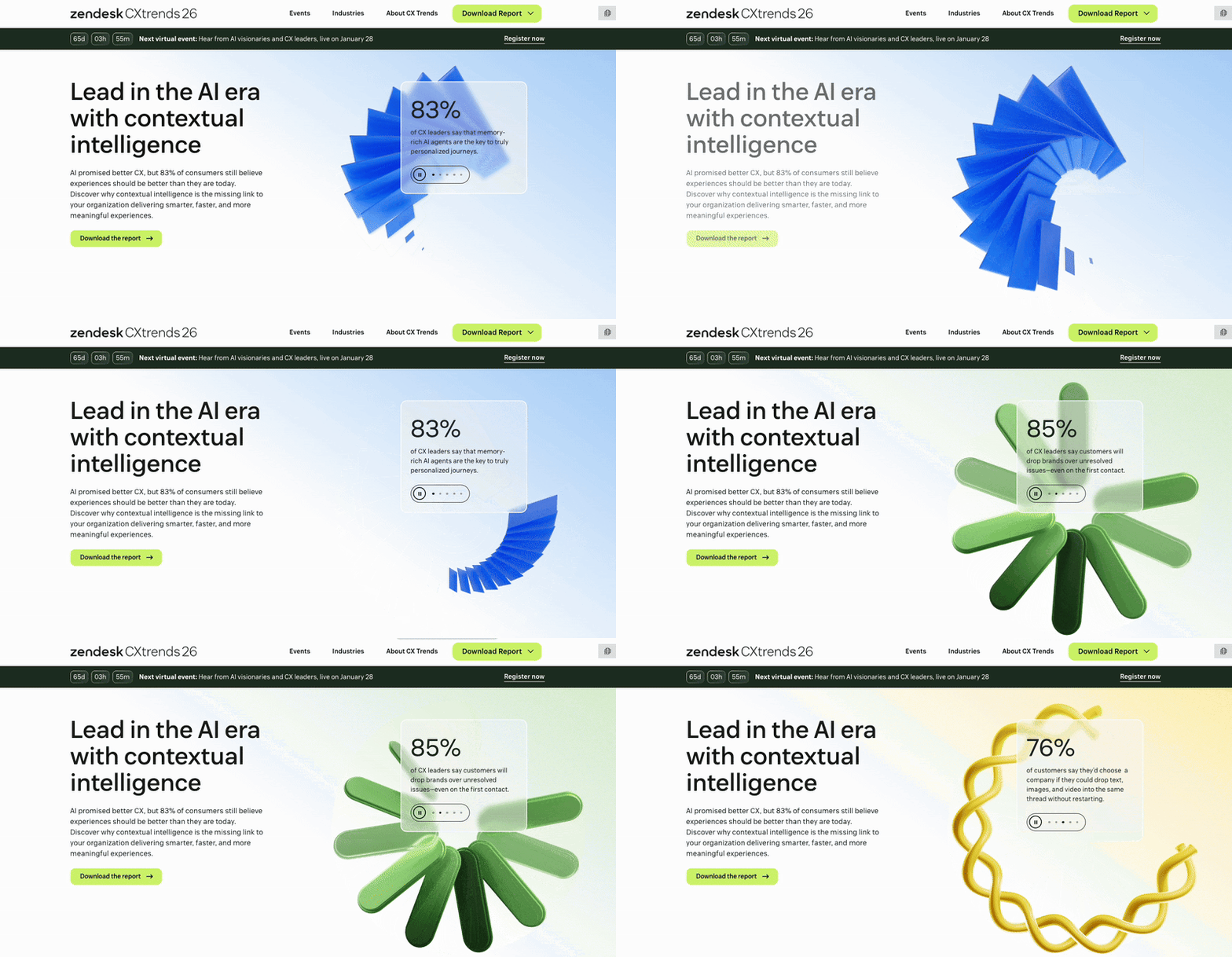
Zendesk’s CX Trends microsite demonstrates the difference.
The company’s annual CX report included research and responses from more than 10,000 participants across 22 countries. The audience ranged from CX leaders to administrators and analysts, each looking for different insights.
A static download page on Zendesk's primary website would have buried the content and experiences tied to the report.
Instead, the microsite created distinct paths for different audiences. Color functioned as navigation across five trend modules. Motion directed attention rather than distracting from it. The result helped drive global campaign delivery across 15 languages and multiple regions, including EMEA, North America, LATAM, and APAC.
The important strategic decision here was not "build a microsite." It was defining what audience questions the experience needed to answer before design began.
Most microsites underperform because strategy is reverse-engineered around a template, rather than driving the structural decisions from the start.
The takeaway is that focused B2B campaigns rarely fail because of buyers lacking interest. Instead, they fail because the experience introduces competing priorities before the buyer can achieve clarity and signal their interest.
Cleaner analytics lead to better attribution and faster decisions.
Many marketing teams struggle to improve campaign performance because they cannot clearly isolate what is working.
The analytics exist. The problem is that campaign data gets blended with traffic data from unrelated audiences, unrelated content, and nebulous conversion paths. Important signals disappear inside the noise.
Large Enterprise Sites Create Data Visibility Problems
Campaign traffic on a corporate website blends into broader site behavior.
A buyer arriving through a targeted ABM campaign and a customer searching for support documentation often look identical in aggregate reporting. Multiple audience types distort engagement signals. Attribution becomes harder to isolate. Teams spend more time debating what the data means than acting on it.
Switching analytics platforms does not solve that problem. Separating the campaign environment does.
What Changes When Campaign Analytics Are Isolated
A microsite creates a contained analytics environment, making campaign behavior easier to interpret.
Traffic patterns become easier to interpret. Conversion paths become more visible because the environment reflects a single audience and a single objective. Optimization cycles accelerate because teams are working from campaign-specific behavior rather than broad site averages.
The downstream effects matter just as much as the reporting clarity itself.
Budget allocation becomes easier to justify. Executive reporting sharpens. Sales and marketing align more easily because the data shows what targeted buyers actually did, not what the broader site population did.
Many organizations assume underperforming campaigns need better messaging.
Often, they first need an environment that makes buyer behavior easier to understand.
ABM campaigns perform better when the experience feels personalized for prospects.
Most ABM campaigns lose credibility the moment targeted buyers land on a generalized corporate experience.
Swapping industry terminology into a generic template is not audience alignment. Buyers quickly recognize whether an experience was designed for them, or merely adapted for them. That distinction affects trust before they read a single line of copy.
Why Personalization Tokens Are Not Enough
ABM depends on delivering experiences that reflect knowledge and understanding of a specific audience’s context.
A personalized email that routes recipients to a generic product page breaks that experience at the most important moment. Yes, the email earns the click. But the destination loses the buyer.
Focused campaign environments offered by microsites change the equation.
For example, a microsite built for a campaign targeting manufacturers can structure pages and content around operational bottlenecks, production efficiency, and integration challenges specific to that sector. Likewise, a microsite built for financial services can prioritize regulatory requirements, risk management, and stakeholder alignment without confusing unrelated audiences.
The Structural Advantage Within Complex B2B Environments

In complex B2B sales environments, microsites allow messaging hierarchy, navigation, content sequencing, and conversion flow to align around a single audience group.
The buyer does not have to search for relevance inside a broad site structure.
The relevance is already built into the experience.
That applies across industries and campaign types: manufacturing solution campaigns, healthcare initiatives, financial services segmentation, executive event experiences, and partner ecosystem programs.
The common requirement is precision.
When the audience is defined, focused campaign environments consistently outperform generalized ones.
How Focused Campaign Environments Support AI and Search Visibility
Tightly themed microsites strengthen topical relevance for search and generative AI engines.
A microsite built around a specific industry challenge, product application, or campaign topic creates a content environment that aligns naturally with long-tail search intent. That concentration improves discoverability, supports industry-specific visibility, and increases the likelihood of appearing in AI-generated answers for focused queries.
AI retrieval systems often surface tightly scoped topical environments more reliably than broad corporate sites where unrelated content competes for relevance.
Corporate sites rarely achieve that level of campaign-specific clarity.
The strongest ABM campaigns do not feel personalized.
They feel intentionally built for the audience encountering them.
Microsites help marketing teams move faster without losing traction.

Focused campaign environments allow teams to execute at the initiative's speed rather than the enterprise website governance's speed.
That becomes especially relevant for product launches, trade shows, executive events, and time-sensitive industry campaigns where timing directly affects performance.
Enterprise Governance Slows Campaign Execution
Large corporate websites operate inside layered workflows and approval structures.
CMS modifications require development resources. Navigation updates need stakeholder approval. Brand governance teams review new content additions before anything goes live.
Those systems exist for good reasons. They protect consistency, compliance, and brand integrity across a platform serving the broader organization.
For focused marketing campaigns, they also slow execution.
Marketing teams regularly adapt campaigns to fit what the corporate website allows, rather than building limited-scope web experiences focused on meeting specific, defined needs of audiences.
The result is constrained storytelling, slower launches, and messaging driven by governance limitations.
What Campaign Agility Actually Requires
Campaign agility means more than launching quickly.
It means updating messaging as buyer questions evolve, expanding content depth as campaigns mature, and responding to event timing without restructuring a platform serving thousands of unrelated users.
A microsite creates that flexibility inside a contained environment.
Zendesk’s CX Trends microsite functioned as a dedicated campaign hub supporting pre-event awareness, live-event engagement, and post-event content access across multiple regions and audience groups simultaneously.
The value came from strategic focus combined with operational adaptability.
The experience evolved throughout the campaign without affecting other digital properties.
The Kao Collins X-BAR microsite demonstrates the same principle in a different way.
X-BAR is an industrial print system with its own technical audience, applications, and sales cycle. When it lived inside the broader Kao Collins website, it competed against messaging aimed at entirely different buyers.
Moving X-BAR into a dedicated microsite created a contained environment built around the questions industrial print buyers were actually asking.
Within 90 days, the site recorded a 234% increase in views and a 257% increase in session starts. Technical and demo-focused pages drove most of the growth, signaling that the right audience was finding the right content.
The separation enhanced targeting precision as much as visibility.
Speed alone still does not guarantee performance.
A fast microsite with weak audience alignment underperforms just as easily as a slow, committee-built one. Agility matters when the campaign structure stays clear as conditions evolve around it.
Well-executed microsites function as strategic campaign infrastructure, rather than being temporary pages.
High-performing microsites require the same strategic discipline as any serious digital platform.
That means it's also where many microsites fail. Stakeholder conversations typically focus on launch speed and visual design. The more relevant question is whether the experience was developed to perform over the life of the campaign.
Why Some Microsites Underperform
Many failure patterns are predictable.
Weak audience definition leads to campaign messaging that tries to reach everyone, and thus connects with no one. Poor UX decisions risk confusing buyers near the point of conversion. A weak conversion architecture might bury calls to action behind content the audience wasn't ready for.
Disconnected content planning leaves the microsite with little visibility in Search or AI answers, once paid promotion slows down.
These failures usually start at the strategy and architecture level, long before they appear in design reviews.
Strategic Microsite Requirements
High-performing microsites tend to share the same foundational elements:
- Information architecture built around the buyer journey, not the org chart
- Conversion paths designed around one defined action
- Accessibility standards treated with the same rigor as primary digital properties
- Technical performance that helps both search visibility and user experience
- SEO and AI visibility optimization aligned with the campaign's topical focus from the start
- Analytics structured to isolate campaign behavior cleanly
- Governance processes that preserve consistency as the campaign evolves
Without those elements, the microsite becomes little more than surface-level branding.
Integrations Influence Long-Term Value
Microsites deliver more value when they are connected seamlessly with CRM workflows, reporting systems, sales enablement content, and the broader content strategy.
Connected microsites become reusable campaign assets that compound over time.
Disconnected microsites generate a report, then quietly disappear into archive folders nobody opens again.
Organizations that treat microsites as temporary deliverables usually build short-lived promotional platforms. Organizations that treat them as focused campaign infrastructure build replicable web environments that produce cleaner data, stronger conversion performance, and more durable long-term brand visibility.
Not Every B2B Campaign Needs a Microsite
Microsites create value primarily when campaigns require focus.
Without that requirement, they can introduce unnecessary complexity, split analytics without meaningful benefit, and consume resources that a simpler structure or landing page would not.
When a Landing Page Is the Better Choice
Dedicated landing pages are effective for high-volume paid campaigns that center on a single offer.
They fit short-lived promotions, straightforward lead capture flows, and campaigns where content depth is not part of the conversion journey.
In those cases, adding microsite infrastructure increases complexity without improving performance.
A Simple Decision Framework
Microsites typically make sense when most of these conditions apply:
- The campaign targets a defined audience with a specific problem
- The initiative requires sustained storytelling across multiple content pieces or audience paths
- The conversion flow differs meaningfully from the corporate website
- Campaign analytics need to be isolated for attribution or optimization
- The experience supports a product launch, executive event, ABM initiative, or industry-specific program
If these conditions are absent from the campaign, a landing page is often enough.
The Risk of Building One Anyway
Poorly planned microsites create problems of their own.
They dilute brand consistency when the experience feels disconnected from the broader organization. They split analytics instead of clarifying them. They reduce the brand's search visibility when the content is shallow and lacks topical focus. They also create maintenance overhead that can outlive the campaign itself.
A strong microsite strategy usually begins with restraint. As a solution, it only creates value when the campaign itself is focused enough to justify it.
The Structure Around the Campaign Often Determines the Outcome
Many B2B organizations continue to optimize campaigns in digital environments that were never designed for campaign precision. Making the shift to developing microsite experiences often leads to dramatic improvement.
The messaging improves. The creative sharpens. Paid spend increases. The structural problem remains.
Diluted messaging, unclear attribution, weak audience alignment, and inconsistent conversion paths on corporate sites make them ill-suited for multichannel campaigns because its broad approach never changes.
That's why it's important to remember a microsite is not simply a smaller website. It is a focused campaign environment built around audience clarity, narrative continuity, measurable engagement, and operational adaptability.
The five advantages covered here all point to the same principle: campaigns perform better when the digital architecture aligns with the goals of the campaign.
The goal is not to run more campaigns.
The goal is to establish environments where buyers move through the funnel with less friction, teams make decisions more confidently, and organizations gain clearer visibility into what is actually driving engagement and converting prospects to closed sales.
That decision belongs in the campaign brief, not the post-mortem.
Start Planning Your Microsite Project
By now, you probably agree that the focused digital foundation provided by a microsite offers advantages your corporate website just can’t deliver for generating demand and converting B2B buyers into qualified prospects.
A dedicated microsite environment can sharpen the message, improve engagement, and support the unique demands of ABM, product launches, executive events, trade shows, and industry‑specific programs.
Here at DBS, our microsites are proven to move the needle for leading global brands like Zendesk.
Related Posts