
 9 Min Read
Custom Laravel development typically costs more to launch than a conventional content management system, but it can cost less to own when a business requires complex data relationships, application-specific access controls, or continued feature development.
The tradeoff becomes difficult when a custom platform recommendation is presented to leadership alongside a lower CMS quote, and someone asks why. If the honest answer is that a content management system was never built to do what the business actually needs, that answer has to survive the room.
Too often, the argument doesn't survive, not because the reasoning is wrong, but because the conversation never got past comparing one CMS to another. That's a costly place to get stuck, and many businesses don't find out until the platform is already live.
Before recommending a platform, it helps to know how to build the internal case for one. "Choosing the Best Enterprise Website CMS Based on Business Value" walks through evaluating platform options on the terms stakeholders weigh most: cost, functionality, and long-term ROI.
The Real Decision Isn't CMS vs. CMS: It's CMS or Custom Development
Most enterprise platform decisions default to comparing one CMS to another without ever asking whether a CMS is the right tool for the job.
A business managing complex financial planning data can spend months evaluating CMS options before realizing the problem was never a content problem.
The bias runs deep because most agencies and vendors are set up to compare CMS platforms. WordPress vs. Drupal. Craft vs. Statamic.
Each comparison assumes the business needs a platform for publishing and organizing content. For many businesses, that assumption holds.
For others, it doesn't.
Heavy customization doesn’t necessarily resolve the underlying mismatch. The constraint isn't the amount of work that goes into the build.
It's whether the platform’s underlying model is organized around content or around the business's own data relationships.
Skipping that question is expensive precisely because the mismatch is invisible at the start.
A business that picks the wrong CMS still gets a working website. It just gets one that starts fighting the business the moment the requirements get complicated.
There's a clarifying wrinkle worth naming here. Statamic, one of the CMS platforms in that comparison set, is itself built on Laravel.
That distinction exposes the real decision: not Laravel versus a CMS, but whether the business needs a CMS or a custom application.
What a Content Management System Is Built to Do
A content management system is built to publish and organize content, but it starts to strain when the real requirement is custom business logic.
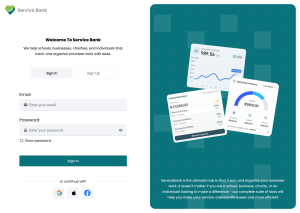
ServiceBank, a volunteer coordination platform, needed a modular, interconnected database that connects volunteers, businesses, and volunteer opportunities.
That relationship model extends beyond what a conventional CMS handles out of the box.
That's not a knock on content management systems.
It's a description of what they're for. A CMS handles articles, pages, product listings, and editorial workflows well because those are content problems with predictable shapes.
The trouble starts when the business needs something a content model can't readily express: a search-and-match system between different types of users, a permission structure that changes based on relationships rather than fixed roles, or a dataset expected to grow in ways nobody can fully specify at launch.
Where the Workarounds Start
A CMS built for content starts to strain in a few predictable places once the requirements move beyond publishing.
- Adding a new data relationship or permission rule requires far more custom development than the request size would suggest.
- Reporting needs outgrow what the platform provides natively, forcing teams to export data to spreadsheets to get the answers they actually need.
- Each large data source can become its own integration project instead of a routine addition to the platform.
What Laravel Changes for Custom Application Development
Laravel lets a business build permissions, data relationships, and modular features around its operations rather than adapting its operations to a CMS.
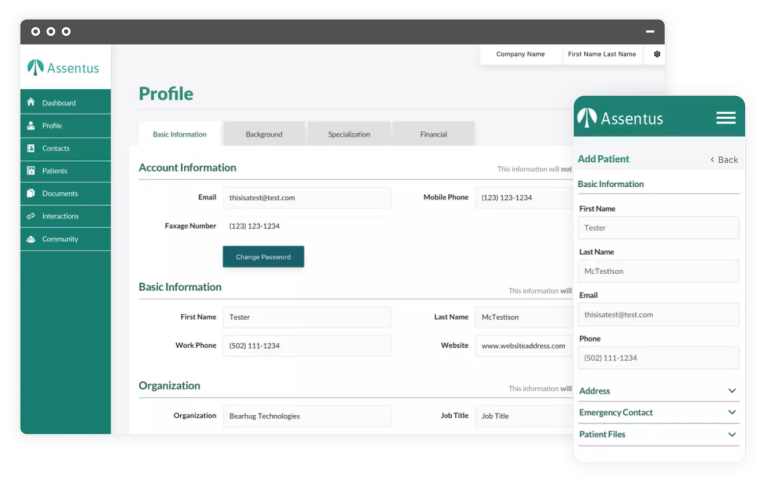
Assentus, a collaborative mental health and addiction treatment platform, needed to give third parties controlled, auditable access to protected health information.
Laravel allowed DBS Interactive to build that permission model into the application rather than bolt it onto a CMS.
Laravel is an open-source PHP framework for building custom web applications.
It includes authentication services and authorization tools that help developers define application-specific access rules.
These capabilities matter because permission logic is usually where CMS platforms first show their limits.
Laravel also gives developers control over how an application handles new data sources, modules, and performance demands as its requirements grow.
New features can be prototyped and tested against the business requirements rather than around a template.
Perspective - The clients in this article didn't start out looking for a framework. They started out with a business problem that a CMS couldn't express, and Laravel turned out to be the tool that fit.
Explore what a custom application built around how your business actually operates could look like.
CMS vs. Custom Laravel: The Tradeoffs
| Conventional CMS | Custom Laravel Application | |
| Launch cost | Lower | Higher |
| Ownership cost over three to five years | Can rise as workarounds accumulate | Can be lower when the application is built for the requirement. Ongoing maintenance is still required |
| Data flexibility | Organized according to the platform's content model | Built around the business's actual data relationships |
| Compliance control | Platform-level and may require customization | Designed according to application-specific access-control and audit requirements |
DBS Interactive's development team, led by John Golden, sees where these mismatches surface firsthand because the same team that builds these platforms also maintains them after launch.
“Most of the platforms we get called to fix weren't built wrong. They were built for a different job than the one the business ended up needing," Golden said. "By the time we see it, the client has usually already tried three plugins and a workaround to make the CMS do something it was never going to do well."
Where Custom Laravel Development Made Sense: Five Client Decisions
Five DBS clients each chose custom Laravel development because their data relationships, compliance requirements, or platform demands had moved beyond CMS territory.
Springstone needed control over sensitive data for a HIPAA-compliant mental health screening and referral platform serving multiple user groups.
ServiceBank needed a modular database connecting volunteers, businesses, and volunteer opportunities at scale. The platform also required custom reporting, besides the templated platform's native tools, and the ability to add large data sources and additional companies as ServiceBank grew.
Assentus needed controlled, auditable third-party access to protected health information, layered on top of custom content controls for a collaborative treatment platform.
Gilliam Mease Advisors (GMA) needed a custom content system that could connect a person's financial data to decision-making and future-planning tools, with support for additional functions as the platform expanded.
Show No Show needed one platform to serve four distinct user types: general users, spa owners, event planners, and communications managers, without duplicating content management across separate builds. Laravel, combined with a Progressive Web App architecture, lets it scale to new features and user types from a single installation, rather than forcing a rebuild each time.
| Client | Why Laravel |
| Springstone | HIPAA-compliant data handling for a mental health screening and referral platform |
| ServiceBank | Modular volunteer-matching database, custom reporting, and support for new data sources |
| Assentus | Controlled, audited third-party access to protected health information and custom content controls |
| GMA | Financial data system built to support future planning functions |
| Show No Show | Single-platform architecture serving four user types, PWA performance, scale without rebuilds |
How to Know If Your Business Needs Custom Development or a CMS
The decision between a CMS and custom development should be based on data complexity, compliance exposure, and growth trajectory, not solely on upfront cost.
A conventional CMS is usually the right choice for a business managing a blog, standard website pages, and a product catalog. A custom application may be a better fit for a business managing interrelated financial planning tools tied to individual client data, such as Gilliam Mease Advisors.
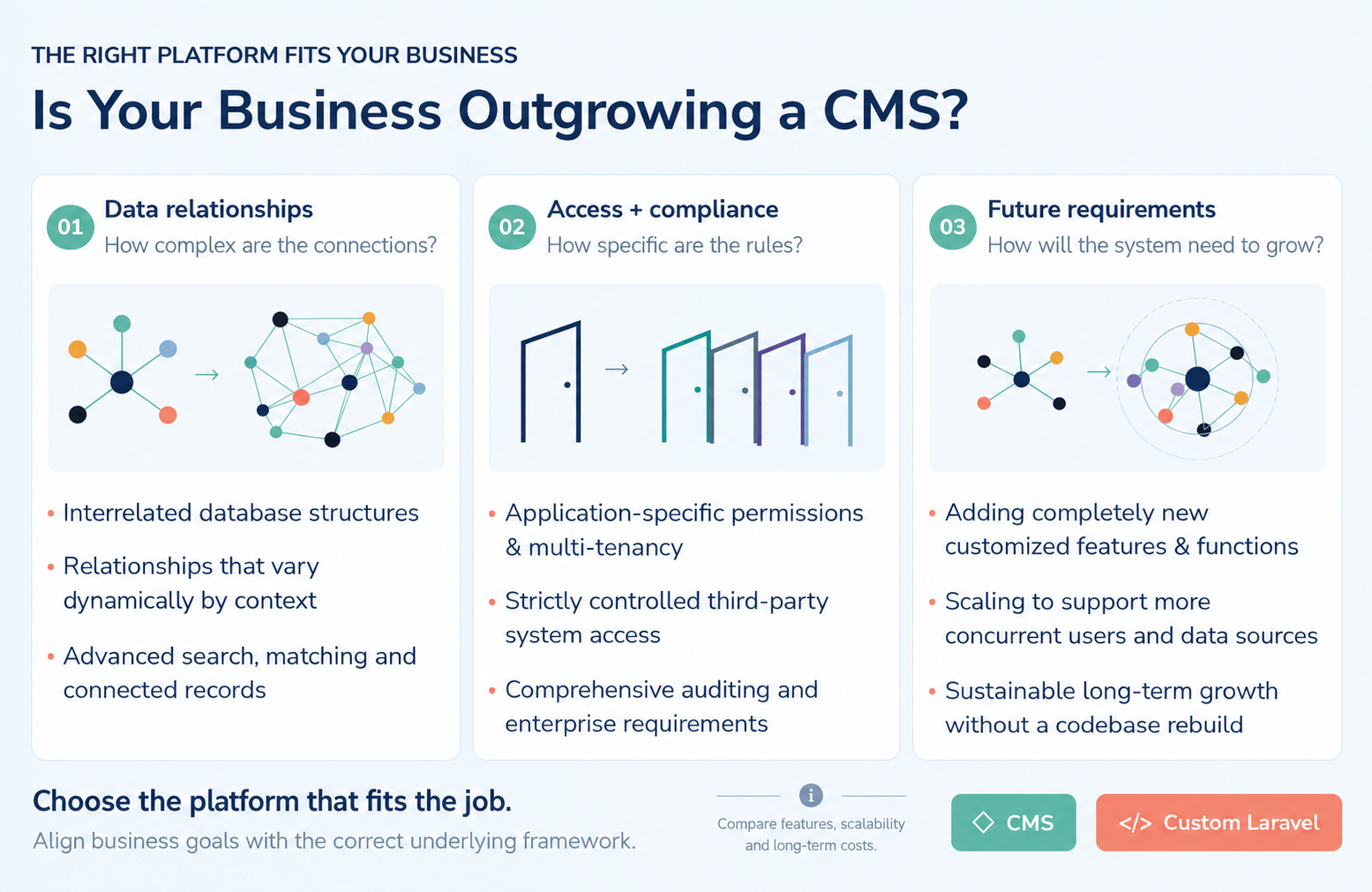
Three questions do most of the work
- How complex are the data relationships this platform needs to manage, and do they vary by context rather than follow a fixed structure?
- What compliance exposure exists, and does it require permission logic more specific than a platform-level setting can provide?
- What will the business need from the platform in three to five years, and can the proposed architecture enable that growth without a rebuild?
Custom development doesn't fit every business asking these questions, and most won't need it. Those who do will recognize their situation in one or more of the questions above.
What Custom Development Requires
Custom development requires a higher upfront investment, a development partner with genuine technical and compliance depth, and a different resourcing model for ongoing maintenance than a typical CMS build.
A business without the complexity to justify those costs is better served by a well-chosen CMS, as DBS recommends in its guidance on platforms like Craft and Statamic. The point isn't that a custom application always wins. It's that the question needs to be asked before the platform gets chosen.
The Cost of Choosing the Wrong Platform
Stretching a CMS to do a custom application's job accumulates technical debt, workarounds, and patches that solve today's problems while making tomorrow's harder to fix. The mismatch can eventually force a rebuild at a higher cost than choosing the right architecture from the start.
The Compounding Cost
Workaround costs compound quietly. Each unsupported requirement gets solved with a plugin, a manual process, or a one-off custom fix. Those costs seldom appear as a single line item until someone adds them up.

Compliance exposure can grow in the same way when sensitive data sits on a platform without access controls and audit capabilities built for the requirement.
Every quarter spent working around the platform also delays the features the business actually needs.
It's a familiar platform lifecycle: by the time the mismatch becomes obvious, the business is often already pricing a rebuild.
A platform strategy assessment can settle the question before the investment does. An assessment evaluates whether a current or proposed platform can support the business's data, compliance, and growth requirements, so the decision gets made on the right criteria the first time.
The Questions Behind Choosing Laravel Over a CMS
A business needs custom development when its core requirement is complex data relationships, specific compliance controls, or business logic that a content management system was not built to handle, not content publishing. This holds even for a heavily customized CMS, since the constraint is whether the platform is organized around content or around the business's own data.
Custom Laravel development typically costs more to launch than a CMS. Over a three-to-five-year ownership period, that upfront gap is often offset by lower maintenance, workaround, and rebuild costs, which is why total cost of ownership, not launch price, should drive the decision.
A CMS can support baseline security measures, but HIPAA-compliant applications that require granting third parties controlled, audited access to protected health information generally need a permission model built directly into the application rather than added onto a content management system.
Laravel is an open-source PHP framework for building custom web applications. Statamic is a content management system built on top of Laravel. Choosing between them is not a framework decision. It is a decision about whether a business needs a content platform or a custom application built around its own data model.
Stretching a CMS beyond content management accumulates technical debt: workarounds and patches solve today's problem while making future changes harder. Most businesses in this position rebuild the platform anyway, at a higher cost than building it correctly the first time.
Healthcare, financial services, and nonprofit organizations managing complex, interrelated, or regulated data most often need custom Laravel development, since these sectors regularly encounter data relationships and compliance requirements that a content-focused platform was not built to handle.
Related Posts