Going From B2B to D2C: Key Website Redesign Requirements
A helpful guide for transitioning from a B2B website to a D2C web experience that extends support to business partners and consumers.
 8 Min Read

Business-to-business (B2B) companies are increasingly shifting to direct-to-consumer (D2C) models. As a result, D2C e-commerce is growing rapidly, with the global market projected to reach over $880 billion in the next decade. This signals a structural change that includes the company website.
If your company is moving from B2B to D2C, a website redesign is essential because traditional B2B sites are not built for consumer expectations around design, performance, or purchasing speed. This article explains the core differences between B2B and D2C websites, outlines seven essential requirements for a successful D2C website redesign, breaks down execution considerations, and highlights the business benefits of going D2C.
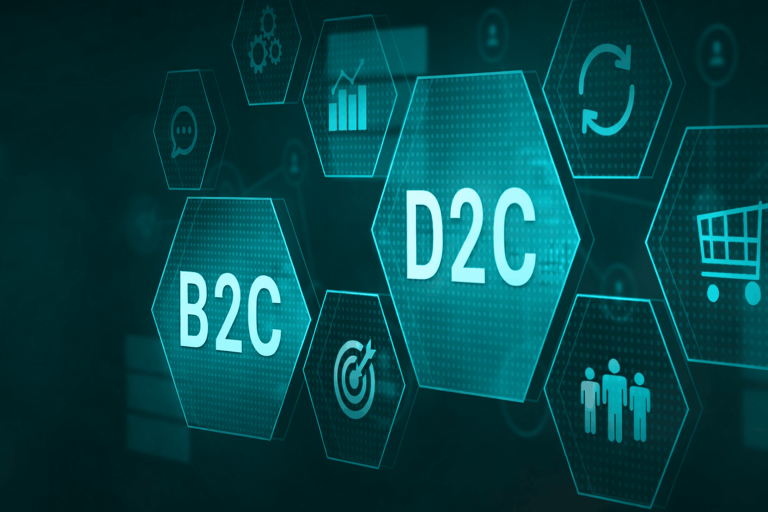
B2B vs. D2C Websites
Moving from B2B to D2C requires a fundamental shift in how your website supports buying behavior, user expectations, and technology. Business-focused websites and consumer-facing platforms are designed for very different use cases.
| B2B Websites | D2C Websites | |
|---|---|---|
| Purpose & Audience | Provide other businesses with detailed product information, specifications, and client portals. Purchases are high-value, involve multiple stakeholders, and follow long sales cycles–which means they rarely happen on the website itself. | Support individual consumers with faster purchase decisions and lower order values. The focus is on convenience, speed, and ease of use for a broad audience, often involving some means of purchasing solutions or replacement parts online. |
| User Experience (UX) | Designed for research-heavy journeys and complex decision-making. Often includes gated content, logins, or quote requests. | A simpler, intuitive experience with clear navigation, fast product discovery, mobile-first design, rich visuals, reviews, and a smooth checkout is critical. |
| Technology & Infrastructure | Commonly integrated with ERP systems for custom pricing, bulk orders, and complex workflows. Online checkout may be limited, behind a login portal, or completely absent. | Requires a full e-commerce stack, including product catalogs, carts, payments, shipping integrations, real-time inventory, scalability, and marketing and support tools. |
Get a quick assessment of what your current site is missing.
7 Core Requirements for a D2C Website Redesign
A successful shift to D2C involves more than visual updates or adding a checkout. Your website must support consumer expectations, conversion, and long-term scalability.
 | 1. Outstanding User Experience (UX)Your D2C site should be fast, intuitive, and easy to use on any device. Simplify navigation and reduce the steps required to find products and complete a purchase. Mobile-first design is critical, as a large share of D2C traffic comes from smartphones. Use clear menus, robust site search functionality, and filters that help users refine results and reach products quickly. Personalization can enhance the experience, but the interface should remain clean and uncluttered. |
 | 2. Robust e-Commerce FunctionalityA D2C site must function as a complete online store. This includes a secure, smooth shopping cart and checkout process, multiple payment options, and clear delivery costs and timelines to reduce cart abandonment. The platform should handle real-time inventory updates, order tracking, and integrations with fulfillment providers. Features such as wish lists, back-in-stock alerts, and product comparisons can further enhance usability. |
 | 3. Strong Branding and ContentIn a D2C model, your website becomes your primary storefront. The redesign should clearly communicate your brand story, values, and differentiation. Maintain consistent visuals, color palettes, and tone of voice across the site. High-quality product imagery and clear descriptions are essential for trust. Supporting content, like About pages, videos, or blog posts, can help build credibility and community when kept focused and purposeful. |
 | 4. Search Engine Optimization (SEO)SEO is a critical driver of D2C traffic and revenue. Optimize site structure, URLs, and metadata around consumer-focused keywords. Each product and category page should include unique, relevant titles and descriptions. Performance is also important. Ensure fast load times and solid technical foundations. During redesign, plan SEO migration carefully by mapping old URLs, implementing 301 redirects, and preserving high-performing B2B content where it remains relevant. |
 | 5. Trust and Credibility SignalsTrust is essential in D2C, especially for first-time buyers. Your site should clearly communicate security and legitimacy. Display payment security indicators near checkout, provide clear contact information, and explain returns, shipping, and guarantees in plain language. Product reviews, customer testimonials, and user-generated content significantly increase confidence. Press mentions or recognizable client logos can further reinforce credibility. |
 | 6. Scalable and Secure InfrastructureYour technology stack must support current operations and future growth. Select a CMS or e-commerce platform that can scale with traffic, orders, and catalog size. Hosting should handle traffic spikes during promotions or seasonal demand. Optimize speed by optimizing code, compressing images, and using content delivery networks (CDN). Uptime and security are non-negotiable. Integrations with back-end systems are also critical to ensure smooth fulfillment and accurate data across channels. |
 | 7. Customer Retention and Loyalty FeaturesAcquisition is only the first step. An effective D2C website should help repeat purchases and long-term loyalty. User accounts and wish lists improve convenience. Loyalty or rewards programs can encourage return visits where appropriate. Email marketing remains a key retention channel, offering abandoned-cart reminders, post-purchase follow-ups, and personalized recommendations. Responsive customer support, social engagement, and user-generated content can further deepen loyalty. |
Execution Breakdown: From Discovery to Optimization

Redesigning a B2C site for a D2C model requires a clear sequence of steps that move from research to launch. Each phase builds on the previous one to ensure the final site is aligned with customer needs, technically sound, and ready for long‑term growth.
Discovery and Strategy
Start with research and planning. Analyze your current B2B site’s content and performance, and audit which elements should carry over versus be reworked. Gather insights on your new target customers and define clear goals for the redesigned site. This phase may include competitor analysis and selecting the right platform or tech stack. The primary deliverable is a strategy brief outlining the sitemap, required integrations, and KPIs.
Design and UX Planning
With strategy defined, move into design. Create wireframes and page mockups that reflect D2C UX principles. Focus on key templates like the homepage, category and product pages, cart and checkout, and supporting content pages. Iterate based on feedback and conduct user testing where possible. Ensure visual design aligns with brand guidelines. The outcome is a set of approved designs or prototypes ready for development.
Development and Integration
The engineering team builds the site by configuring the chosen e-commerce platform or CMS, creating templates, and implementing functionality. Backend integrations should be handled at this stage. Front-end development should prioritize performance and page speed. Regular coordination between developers, designers, and SEO specialists helps surface issues early.
SEO Migration
As development nears completion, execute an SEO migration plan before launch:
- Create a URL redirect map and implement 301 redirects to route traffic from old URLs to their new equivalents.
- Carry over or update on-page SEO elements and generate a new XML sitemap.
- Block search engine indexing on staging environments and enable indexing for the new site only after launch.
- If the domain changes, update Google Search Console and related tools accordingly.
Quality Assurance and Testing
Before launch, test the site thoroughly. QA should cover functionality across major browsers and devices, including edge cases like out-of-stock products or failed payments. Validate all integrations and review page load performance. Complete content proofing to remove placeholder text, fix broken links, and confirm assets load correctly.
Launch and Optimization
Once QA is approved, launch the site, ideally during a low-traffic window. Have the team on standby to address unexpected issues. Post-launch, monitor analytics, error logs, and broken links. Initial fixes are common. After stabilization, move into optimization by analyzing user behavior and refining UX and conversion paths.
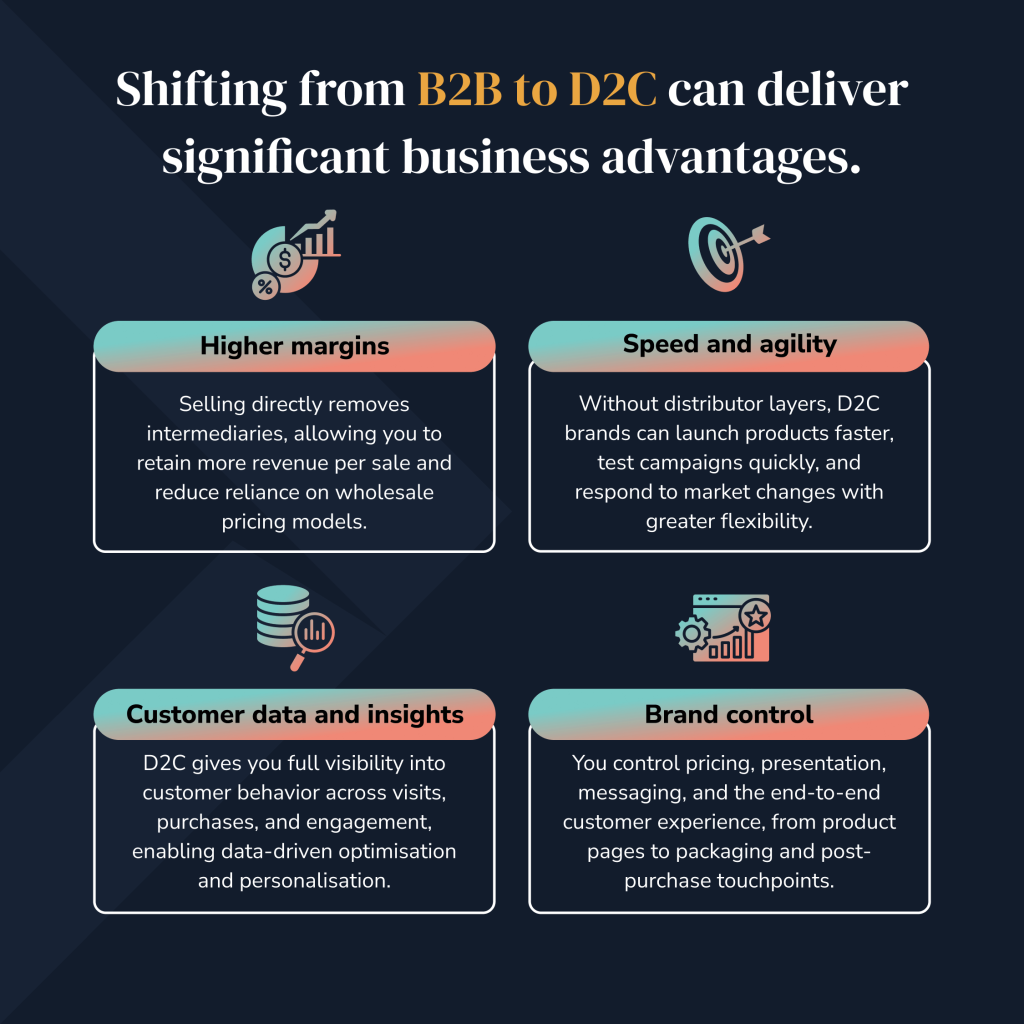
Business Benefits of Going D2C
A shift to D2C changes a business's economics and operating model, and those changes become apparent quickly once the channel is in place. Companies gain greater control over how they sell, communicate, and respond to demand.
The advantages are structural and practical, influencing everything from pricing to customer relationships.
D2C Website Redesign Priority Checklist
A D2C launch succeeds when foundational decisions are made early, and execution stays aligned. Before launch, teams should confirm that strategy, platform configuration, UX, content, SEO, and operational readiness are all in place and functioning as a unified system.
This checklist ensures the site is structurally sound, conversion‑ready, and prepared to support real customer traffic from day one.
- Market research and strategy. Define your target audience, value proposition, and site goals.
- Platform and tech setup. Select a scalable e-commerce platform and integrate inventory, payments, and CRM systems.
- Mobile-first design. Optimize for mobile performance, navigation, and load speed.
- User-friendly navigation. Simplify menus, search, and filtering with clear CTAs.
- Content and branding. Use high-quality imagery, concise descriptions, and consistent branding.
- E-Commerce features. Enable smooth checkout, transparent pricing, accounts, and recommendations.
- SEO and redirects. Optimize SEO elements, implement 301 redirects, and generate a new XML sitemap.
- Trust Signals. Display SSL, policies, contact details, reviews, and testimonials clearly.
- Analytics and tracking. Configure analytics, conversion tracking, and Search Console verification.
- Testing (QA). Validate full user flows, performance, and cross-device behavior.
- Customer support prep. Ensure support channels are ready for consumer traffic.
- Launch plan. Schedule launch carefully and monitor performance immediately after go-live.
- Post-launch optimization. Review behavior data, run A/B tests, and refine UX and conversion paths.
Ready to Transform? Let’s Talk D2C
Moving from B2B to D2C is a strategic shift, and your website plays a central role. DBS delivers website redesigns for businesses expanding into e-commerce, combining expertise in e-commerce development, UX/UI design, and SEO.
Get in touch with DBS to start your D2C transformation and build a site designed for direct growth.
Start your D2C redesign with a team that builds for growth.
Related Posts