AI Integrations with Websites: How to Plan for Successful Deployment
For website developers tasked with integrating AI features or technologies, here's how the gap between ambition and results can be minimized with readiness.
 10 Min Read

From the top floor to the factory floor, the pressure to deploy AI is real.
Across manufacturing, logistics, and other B2B industries, leadership teams are being asked the same question by the C-Suite: What is our AI strategy?
Marketing wants smarter customer experiences. Operations sees opportunities to increase efficiency. Sales wants better intelligence. Technology teams are evaluating platforms at a pace that would have seemed impossible only a few years ago.
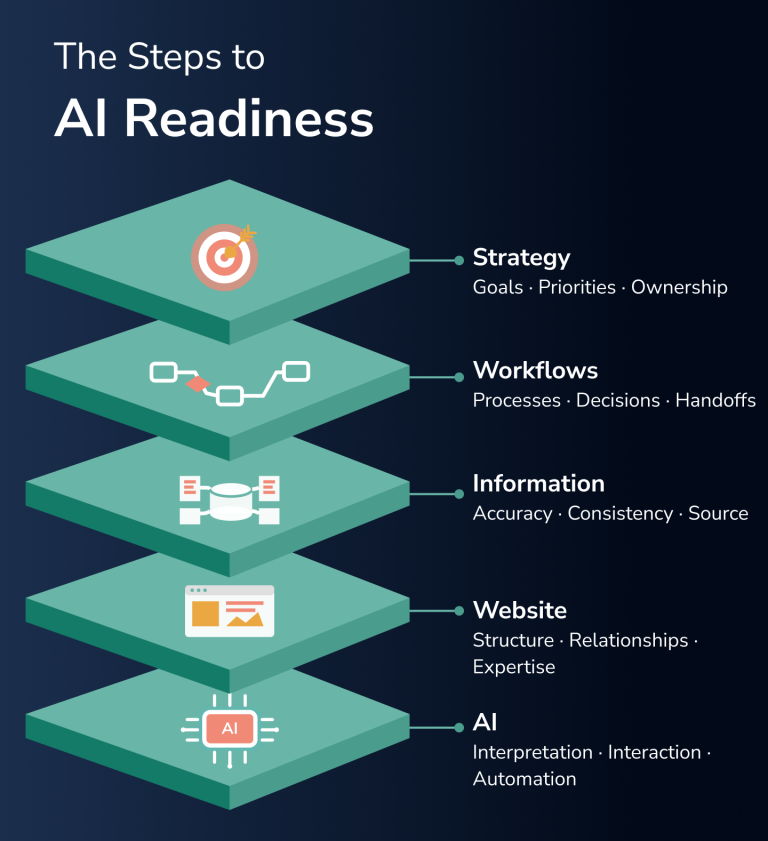
Still, AI readiness has not kept pace with that enthusiasm. While AI has accelerated the pace of innovation, many organizations are struggling to achieve successful outcomes with website AI integrations.
When AI-driven technology decisions are made before answering key business questions tied to those technologies, the results are predictable: Promising pilots fail to scale, initiatives remain disconnected, ROI is hard to prove, and AI ends up delivering far less value than expected.
Most organizations don't need another vendor demonstration. What they need is a better starting point.
Before evaluating another chatbot, AI search platform, intelligent assistant, or automation tool for the website, every organization should answer four questions:
- What business problem are we trying to solve?
- What would a successful outcome look like?
- Is the information AI will rely on accurate, complete, and trustworthy?
- Does our website clearly communicate who we are, what we do, and how our expertise is organized?
The questions are straightforward. Answering them requires organizations to evaluate their web strategy, processes, information, ownership, governance, and digital infrastructure together.
That is where AI readiness begins.
Start With the Business Problem
The first mistake many organizations make is assuming "AI is the strategy." It isn't.
AI is an enabler. The strategy should identify and define the business problem(s), the desired outcome(s), and why solving it with web-based AI technology is important.
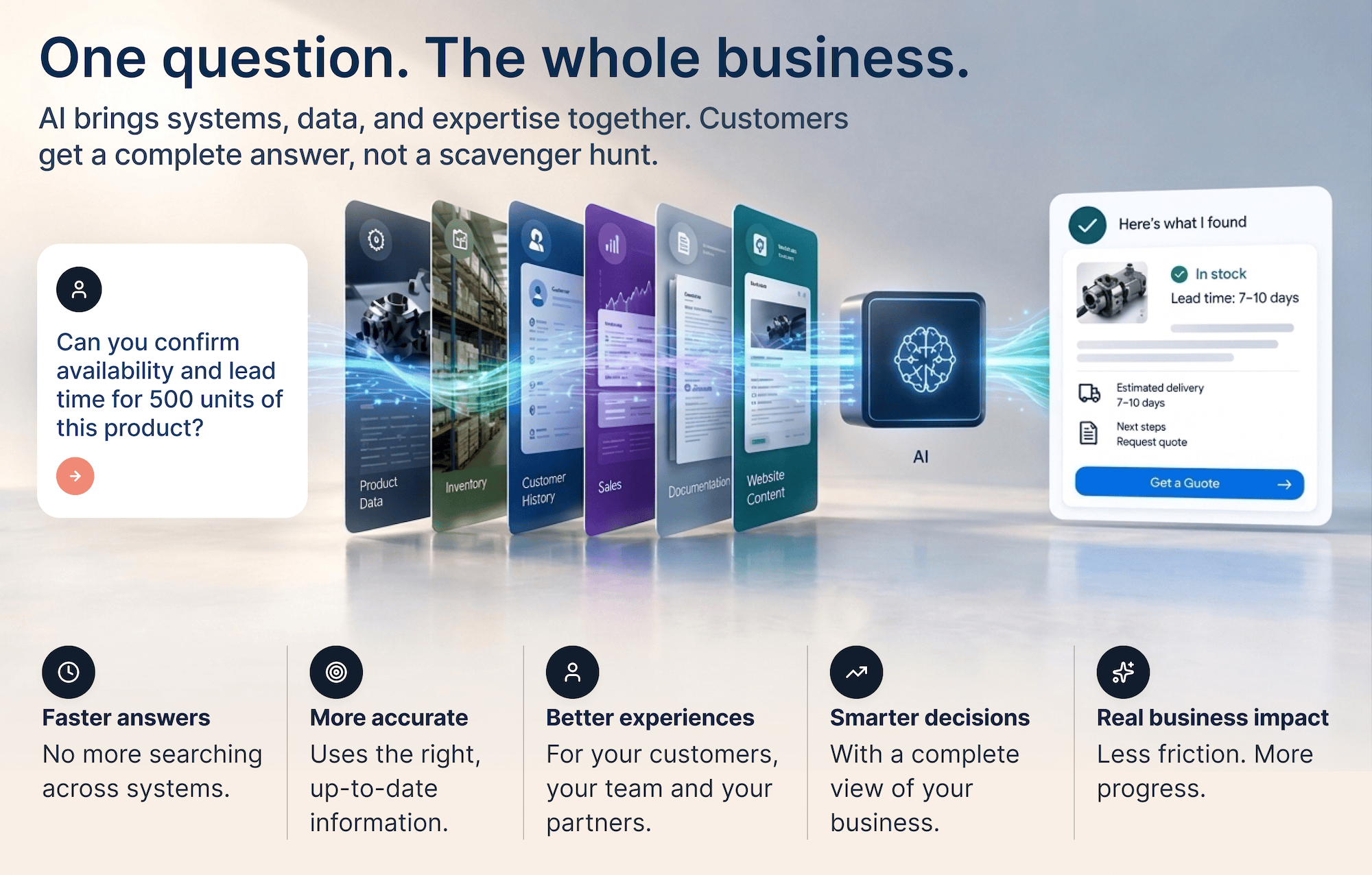
The goal isn't to deploy a chatbot because competitors have one, automate content because the technology exists, or add AI search because a vendor promises a better customer experience. The goal is to solve a business problem that matters.
That requires stepping back from the technology and asking a different set of questions.
- Where is the organization experiencing operational bottlenecks?
- Where is the website failing to nurture leads or support customers?
- Where are customers struggling to find resources or engage with the brand?
- Where are employees spending time on repetitive, low-value work?
- Where is knowledge difficult to access or inconsistent across systems?
The answers often reveal that the problem isn't a lack of AI.
What initially appears to be an AI opportunity may instead be a process, information, or organizational problem that needs to be addressed first. AI may ultimately become part of the solution, but its absence should not define the problem.
Planning Perspective
Organizations rarely gain a lasting advantage simply by being the first to implement AI. The advantage comes from understanding the problem more clearly than competitors, then determining where AI can meaningfully contribute to the solution.
Define Success Before Writing One Line of Code
Even when organizations identify the right problem, they may skip the next critical step: Agreeing on what success looks like.
Leadership may expect revenue growth. Marketing may expect better engagement. Customer service may focus on faster response times. IT may define success as a stable, secure implementation.
Each outcome matters, but an AI integration initiative cannot be evaluated against competing definitions of success without well-defined priorities.
When teams aren’t aligned, the project scope creeps, expectations drift, and departments begin diverging as they solve different problems without realizing it.
Questions to Answer Before AI Integration Development Begins
- What business outcome are we trying to improve with AI?
- How will the success of the integration be measured?
- Who owns the initiative?
- What would indicate that the investment is working?
- What would cause us to change direction?
Simple questions can (and often do) uncover complex disagreements. That isn't necessarily a warning sign. It means the organization is resolving strategic questions before technology locks in the wrong assumptions.
Can AI Trust Your Information?
This is where many AI initiatives begin to unravel.
AI can’t independently determine whether the information it receives is accurate. If that information is inconsistent, incomplete, outdated, duplicated, or contradictory, the system may reproduce those weaknesses in its outputs.
Organizations often assume their information is ready because employees have learned to work around its shortcomings. Sales knows which spreadsheet is current. Customer service understands which documentation is outdated. Marketing knows which product descriptions need to be corrected.
People compensate for fragmented information. AI systems cannot reliably make the same judgment without established rules, context, and governance.
That is why information readiness deserves the same attention as technology readiness.
Questions to Answer About Data That Supports AI Integrations
- Is our information accurate?
- Is it complete?
- Is it current?
- Does everyone work from the same source of truth?
- Is ownership clearly defined?
These questions often expose issues that have existed for years without demanding immediate attention. AI makes those weaknesses harder to ignore because the quality of its output depends heavily on the quality and organization of the information available to it.
What appears to be an AI challenge is often an information challenge that was already there.
Can Your Website Explain Your Business?
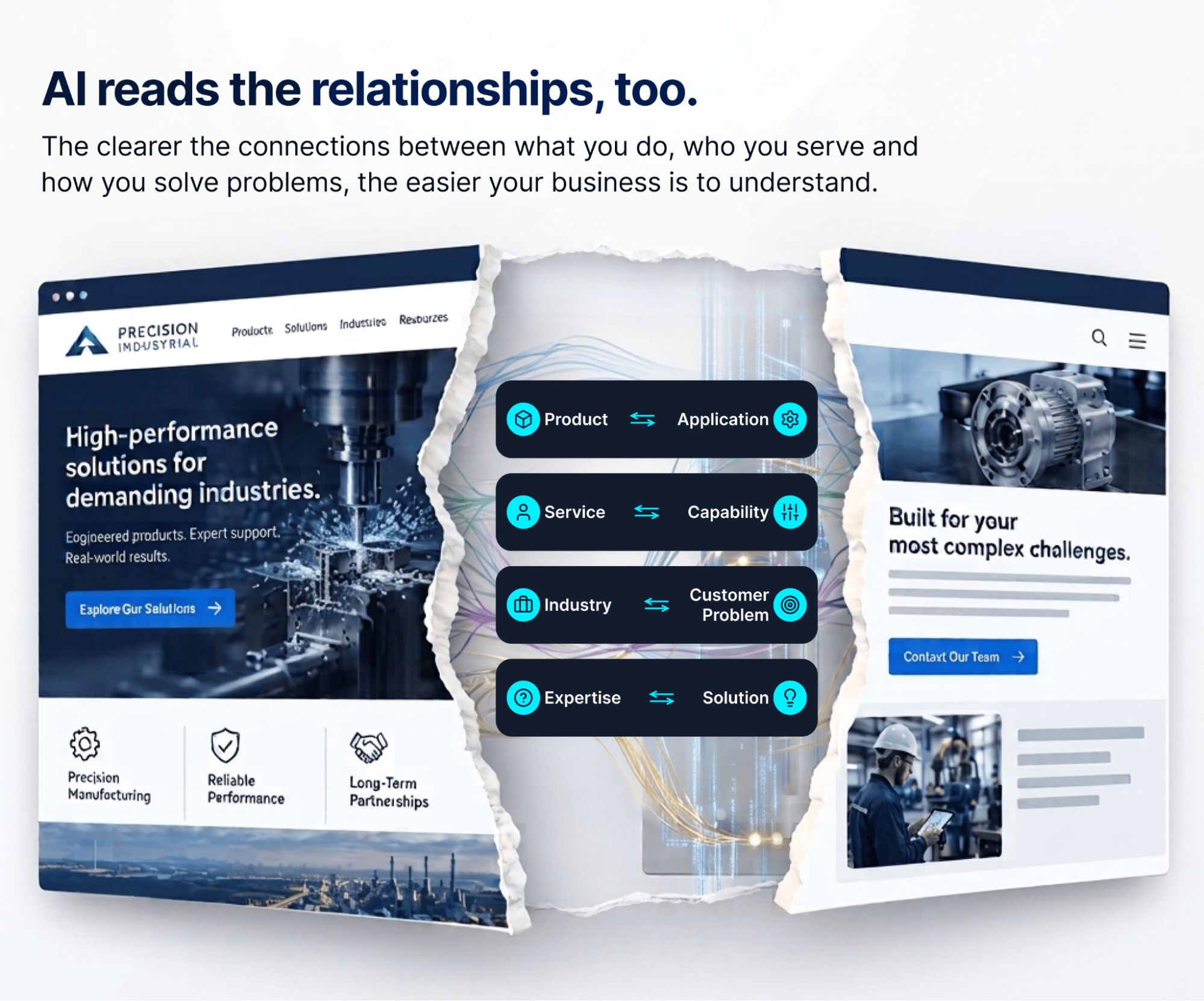
Most organizations think of their website as a marketing asset. Yet increasingly, the website serves another important role: it is one of the primary public-facing sources used by AI systems to understand the business.
That changes the website’s role.
AI systems don't interpret websites the way people do. Visual design and clever headlines may influence visitors, but AI relies more heavily on how products, services, industries, applications, expertise, and customer problems connect. Structured data that enhances consistency, context, and meaning helps AI and search engines understand those connections better.
The question is no longer whether customers can navigate it. It is also whether AI can interpret it.
Questions to Answer About AI-Friendly Website Content and Structure
- Does the site distinguish products or solutions from services and support?
- Does the site connect capabilities to customer challenges?
- Is the organization's subject-matter expertise clear?
- Does the content describe the same concepts consistently across the site?
- Does the site accurately position the organization within the right industries and markets?
These are not simply technical questions. They are fundamental questions related to the brand, the business, and their target audiences.
If AI cannot accurately interpret an organization's expertise and market position, it becomes harder for AI-powered search and other intelligent systems to surface that expertise to customers–whether that's on-site, or in AI platforms like ChatGPT, Gemini, or Copilot.
In other words, in the AI era the website is no longer just a destination. It has become an integral part of the organization's knowledge infrastructure.
Perspective
A website that reads clearly to customers won't automatically read clearly to AI. Page structure, consistency, and semantic relationships carry at least as much weight as on-page design.
→ Suggested next step
Explore an objective evaluation of how your digital foundation actually performs, the kind of assessment that surfaces a website's structural and content gaps that traditional design reviews often miss.
Why AI Readiness Is Really an Alignment Problem
By now a broader pattern should be evident: AI readiness does not belong to a single department. Marketing, IT, operations, sales, leadership, and legal and compliance teams each own part of the answer.
That shared responsibility is precisely what makes AI readiness difficult. The challenge isn't primarily technological. It’s aligning the people, priorities, and ownership that determine whether the technology can work.
Questions to Answer About the Website AI Integration Project
- Who owns the business objective?
- Who owns the information AI will depend on?
- Who maintains content quality?
- Who governs AI outputs?
- Who measures long-term success?
When those answers are unclear, AI doesn't eliminate the confusion.
It scales it.
The organizations making the greatest progress with AI are rarely the ones buying technology fastest. They are the ones aligning people, priorities, and ownership before implementation begins.
Build the Foundation Before You Scale
Imagine a manufacturer introducing AI to improve lead qualification.
On paper, the initiative appears straightforward: connect the website to the CRM, train the AI to identify high-value opportunities, and route qualified leads to sales.
Speed may win headlines.Discipline builds capability.
Then the planning gaps begin to emerge. Marketing and sales use different definitions of a qualified lead. Customer data exists in multiple systems. Product information varies between business units, while website content describes the same solutions differently from one page to another. Meanwhile, nobody owns the knowledge base the AI is expected to reference.
At that point, configuring the technology is no longer the hardest part. Preparing the business is.
The same pattern appears in AI customer support, intelligent search, content personalization, and workflow automation. Organizations often find that implementation is the shortest phase of the project, while preparation accounts for most of the work.
That isn't a reason to delay AI. It's a reason to approach it differently.
Organizations that get lasting value don't try to solve everything at once. They establish a reliable foundation, test it through focused initiatives, learn from those experiences, and then expand.
Speed may win headlines. Discipline builds capability.
The Real AI Challenge Isn't Technology
What starts as a conversation about AI quickly becomes something larger: a conversation about how well an organization understands itself.
4 Questions the Business Should Confront First
- Can it clearly define its business problems?
- Can it agree on what success looks like?
- Can it trust the information flowing through its systems?
- Can it communicate its expertise consistently to customers and intelligent technologies alike?
The more honestly organizations answer those questions, the more apparent the connections between them become. That's when a project that started as a technology initiative becomes an organizational imperative.
That realization can feel overwhelming, but it's for a good reason.
AI isn't simply another software deployment. It's an operational capability that exposes the strengths and weaknesses already present across the business. Every decision about data, content, governance, ownership, and digital strategy affects whether an AI integration can perform as intended.
Organizations that create lasting value from AI aren't simply implementing better tools. They're doing the harder work first by making the business easier to understand and operate, then generating data that AI can reliably use.
AI Doesn't Simplify Complexity. It Exposes It.
Planning website AI integrations isn't primarily about selecting the right platform. It's about determining whether the business can support what that platform is expected to do.
A conversation that begins with chatbots, intelligent search, or automation soon reaches strategy, data, content, workflows, governance, ownership, and organizational alignment. Every answer reveals another dependency, and each dependency affects the decisions that follow.
This is where the challenge comes into focus: Implementing AI may be the easier part. Preparing the business for AI is where most of the work begins.
That realization can feel daunting, but it also explains why so many organizations struggle to move beyond pilot projects. Ambiguous objectives, disconnected information, inconsistent content, and divided ownership can’t be fixed by deploying more technology.
AI doesn't solve those business gaps. It exposes them.
The lesson is that organizations gaining the most value from AI didn't necessarily achieve success by being the first to integrate it. They succeeded by understanding what AI requires from the business before deciding what the business requires from AI.
Unsure of Your AI Readiness?
If these questions make you wary of integrating AI with your company website, don't be concerned that your organization is falling behind.
Instead, take the opportunity to identify these issues before they become implementation problems. Before committing to another platform, integration, or AI initiative, evaluate the foundation that new technology will depend on.
A structured AI readiness assessment can identify what is ready, where gaps remain, and what needs attention before implementation begins. It brings strategy, data, content, technology, governance, and organizational alignment into a single prioritized plan to reduce risk and prepare for implementation.
The best AI decisions aren't made after choosing a platform. They're made long before that happens.
If this article raised more questions than it answered, that's actually a good thing. Before committing to another integration, we can start with a complimentary look at where your digital foundation stands today.
The AI Readiness Questions B2B Organizations Should Answer Before They Deploy
Before planning website AI integrations, organizations should define the business problem they are trying to solve, establish measurable success criteria, assess the quality and governance of their information, and evaluate whether their website accurately communicates their products, services, and expertise. AI is more likely to deliver value when it is built on a reliable business and digital foundation, not driven by technology selection alone.
Most website AI integration projects struggle because organizations select tools before establishing the conditions those tools need to work. Poor information quality, unclear objectives, fragmented content, and misaligned teams can prevent AI from delivering meaningful results. The platform may be functional, but the website foundation and tech stack beneath it is unstable.
AI systems rely on accessibility trees, content relationships, semantic structure, metadata, and contextual information to interpret what a business does and how its expertise is organized. Clear information architecture, consistent terminology, and structured content make it easier for AI-powered search, recommendation, and customer experience tools to return accurate and relevant information.
The first step is identifying the business problem AI should solve, rather than starting with platform selection. Organizations should then define the desired outcome, establish success metrics and KPIs, evaluate information quality, assess website readiness, and align stakeholders across marketing, operations, and technology. When that planning is skipped, unresolved business problems end up creeping into the implementation itself.
Related Posts