Industrial Website ROI: An Executive Guide to Evaluating Web Design Results
Learn how to determine an industrial website's value by attributing its design to qualified leads, pipeline performance, and revenue.
 7 Min Read

For industrial companies, digital investments must directly contribute to business growth and profitability. For industrial websites, that contribution translates into generating qualified leads, facilitating decision-making, competitively positioning the brand, and driving revenue.
The challenge for website stakeholders and decision makers often lies in identifying the right KPIs to assess performance and confirm that the site is delivering against business objectives.
This report outlines how industrial companies can take a more methodical approach to evaluating their website's ROI. It points to the metrics that matter most in manufacturing and B2B environments, highlights common performance gaps, and explains how underperforming sites can be improved to boost lead generation and long‑term business growth.
Why ROI Matters for Industrial Websites
For any industrial company, the website represents a significant investment. Without clear KPIs and target metrics, it can be difficult to justify that spend, or determine whether the website supports the company's marketing and long-term growth goals.
When digital efforts like the website are not tied to business outcomes, performance and success becomes difficult to evaluate.
Quantifying the success of these digital initiatives as ROI helps connect website investments directly to business objectives. Without this ROI tracking, it’s difficult to assess whether a website is contributing to growth or supporting core business priorities.
How the Website's ROI Unlocks Strategic Value
Before you can measure ROI, you have to understand what actually drives it. Modern manufacturing websites aren’t just digital brochures.
The infographic below highlights the core levers that determine whether a website becomes a growth engine or an underperforming cost center:
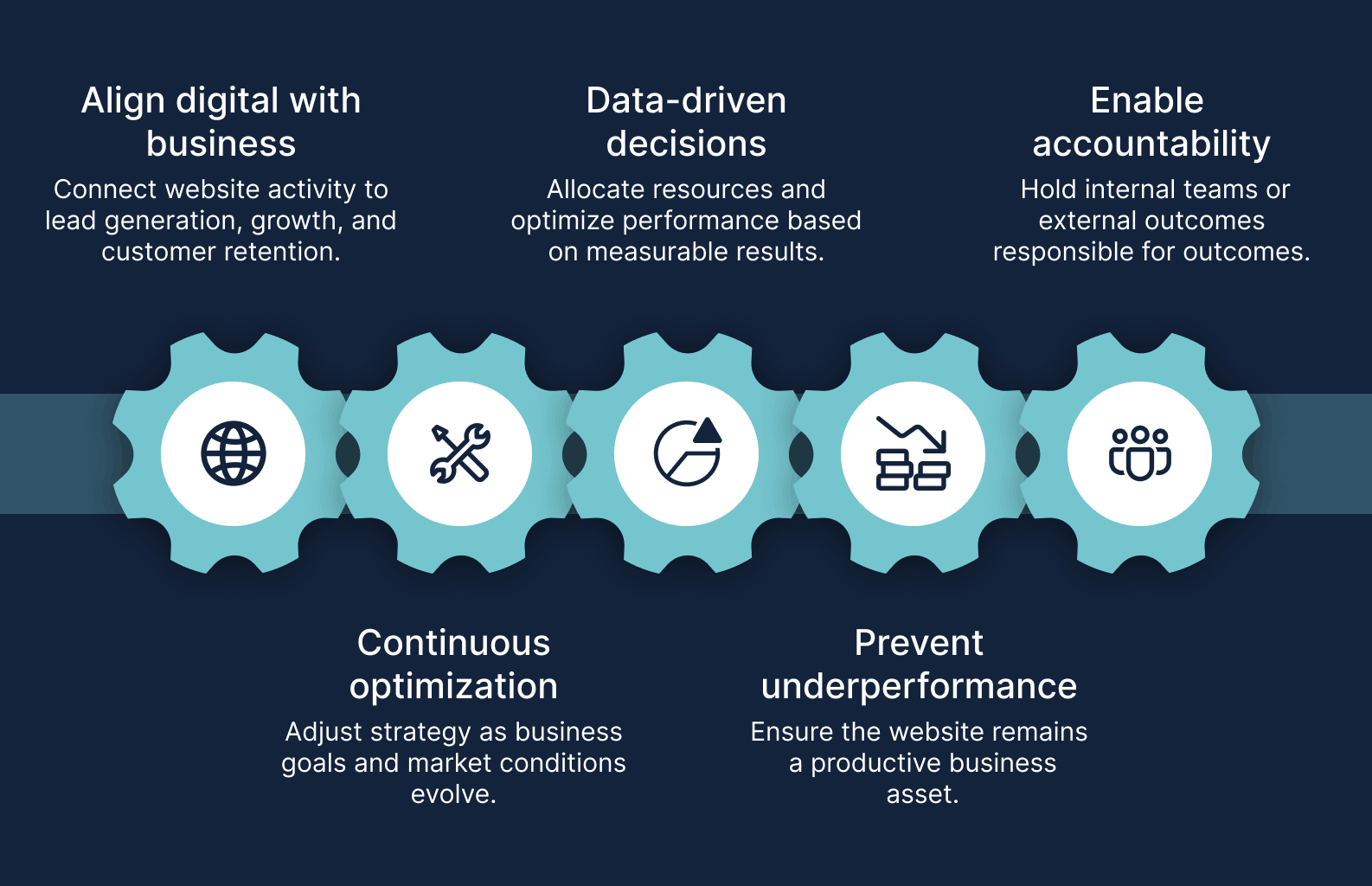
These principles lay the foundation for aligning digital investments, like the website, with real business outcomes, ensuring that every improvement delivers measurable value.
What "ROI" Means in Industrial Web Design
Industrial website ROI is often misunderstood to mean traffic volume, or oversimplified as merely its visual appeal.
In reality, a high-performing website 1) drives qualified leads, 2) supports pipeline movement, and 3) improves operational efficiency. Design and technology decisions should directly contribute to these outcomes.
To assess website value, it's essential to focus on factors that drive measurable business results.
Key Factors Driving Website ROI
- Marketing-Qualified Demand - Does it generate leads that meet technical and decision-making criteria, reducing wasted sales effort?
- Sales Enablement Impact - Does website content match signals for buyer readiness and help them progress faster through the sales funnel?
- Revenue Influence - Connect digital interactions to closed deals to show the impact on revenue.
- Operational Efficiency - Integrating with CRM, ERP, and marketing automation systems should simplify workflows and improve productivity by facilitating collaboration.
When aligned with these factors, a website becomes a functional growth asset.
How to Measure ROI of Industrial Web Design
Measuring ROI requires understanding how a website contributes to business outcomes. Instead of focusing on vanity metrics, teams need visibility into actions that generate leads, facilitate decisions, and impact revenue.
“Marketing earns its seat at the table when digital performance is tied directly to pipeline and revenue,” Steve Fowler, Director of Client Market at DBS Interactive.
The ROI Scorecard
A scorecard provides a clear snapshot of website performance by organizing metrics that link digital activity to business results. It allows executives and marketing teams to monitor trends, compare against targets, and act on performance gaps.
| Metric | Description | Why It Matters | Example KPI |
| Qualified Lead Volume | Leads meeting technical and decision-making criteria | Confirms lead quality over raw traffic | 120–150 qualified leads/month |
| Lead Conversion Rate | Percentage of qualified leads becoming opportunities | Measures effectiveness of content and CTAs | 22–25% conversion rate |
| Sales Cycle Velocity | Time from lead to closed deal | Shorter cycles indicate the faster decisions | 85 days vs. 90-day target |
| Pipeline Influence | Share of opportunities influenced by website activity | Shows impact on active sales efforts | 37% of total pipeline |
| Revenue Attribution | Revenue linked to website interactions | Connects digital touchpoints to revenue | $1.05M in closed deals |
| Engagement Quality | Time on task, repeat visits, depth of interaction | Indicates buyer interest and readiness | 4.7 minutes sessions, 1.9 return visits |
How to Read the Scorecard Each metric should be reviewed and measured against defined targets. Trends help identify whether the website is supporting business objectives or creating friction in the buying process. | |||
How to Identify Gaps and Problems
Interpreting ROI data is where most industrial teams struggle, not because the metrics are unclear, but because the underlying patterns are easy to misread. A scorecard only becomes valuable when you understand what the numbers are signaling about buyer behavior, sales friction, and operational alignment.
Before jumping to solutions, it’s essential to diagnose where the website is creating drag, where it’s accelerating decisions, and where hidden bottlenecks are eroding ROI. These scenarios illustrate the most common performance gaps manufacturers encounter and what they typically reveal.
- Strong Lead Volume, Weak Conversion - High lead volume with low conversion may indicate unclear messaging or ineffective calls to action.
- Strong Conversion, Long Sales Cycles - Long cycles suggest buyers lack the technical clarity or comparison tools needed to make decisions. Research shows B2B sales cycles average just over two months, with high-performing websites working to reduce this timeline.
- Low Pipeline Influence - Limited pipeline impact often signals misalignment between website content and the sales process.
- Unclear Revenue Attribution - Difficulty linking digital activity to revenue may point to gaps in CRM integration or attribution models.
- Low Engagement Quality - Low engagement typically reflects UX, navigation, or content depth issues that reduce buyer confidence.
Regular review of these metrics helps teams identify performance gaps and adjust strategy to improve ROI and align the website with business objectives.
What Makes a High-Performing Industrial Website
Understanding how to measure ROI is only the first step. To translate those metrics into business impact, you need to understand what drives performance on the site itself.
Many industrial companies assume a visually appealing website alone can deliver results. Design is important, but it’s only one part of the equation. A high-performing website addresses the factors that directly influence lead generation, sales efficiency, and business growth.
A website must deliver measurable outcomes. Below are the core that components consistently drive performance.
Clear Buyer-Focused Messaging: Messaging should speak directly to your target audience, facilitate complex technical evaluation, and enable informed decision-making. |

Optimized Lead Capture: Well-structured forms, clear CTAs, and relevant content capture qualified leads efficiently and connect digital activity to business outcomes. |

Sales Enablement Support: Content, comparison tools, and technical resources should help buyers move forward with confidence and reduce friction in the sales process. |

Operational Integration: Integration with CRM, ERP, and marketing automation systems reduces handoff issues and enables more efficient workflows and reporting. |

Performance and Usability: Fast load times, intuitive navigation, and responsive design support engagement and retention across long buying cycles. |

To act as a growth driver, a website must do more than look good. It must align with business objectives and deliver measurable results throughout the buyer journey.
How to Choose an Agency That Delivers Results
Building an effective industrial website requires coordination across strategy, content, design, development, SEO, and analytics. Managing this internally can be complex and resource-intensive.
While some organizations handle this in-house, many lack the capacity to align digital execution with business goals, accurately measure performance, and drive continuous improvement.
An experienced agency helps close those gaps by aligning website strategy with objectives, defining KPIs, and turning performance data into action.
When evaluating an industrial web design agency, prioritize outcomes. Look for clear KPI definition, revenue attribution, funnel optimization, and proven experience with SEO and system integration.
Alignment is also important. Industry understanding, collaboration, and long-term support are essential for sustained results.
Drive Growth with Industrial Website ROI
A high-performing website is a strategic asset that drives measurable business results. Focusing on the right KPIs allows you to track qualified leads, sales efficiency, and revenue contribution, giving you a clear view of performance.
“Marketing earns its seat at the table when digital performance is tied directly to pipeline and revenue,” Steve Fowler, Director of Client Market at DBS Interactive.
Driving ROI requires coordination across design, messaging, UX, development, SEO, and analytics. Many mid-market industrial companies lack the internal resources to integrate these areas effectively.
An ROI-focused agency brings these capabilities together to improve lead quality, accelerate buyer decisions, and drive sustainable growth. Agencies like DBS Interactive apply a performance-driven approach that links design and technology to tangible business outcomes.
With the right structure in place, teams can set clear expectations, hold partners accountable, and continuously improve website performance.
Not sure where your website is falling short? Request Free Audit
FAQs
ROI is measurable when tied to pipeline contribution, qualified leads, and revenue influence. Metrics like conversion rates, sales cycle velocity, and engagement provide clear insight into impact.
No. Performance depends on strategy, user experience, and technical integration. Visual appeal alone doesn’t drive results.
Agencies influence buyer readiness and sales velocity by aligning messaging, UX, and CTAs with buyer needs, enabling faster decisions.
No. SEO and design are closely linked. Site structure, speed, and content alignment all affect visibility and lead generation.
No. Leads should be evaluated against technical fit, budget, authority, need, and timing to prioritize prospects most likely to convert.
High-performing industrial websites evolve in the long term. Ongoing optimization and updates are needed to maintain performance across long sales cycles.
Related Posts