B2B Marketing Statistics & Emerging Trends for 2026
Here is what the data so far in 2026 is telling B2B marketing leaders about where to invest, what to fix, and what to prioritize for 2027 planning.
 14 Min Read

There is no shortage of B2B marketing statistics. Useful interpretation of the data is harder to find.
That's why here we connect the 2026 numbers to the decisions they should actually inform: where to invest in 2027, how to stay visible in search and AI, and how to structure content that earns attention on channels where key audiences spend their time.
Of course, the elephant in the room is AI. More than half of B2B software buyers now start their research with an AI chatbot more often than with Google (G2). That shift is changing how vendors work to show up in buyer shortlists.
Buying committees continue to grow. Marketing budgets remain nearly flat, while the expectations rise. AI has increased content production and changed how buyers explore and discover information. Traditional rankings and AI-generated answers draw from overlapping sources, but do not select them in the same way.
With 2026 in its second half and 2027 planning underway, this report connects recent data to the decisions facing B2B marketing leaders.
Four Takeaways at a Glance
The figures point to four conclusions for 2027 planning.
- Buyers form shortlists before sales conversations begin. In 6sense’s 2025 research, 94% of buying groups ranked preferred vendors before first contact. G2 found that AI chatbots were the most influential source for vendor shortlists. (6sense, G2).
- AI chatbots now influence vendor discovery and shortlisting. More than half of B2B software buyers start their research with an AI chatbot more often than with Google, and AI chatbots are the most influential reported source for vendor shortlists (G2).
- AI spending is rising faster than organizational readiness. CMOs allocate about 15% of their marketing budgets to AI, but only 30% report having processes mature enough to use it across the organization (Gartner).
- Content quality remains the leading reported driver of effectiveness. Among B2B marketers who consider their content effective, 65% credit its relevance and quality (Content Marketing Institute).
Where B2B Marketing Stands Heading Toward 2027
B2B buyers evaluate vendors earlier, buying groups extend beyond internal teams, and AI assistants have joined search engines as a research channel. 2027 plans need to account for these conditions.
Five Market Conditions for 2027 Planning
-
Buying committees continue to expand. Complex B2B purchases now involve an average of 13 internal stakeholders and nine external influencers, with larger groups involved in strategic purchases (Forrester. External Link. Opens in new window.).
-
Budgets have plateaued as demands increase. Marketing budgets average about 8% of company revenue in 2026, essentially unchanged from the previous year (Gartner).
-
AI has changed content production and discovery. Generative AI now sits inside the marketing workflow and the buyer's research process.
-
Search visibility now operates on two systems. Traditional organic rankings and AI-generated answers draw from some of the same sources, but their selections overlap only partly.
- Higher content volume has raised the value of relevance. Among marketers who consider their content effective, relevance and quality remain the most frequently reported reasons for that performance.
AI Search, GEO, and AEO
AI search now affects which vendors make it onto buyer shortlists. Generative engine optimization (GEO) and answer engine optimization (AEO) focus on how content is discovered, interpreted, and cited in AI-generated responses.
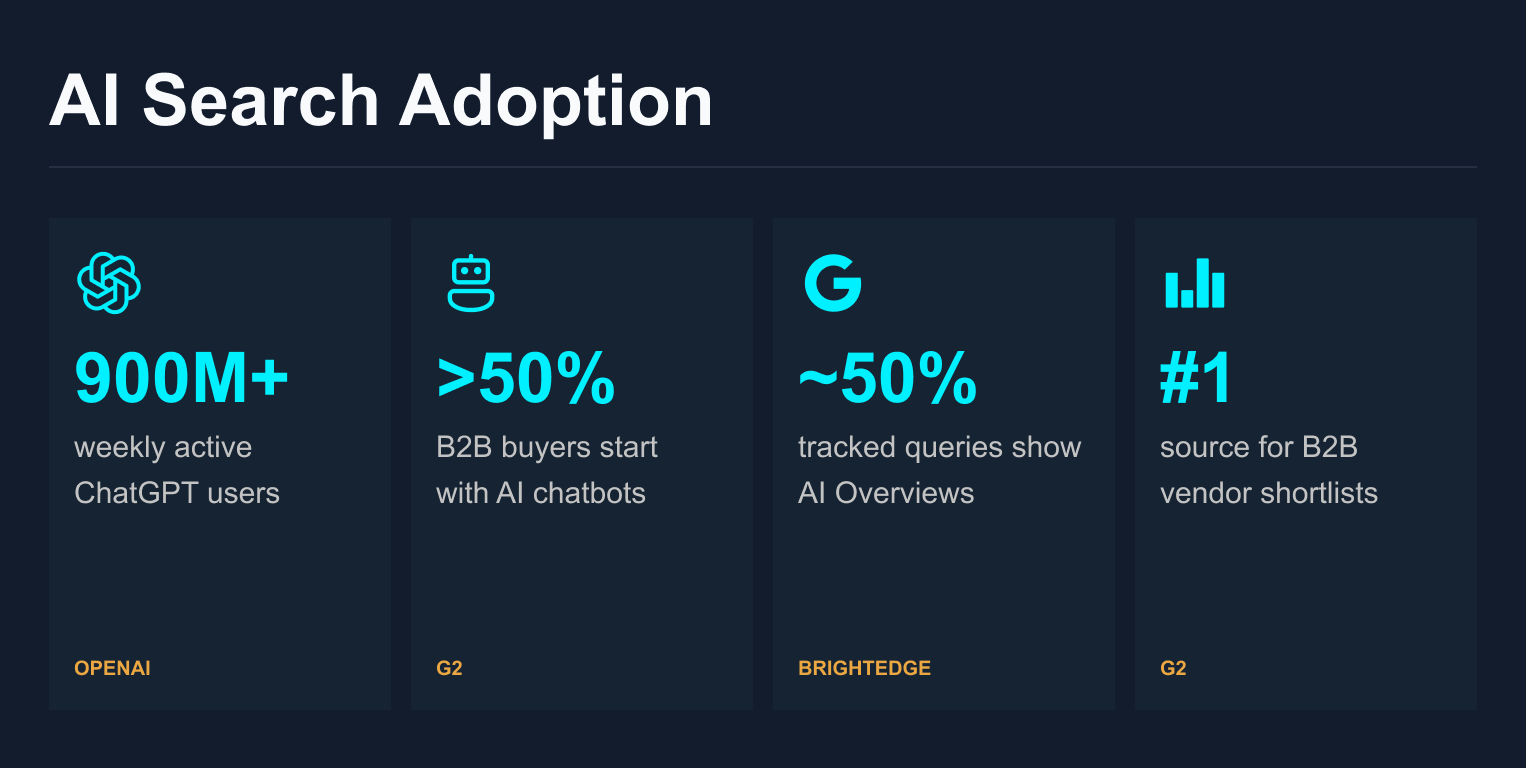
G2 found that more than half of B2B software buyers begin research with an AI chatbot and that chatbots now have the greatest influence on vendor shortlists. OpenAI reported more than 900 million weekly active ChatGPT users by February 2026, while BrightEdge found Google AI Overviews on nearly half of the queries in its tracked set.
The practical question is whether an organization's content can be retrieved, understood, and cited by these systems.
AI Search Adoption
- OpenAI reported more than 900 million weekly active ChatGPT users by February 2026 (OpenAI).
- More than half of B2B software buyers now start their research with an AI chatbot more often than with Google (G2).
- Google AI Overviews appeared on close to half of BrightEdge’s tracked queries in early 2026, representing a 58% year-over-year increase (BrightEdge).
- AI chatbots ranked as the most influential source for B2B vendor shortlists in G2’s 2026 buyer research (G2).
What AI Platforms Reward
- LinkedIn was the most-cited domain across AI platforms for professional queries in Profound’s analysis covering late 2025 and early 2026 (Profound).
- AI assistants may cite forums, review platforms, trade publications, and other independent sources when those sources provide evidence about a brand, product, or category (Semrush).
The practical shift is less about chasing a ranking position and more about qualifying for citation, says Steve Fowler, Director of Client Marketing at DBS Interactive.
“Ranking has always been a proxy for trust. AI systems just make that explicit: they only cite what they can verify, so unclear or unsupported claims get filtered out before a reader ever sees them," Fowler said.
How visible is your organization within AI search results? A short visibility assessment identifies where a brand appears across ChatGPT, Perplexity, and Google's AI Overviews and where additional work is needed.
B2B Buyer Behavior Statistics
The buyer journey no longer looks like a funnel. It looks more like a network.
More people are involved in each decision, buyers conduct more research before sellers hear from them, and a growing share of that research now happens through AI assistants.
Credibility through that process matters more than any single channel tactic.
-
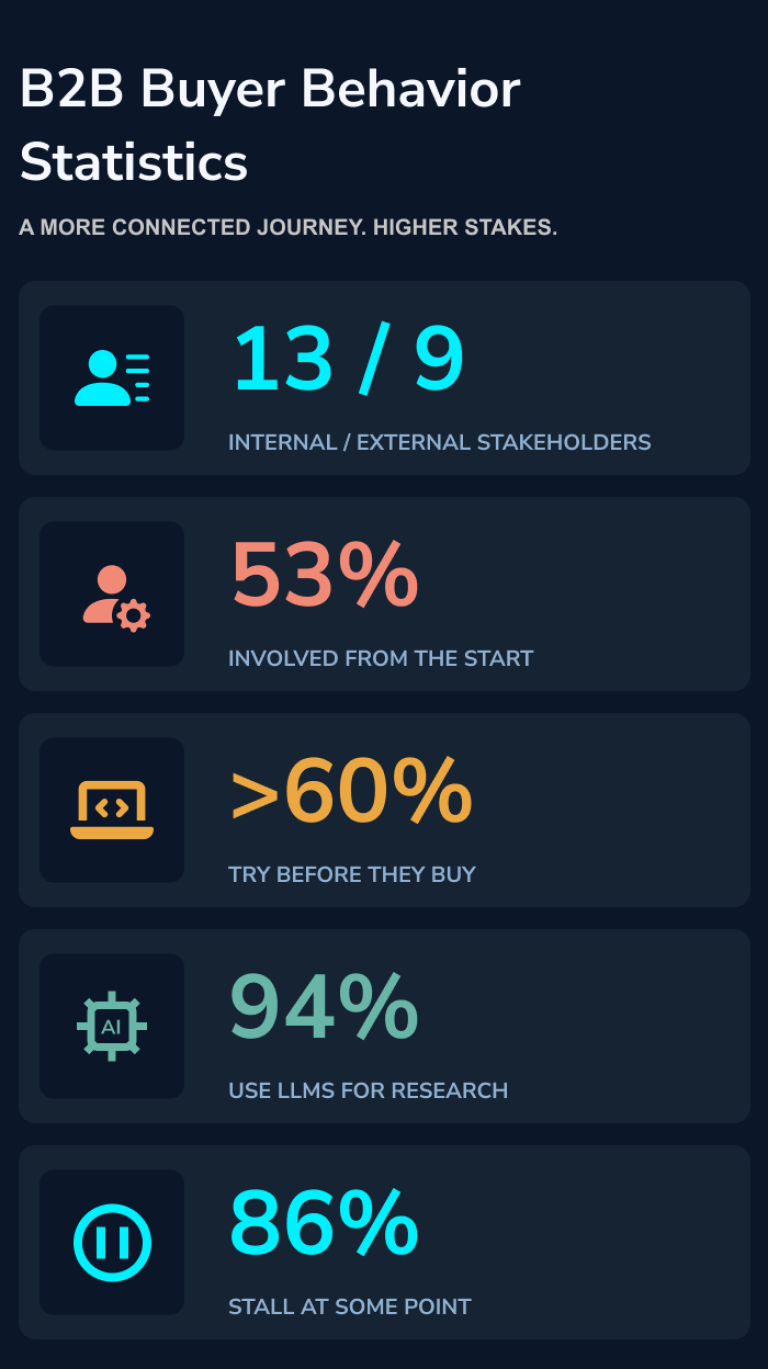
Buying committees for complex B2B purchases now average 13 internal stakeholders and 9 external influencers (Forrester, The State of Business Buying, 2026).
-
Procurement professionals now participate as decision-makers in 53% of business buying cycles and are involved from the start rather than brought in at the end (Forrester, 2026).
-
More than 60% of business buyers now use a trial, ranging from bespoke sandboxes to usage-based periods, to de-risk a purchase before committing (Forrester, 2026).
-
94% of B2B buyers reported using large language models to research their most recent purchase (6sense, 2025 Buyer Experience Report).
- 86% of B2B purchases stall at some point during the buying process (Forrester, 2024).
Observation: Buyers often form their shortlists before speaking with sales. Marketing influences which vendors make the list. Sales works from the options already under consideration.
AI in B2B Marketing Operations
AI use in B2B marketing is now widespread. Implementation maturity varies considerably, and adoption alone says little about how far an organization has progressed.
- 95% of B2B marketers say their organizations use AI-powered applications, while 68% describe implementation as exploratory or developing (Content Marketing Institute, 2026).
- CMOs allocate about 15% of their marketing budgets to AI initiatives, while organizations with mature AI readiness allocate about 21% (Gartner, 2026 CMO Spend Survey).
- 70% of CMOs name AI leadership as a critical 2026 goal, yet only 30% report mature or fully developed AI readiness (Gartner, 2026).
Fowler pointed to the readiness gap, not the adoption number, as the real story, noting “every marketing team has access to the same AI tools now, so that's not where the advantage comes from anymore. It comes from the judgment to know when the output is good enough to ship and when it isn't.
B2B Content Marketing Statistics
Content marketing has not lost relevance. It has lost its margin for generic execution. Generative AI has lowered production costs and made volume easier to achieve. Expertise, structure, and distribution now determine which content earns attention.
The 2026 data show strong interest in AI tools, while effective marketers continue to credit relevance and quality with their results.
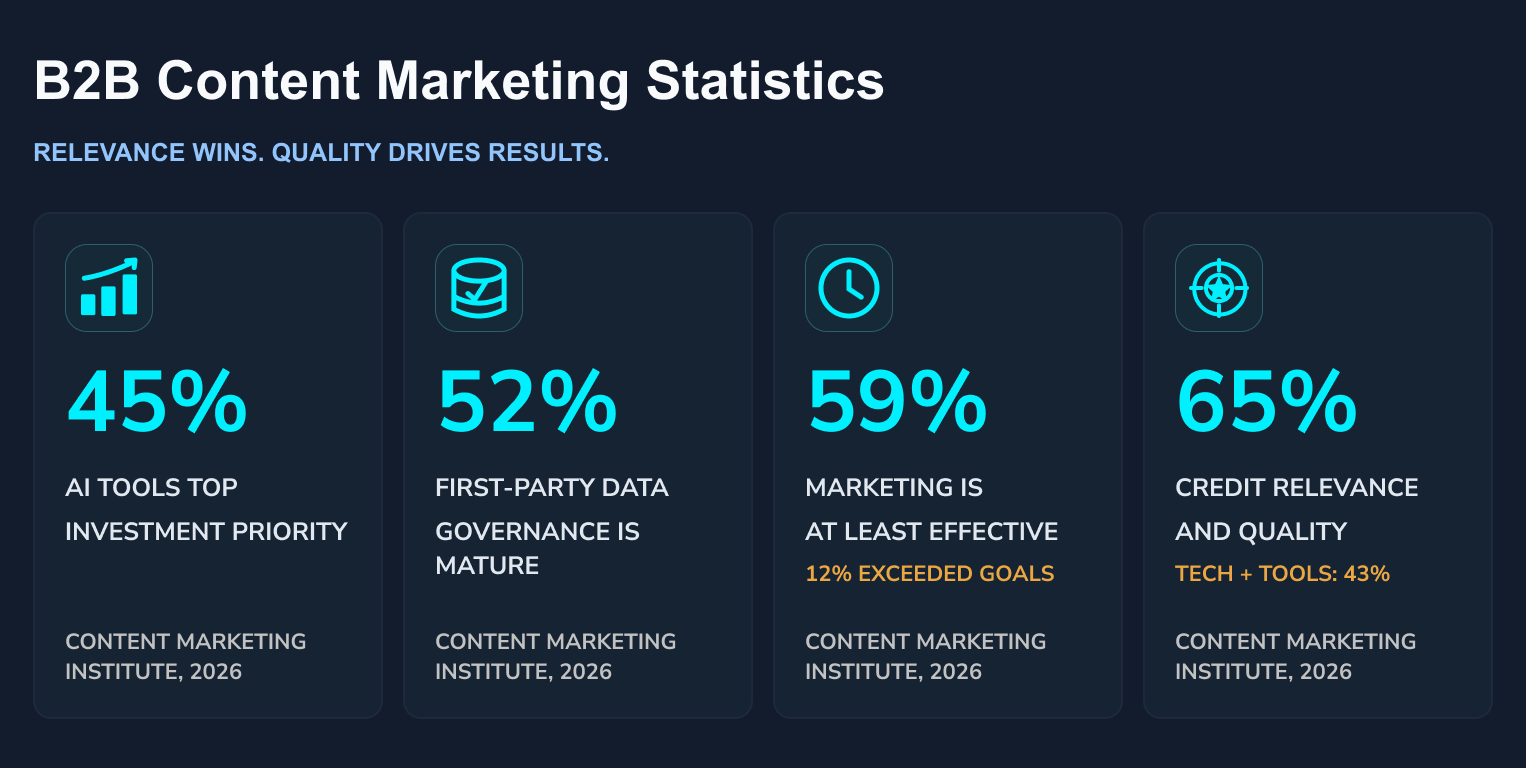
- AI-powered marketing tools lead 2026 investment priorities at 45%, followed by events and experiential marketing at 33% and owned media at 32% (Content Marketing Institute, B2B Content and Marketing Trends: Insights for 2026).
- 52% of B2B marketers describe their first-party data governance as established, advanced, or leading. Nearly half remain in the exploratory or developing stages (Content Marketing Institute, 2026).
- 59% of B2B marketers rate their marketing efforts as at least somewhat effective, and 12% say they exceeded their goals (Content Marketing Institute, 2026).
- Among marketers who consider their work effective, 65% cite content relevance and quality as a reason. Technology and tools rank lower at 43% (Content Marketing Institute, 2026).
Observation: AI-powered marketing tools lead 2026 investment priorities. Content quality and relevance remain the factors that effective marketers cite most. AI investment should be judged by its effect on those factors.
B2B SEO Statistics
Organic search remains an important long-term B2B channel, despite years of predictions to the contrary. Traditional rankings and AI citations overlap, but the same pages do not always appear in both.
- Organic search converted at about 5% across industries in Ruler Analytics’ 2026 benchmark. The rate for software was nearly 8% (Ruler Analytics, 2026).
- About 38% of Google AI Overview citations also ranked in the traditional top 10 for the same query, down from 76% in Ahrefs’ previous study (Ahrefs, 2026).
Observation: Existing SEO work still has value. However, the decline in citation overlap means a traditional ranking cannot be treated as a guarantee of AI Overview visibility.
Website and Digital Experience Statistics
Marketing channels bring visitors to the website. Site speed and usability affect what happens next. Current performance and accessibility data give marketing leaders concrete reasons to include the website in channel planning.
About 56% of origins in the July 2026 Chrome User Experience Report passed all three Core Web Vitals thresholds (Chrome UX Report release notes).
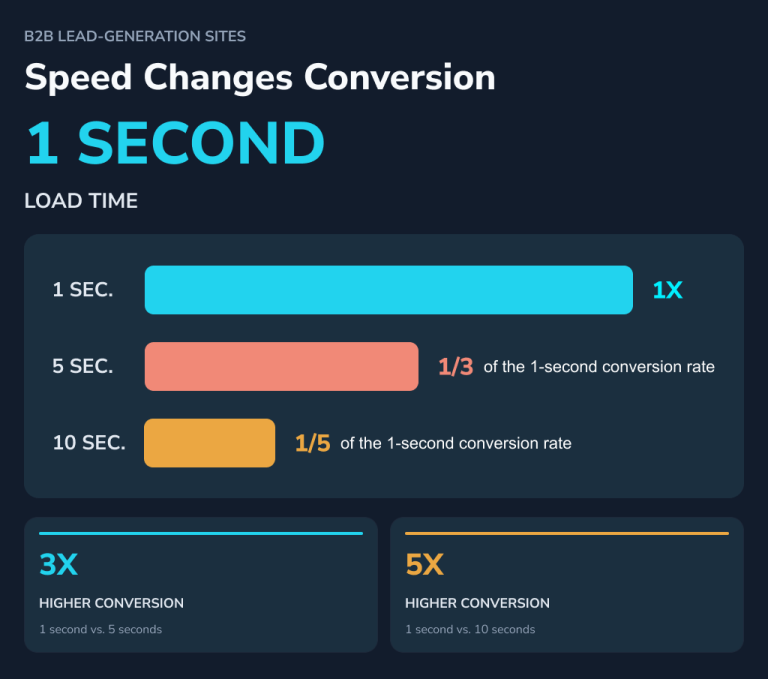
Portent’s study found that a B2B lead-generation site loading in one second converted at three times the rate of a five-second site and five times the rate of a ten-second site (Portent).
Federal website-accessibility lawsuits rose 27% in 2025, reaching 3,1117 filings (Seyfarth Shaw).
Observation: Page speed belongs in conversion planning, performance audits, and design reviews because it affects every channel that sends traffic to the website. Read more.
Owned Channels: Email and Social
Email and social media play different roles. Email gives marketers direct access to a subscribed audience. LinkedIn distributes thought leadership and helps buyers evaluate professionals and organizations.
- Email marketing delivers an average return of about $36 for every dollar spent (Litmus).
- 76% of B2B marketers identify LinkedIn as one of their most effective channels for publishing thought leadership (Content Marketing Institute).
- Metricool’s 2026 LinkedIn study found that personal profiles generated 63% higher engagement than company pages. Personal profiles received more comments, while company pages generated more shares (Metricool, 2026 LinkedIn Study).
Measurement and Attribution
B2B marketing reports can measure activity more easily than impact, which can complicate budget decisions. Attribution models built for trackable touchpoints do not account for every part of the buyer’s research.
- Clicks, sessions, and form fills show activity. They do not show whether a buying committee's view changed.
- Research through ChatGPT, Perplexity, and Google AI Overviews complicates attribution. Standard analytics can record a website visit after a buyer clicks a link, but they cannot capture research completed inside an AI conversation.
- Attribution also needs to account for research completed before a form fill. First-touch and last-touch models can miss sources consulted during the evaluation.
DBS Observation: An organization that cannot see how a deal was influenced may keep funding the channels it can measure and starve the ones doing the work.
B2B Marketing Budget Trends for 2027 Planning
Total marketing budgets barely changed in 2026, but how CMOs allocated them did. AI and labor took large shares, while martech fell to its lowest share in five years.
- Marketing budgets averaged about 8% of company revenue in both 2025 and 2026
(Gartner, 2026 CMO Spend Survey).
- CMOs allocate about 15% of marketing budgets to AI on average. Organizations reporting mature AI readiness allocate about 21% to AI and report overall marketing budgets equal to about 9% of revenue
(Gartner, 2026).
- Labor's share of marketing budgets rose from about 22% in 2025 to about 25% in 2026. Gartner connects the increase to the continued need for people, skills, and execution as AI adoption grows (Gartner, 2026).
- Martech accounted for about 19% of marketing budgets, its lowest share in five years, even as 62% of CMOs planned to invest more. Consumption-based pricing is becoming more common, although it can introduce cost volatility (Chief Marketer’s Report on the Gartner survey).
- 56% of CMOs say their marketing organizations lack the budget required to deliver their 2026 strategies (Gartner, 2026).
What the Budget Data Means for 2027
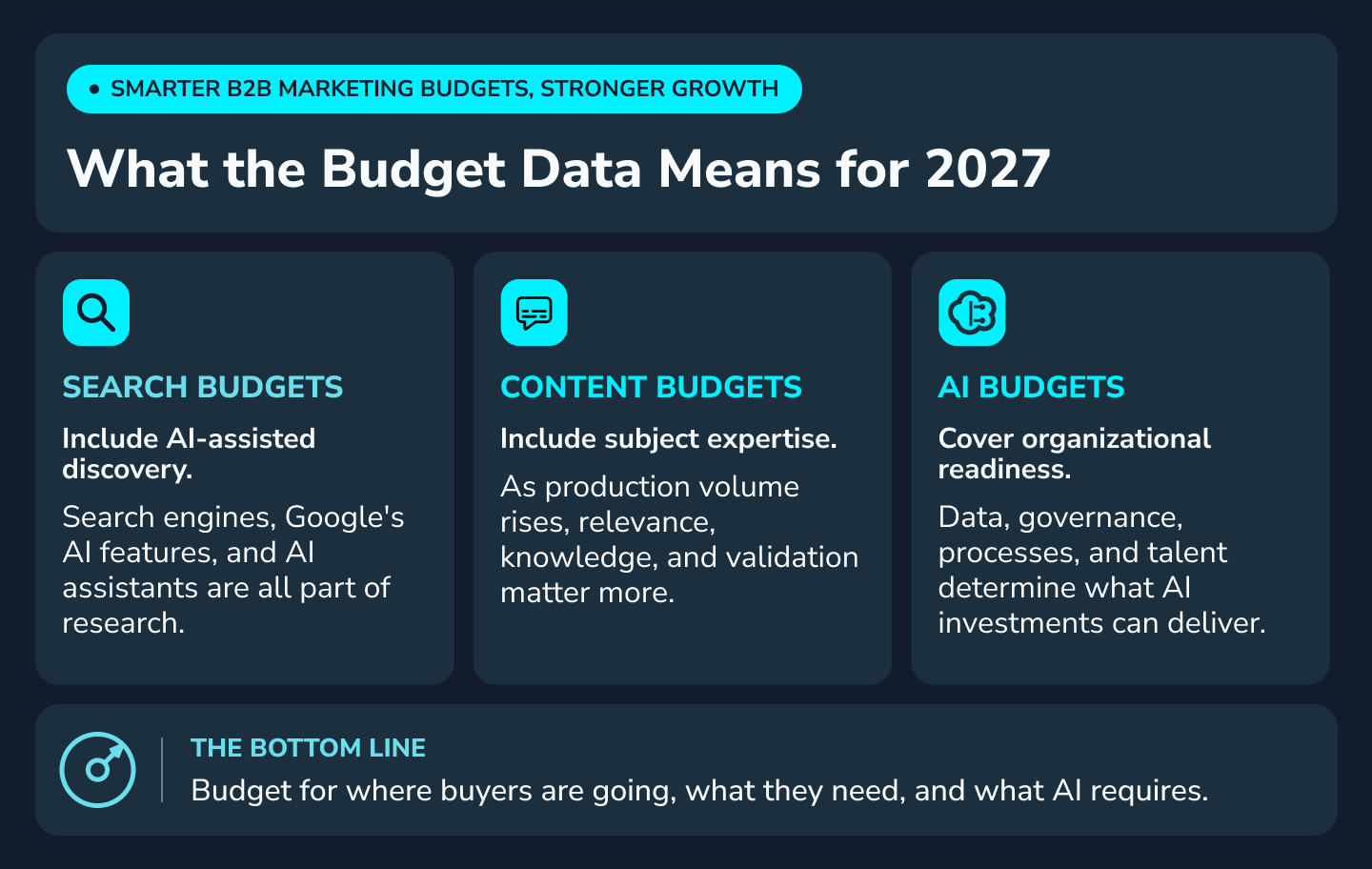
- Search budgets need to include AI-assisted discovery. Buyers use search engines, Google’s AI features, and standalone AI assistants during research.
- Content budgets need to include subject expertise. As production volume increases, relevance, subject knowledge, and external validation become more valuable.
- AI budgets need to cover organizational readiness. Data, governance, operating processes, and talent affect what an organization can achieve with the tools it buys.
Observation: AI-ready organizations allocate more to AI and report larger overall marketing budgets. Gartner's survey does not establish whether readiness attracted budget or budget funded readiness. Marketing leaders still have to divide limited funds between the tools and the work required to use them well. Read more.
What the Data Tells Us
Five patterns run through this report.
- Buyer behavior is changing faster than buyer needs. The tools buyers use to conduct research have changed dramatically. They still want to reduce risk and find a partner who understands their requirements.
- AI is changing both execution and discovery. Marketing teams use AI to produce work faster, while buyers use it to conduct research. Both changes affect the channel mix simultaneously.
- Expertise matters more as content volume increases. The barrier to producing content has fallen. The standard for producing content worth finding has risen.
- AI-generated answers are now part of search visibility. A page can rank well and remain absent from an AI-generated answer. AI citations can also come from pages outside the top traditional results.
- Channels influence one another. The budget, content, and search findings show why strategy, content, technical performance, and buyer experience need to be planned together.
Fowler said the five patterns point to one operating principle.
“Treating search, content, and the website as separate line items is how the budget gets misallocated. They're inputs to the same buying decision, so they need to be planned on the same timeline," Fowler said.
Where Most B2B Marketing Plans Break Down |
The 2026 data tells the same story across every channel. Connected systems outperform isolated investments. Before 2027 planning locks in, it is worth knowing where the gaps are.
|
| DBS Interactive works with B2B organizations to identify where visibility, content, and digital infrastructure are working against each other. If that conversation is useful, it starts here. Contact Us. |
B2B Marketing Questions for 2027 Planning
What percentage of B2B marketers use AI?
The Content Marketing Institute found that 95% of B2B marketers say their organizations use AI-powered applications. However, 68% still describe implementation as exploratory or developing (Content Marketing Institute, 2026).
Is SEO still effective for B2B companies?
Yes, although performance varies by industry. Ruler Analytics found that organic search converted at just under 5% across industries and about 8% for software and professional services (Ruler Analytics). Ahrefs found that about 38% of Google AI Overview citations also appeared in the traditional top 10 results for the same query (Ahrefs).
How are AI search tools changing B2B marketing?
More than half of B2B software buyers say they start their research with an AI chatbot more often than with Google (G2). Google's AI Overviews appear on close to half of BrightEdge’s tracked queries (BrightEdge). Visibility now depends on content that search and AI systems can retrieve, interpret, and cite, as well as references from independent sources.
What are the most effective B2B marketing channels in 2026?
Email delivers an average return of about $36 for every dollar spent (Litmus). LinkedIn is the most frequently cited effective channel for B2B thought leadership distribution (Content Marketing Institute). Organic search continues to generate conversions, although performance varies by industry. The appropriate mix depends on the buyer journey and business model.
What role does website performance play in lead generation?
B2B lead-generation sites loading in one second converted at three times the rate of those loading in five seconds (Portent). About 56% of origins passed all three Core Web Vitals thresholds in the July 2026 Chrome User Experience Report (Chrome UX Report).
What should B2B organizations prioritize in 2027?
The 2026 data points to three priorities: accounting for AI-assisted discovery in search planning, investing in documented expertise, and funding the data, governance, processes, and talent needed to use AI effectively.
Related Posts