
Speed Wins: Why Fast Websites Earn More Visibility in the Age of AI
Performance now determines how well AI can crawl, render, and understand your content, which shapes visibility and trust across every discovery channel.
 6 Min Read

There was a time when website performance lived mostly in the UX bucket. Faster pages meant lower bounce rates, higher conversions, and smoother user journeys. Important, yes. Strategic, to a point.
That role has changed.

Today, performance determines whether machines can work with your content at all. AI prefers fast websites because speed directly affects how content is crawled, rendered, indexed, embedded, and retrieved.
Modern discovery often begins before a human ever clicks a link. Crawlers, renderers, parsers, and language models continuously scan the web to organize information ahead of demand.
When a site is slow, friction appears across the entire discovery stack. Delays compound. Visibility drops.
Speed has become a critical factor in AI-driven discovery, beyond tactics and technical fixes.
Why Fast Websites Win in the Age of AI and Search
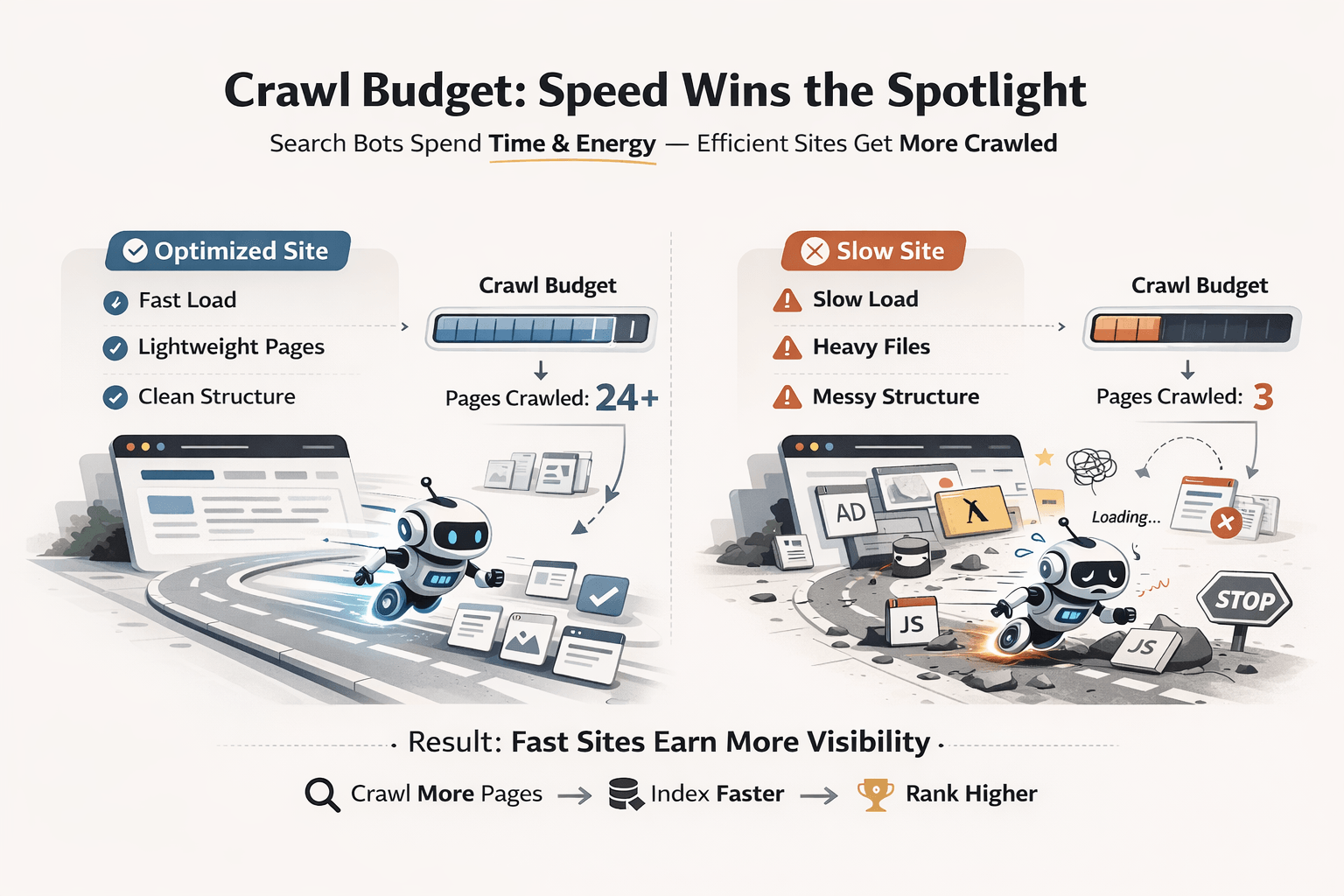
Speed shapes how efficiently value moves through your digital ecosystem. It determines how quickly machines process your content, how confidently platforms rely on it, and how often your brand surfaces when intent appears
Fast pages allow search engines to crawl more URLs within the same crawl budget, increasing content discovery without additional strain on indexing systems.
Reliable performance enables AI systems to render pages fully, extract context accurately, and generate high-quality embeddings.
As more content is indexed and understood, machines build a clearer picture of your site’s structure, topical depth, and authority. That foundation supports stronger performance across traditional search and AI-generated answers.
Speed compounds. Faster sites shorten the distance between intent and insight.
Why AI Prefers Fast Websites for Reliable Content Retrieval

AI systems interact with the web differently from humans. Tools like ChatGPT, Copilot, and search-integrated language models rely on content that has already been crawled, organized, and stored.
AI experiences your website through the quality and speed of the data it can gather.
Slow websites introduce failure points. Timeouts lead to incomplete crawls. JavaScript-heavy pages may render partially or not at all.
Indexing can be delayed or skipped. Embeddings may be created from truncated or missing content.
Fast websites remove these constraints. They allow machines to crawl more pages, process full context, and retrieve information reliably.
Speed becomes a strategic advantage because it directly improves how AI understands and references your brand.
How AI Systems Interact With Your Website for Maximum Efficiency
At scale, machines operate under strict constraints. Crawlers, renderers, and parsers work within these limits, resource budgets, and cost thresholds. Multiply those constraints across billions of URLs, and performance becomes a filtering mechanism.
This is why AI prefers fast websites.
Slow sites consume more crawl budget per page, miss rendering deadlines, delay indexing and embedding creation, and become expensive to process. Fast sites cost less to crawl, produce cleaner data, and are easier to retrieve repeatedly.
Over time, efficiency earns preference. Sites that are fast, stable, and predictable are indexed more completely and relied on more consistently across AI systems.
Speed as a Trust and Quality Signal for Machines

Performance functions as a trust signal for machines. Before content is indexed or retrieved, AI systems assess whether a site behaves in ways they can consistently rely on.
Machines look for technical maturity, accessible content, predictable behavior, a clear information architecture, consistent URLs and metadata, and optimized server response times.
Fast websites exhibit stable layouts, predictable load behavior, quick interaction readiness, and low rendering complexity. These characteristics reduce uncertainty during crawling and rendering.
From a machine’s perspective, a fast site is a trustworthy site. Over time, that confidence compounds into better visibility and more reliable retrieval.
The Business Value of Speed Beyond UX
Website speed delivers value well beyond user experience. It strengthens discoverability, drives engagement, and improves operational efficiency across the digital ecosystem.
Faster sites surface more consistently across traditional search and AI-powered answers because machines can process them efficiently at scale. Reduced latency lowers hesitation, enables smoother interactions, and improves conversion in high-stakes B2B journeys.
As AI systems play a larger role in how buyers discover and assess content, speed becomes a competitive advantage across visibility, trust, and business impact.
Sustainable Performance Leads to a Lower Carbon Footprint

Every crawl, render, and AI query consumes energy. At scale, that adds up quickly.
Slower websites demand more CPU cycles, increased data transfer, and repeated requests to achieve the same outcome. Faster websites do more with less, reducing waste across infrastructure and compute layers.
That efficiency lowers energy consumption per visit, reduces the carbon footprint of each request, and enables more sustainable digital infrastructure overall.
This becomes more critical as AI usage accelerates. AI queries typically consume more energy than traditional searches, and AI workloads already account for a growing share of data-center electricity use, with projections continuing to rise. Optimizing performance is therefore both sound engineering and responsible system design.
Speed aligns naturally with ESG and corporate sustainability goals. Fewer wasted cycles. Less unnecessary computation. Cleaner systems.
Measuring What Matters: Evaluating Your Site’s Performance
Intuition isn’t enough anymore.
Performance issues often hide in plain sight, which is why structured evaluation frameworks like Lighthouse and Core Web Vitals have become strategic tools. Examining your site in detail reveals inefficiencies that affect users. machines, and sustainability outcomes.
Insights Revealed by Performance Evaluation
| Essential Metrics to Evaluate
|
Tracking these signals creates a clear picture of how your site behaves in real conditions and connects technical performance directly to business impact.
These metrics form the bridge between diagnosis and meaningful optimization, grounding performance decisions in evidence.
How Organizations Improve Speed Without Compromising Strategy
High-performing websites prioritize intent over tactics.
Sustainable performance gains come from clear goals and deliberate design choices, treating speed as a product requirement instead of a post-launch fix. A structured approach helps teams to turn performance into a lasting advantage.
Focus Areas for High-Performing Websites
Eliminating unnecessary weight. Remove unused code and oversized assets to reduce load times | Optimizing delivery paths. Streamline how content and resources are loaded and cached |
Designing performance-first architectures. Build with speed, scalability, and reliability in mind | Treating speed as a product requirement. Make performance a constraint in every feature and design decision |
The specifics may vary, but the mindset is consistent. Performance is designed in from the start, producing faster, more reliable, and future-ready websites.
Speed Wins Because Efficiency Wins

Performance is no longer just a technical concern. It’s a strategic one.
AI prefers fast websites because efficient systems are easier to crawl, index, understand, and trust. Speed improves visibility, strengthens retrieval reliability, and enables more sustainable digital operations. When a site loads quickly and behaves predictably, machines can process it with confidence and surface its content more consistently.
As AI becomes a primary audience for digital content, speed functions as the entry requirement. Humans may be the end users, but machines are the first readers.
Evaluating your site through Lighthouse audits, Core Web Vitals, and related diagnostics is the starting point.
Or skip the guesswork with our free performance audit, which compares your site against three competitors and highlights the highest-impact opportunities.
FAQs
AI prefers fast websites because they are easier to crawl, render, index, and retrieve, reducing friction across AI discovery pipelines.
Yes. Faster sites improve crawl efficiency, indexing completeness, and the reliability of AI systems referencing your content.
No. High-quality content is essential, but it can’t perform if machines struggle to access it efficiently.
Faster websites use fewer CPU cycles and less data transfer, lowering energy usage and carbon impact per visit.
No. Speed affects both humans and machines, shaping engagement, retrieval, and visibility.
Tools like Lighthouse and Core Web Vitals provide structured insight into performance, accessibility, and optimization opportunities.
Yes. Speed improvements compound across SEO, AI visibility, user experience, and sustainability, delivering measurable impact across the digital ecosystem.
Related Posts