Why Inbound B2B Marketing Drives Better Leads Than SEM & PPC
Inbound marketing offers many advantages to generating B2B leads when compared with paid SEM or PPC strategies.
 23 Min Read

The Core Challenge Facing B2B Growth Teams Today
Every role in a B2B growth team faces the same core challenge. The CMO, marketing manager, analyst, sales lead, business owner, and product manager all need a steady flow of qualified leads. Yet generating consistent B2B leads is harder than ever.
Many teams rely heavily on search engine marketing and pay-per-click campaigns for quick wins. This approach often disappoints in the long run.
High Costs, Short-Lived Returns
Paid ads can quickly become a money pit. The average cost per lead across industries is around $198. In many B2B sectors, it’s even higher.
Teams often invest thousands in Google Ads or LinkedIn campaigns to meet monthly targets. When spending stops, so do the leads. There’s little lasting value, and visibility disappears once the budget is cut. The result is high spend with limited long-term return.
Unclear ROI and Quality Concerns
Even when PPC generates leads, quality is often inconsistent. Traditional outbound tactics typically produce close rates of about 1.7%. Out of 100 leads, one or two may convert into customers. This makes ad spend difficult to justify.
Sales teams chase contacts that rarely become closed deals, while analysts struggle to determine whether the clicks being paid for are translating into real business value.
Inconsistent and Unsustainable
Lead volume fluctuates when results depend on variable ad spend.
Trust is also an issue. Buyers often recognize paid promotions and tend to skip sponsored listings altogether. In complex B2B purchases, where education and credibility are important, this limits the effectiveness of paid campaigns.
B2B decision-makers are left asking whether there’s a more sustainable approach. Companies selling to other businesses need a strategy that supports long-term sales growth, instead of temporary spikes. That requires addressing high costs, uneven lead quality, and short-lived results associated with PPC-driven tactics.
The Inbound Solution
Inbound marketing provides an alternative to wasteful spending. Inbound focuses on earning attention, rather than interrupting it. Instead of pursuing prospects through ads, companies create inbound content and experiences that attract buyers organically.
The result? Prospects find the brand when they are actively researching a problem it's positioned to solve.
Inbound is a Long-Term Growth Engine
Inbound marketing does not aim for immediate surges in lead volume. It’s a long-term, content-driven B2B growth strategy where assets compound in value and ROI.
Consider the fact that a well-researched article, guide, or case study can attract qualified B2B leads months, or even years, after publication.
While inbound requires more patience, it enables sustainable growth and improves return on investment.
Unlike PPC results that end when spending stops, inbound builds an owned lead engine that strengthens with continued use.
How Inbound Marketing Addresses Core Challenges
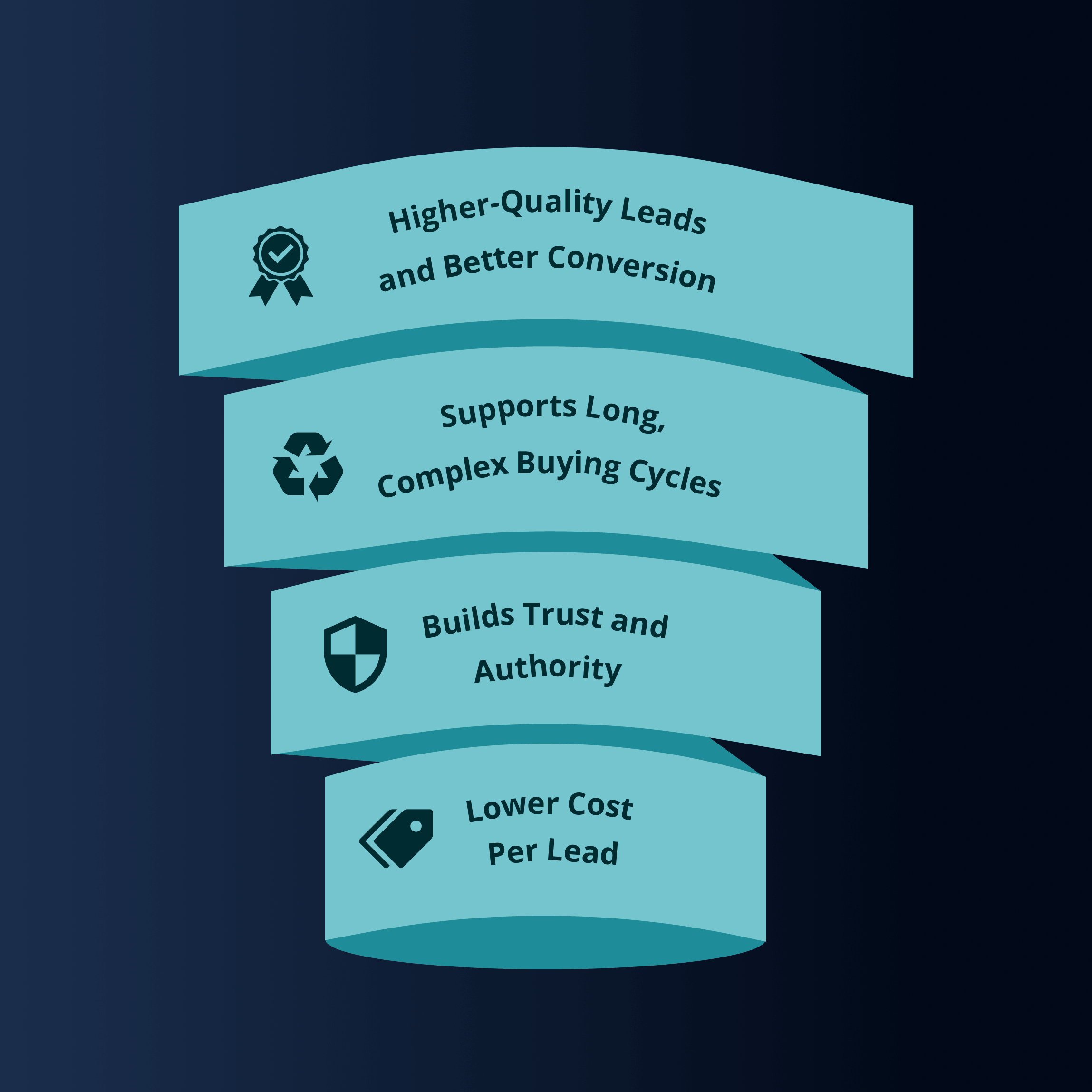
Lower Cost Per Lead
Inbound tactics like content marketing and SEO become more cost-efficient over time. Content marketing costs about 62% less than traditional outbound marketing, on average.
Once published, strong content can generate leads without ongoing media spend, unlike PPC campaigns where each click incurs a cost.
Higher-Quality Leads and Better Conversion
Inbound attracts more qualified prospects actively seeking information and solutions. Because they engage through relevant content, they align more closely with ideal customer profiles, and they convert at higher rates.
This shift focuses B2B lead generation efforts on best fit rather than highest volume, leading to more productive sales conversations and shorter sales cycles.
Builds Trust and Authority
Inbound marketing positions a company as a reliable source of expertise. Consistent educational content builds credibility over the long term.
As trust grows, the brand becomes a reference point during the buying process, something paid ads cannot replicate.
Supports Long, Complex Buying Cycles
B2B purchases often involve multiple stakeholders and extended research phases. Inbound content helps buyers at each stage, from early education to final evaluation.
Email nurturing, case studies, and targeted follow-up maintain engagement throughout the decision process, providing continuity that short-term ads cannot.
Contact us for a strategy to build a long-term lead engine.
Key Steps to Implementing Inbound Strategies
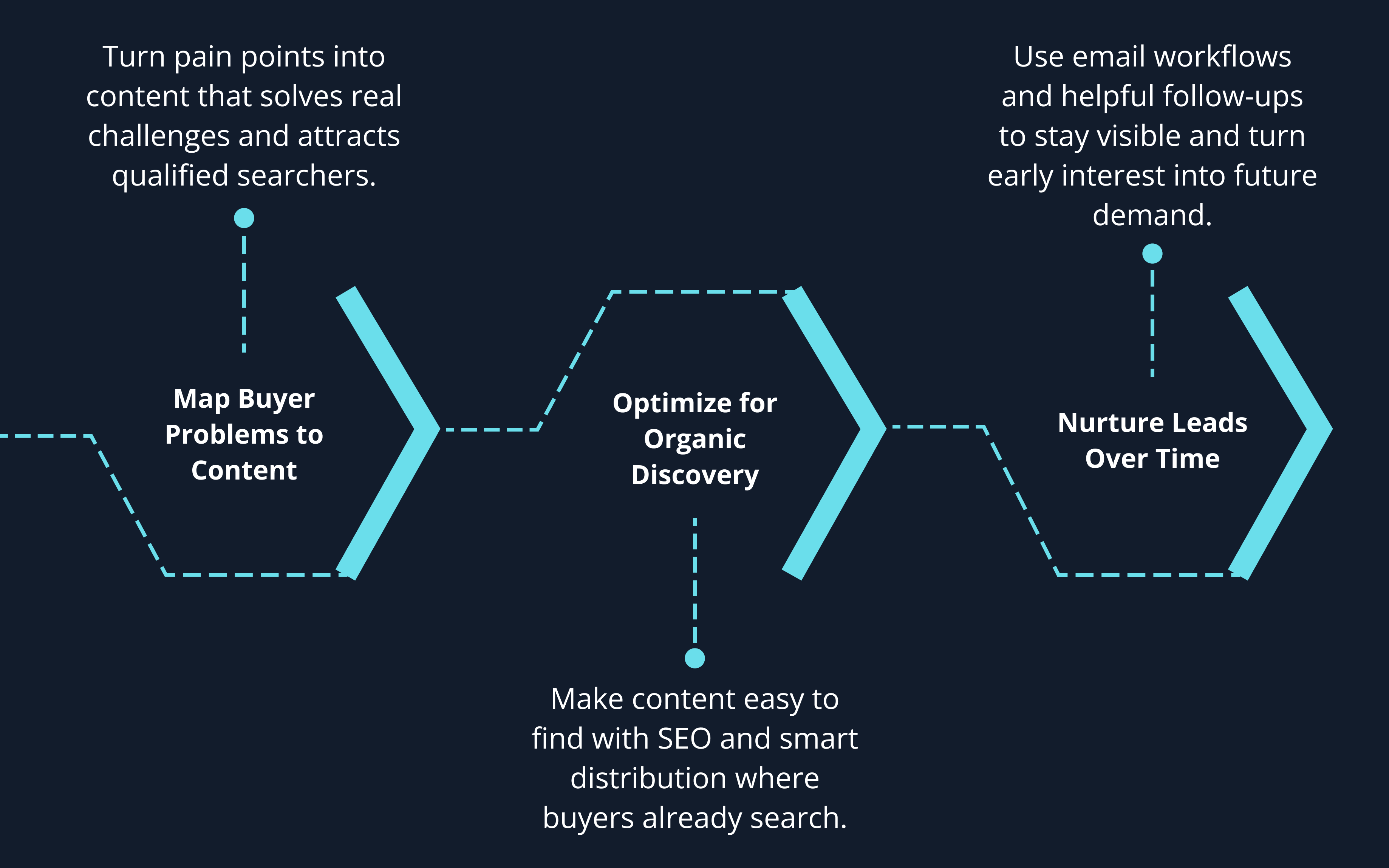
1. Map Buyer Problems to Content
Start by understanding buyer pain points. Each problem creates an opportunity for targeted content. When content addresses real challenges, it attracts prospects through search and sharing.
2. Optimize for Organic Discovery
Content must be easy to find. This requires SEO, GEO, and thoughtful distribution across relevant marketing channels, so that B2B buyers encounter your brand where they already search.
3. Nurture Leads Over Time
Not every lead is ready for sales engagement. Inbound helps nurture prospects along the funnel through email workflows and relevant follow-up content.
Note this is where paid campaigns can actually support inbound. For example, retargeting prospects with helpful resources maintains visibility and increases the likelihood that early interest becomes a future purchase.
This content-driven approach reduces cost per lead, improves lead quality, and supports the extended decision cycles common in B2B buying.
It positions the company as a guide throughout the buyer journey, offering value at each step rather than relying on interruption-based tactics.
Mapping Content to Buyer Intent and Funnel
Inbound marketing works well because it delivers the right content at the right time. B2B buyers move through stages, from recognizing a problem to researching solutions, and ultimately evaluating vendors to making a decision.
Each stage carries a different intent and requires different information. Mapping content to these funnel stages is critical. Here’s how it breaks down.
Awareness (Top of Funnel)
At this early stage, potential buyers are learning about their problem or opportunity. They may not yet know what type of solution they need.
- Content to use: educational blog posts, how-to articles, research reports, infographics, and short informative videos.
- Buyer intent: to understand challenges and explore possible approaches.
- Purpose: educate and build awareness. Content should attract attention through useful insight, instead of sales messaging.
Consideration (Middle of Funnel)
At this point, the buyer has clearly defined the problem and is evaluating possible solutions.
- Content to use: webinars, whitepapers, detailed e-books, case studies, and product comparison guides.
- Buyer intent: to compare solutions or vendors and narrow choices.
- Purpose: differentiate your solution and nurture interest. Show how your approach or product addresses the problem more effectively than alternatives.
Decision (Bottom of Funnel)
At this stage, the buyer is ready to select a solution or vendor and needs final confirmation.
- Content to use: ROI calculators, product demos or free trials, customer testimonials, results-focused case studies, and FAQs.
- Buyer intent: to validate the decision and confirm they’re choosing correctly.
- Purpose: build trust, remove friction, and drive conversion. Content becomes more product-specific and proof-oriented. For example, a business owner may use an ROI calculator to estimate savings or read a testimonial from a similar company before signing a contract.
Post-Purchase (Retention and Loyalty)
The journey continues after the sale, especially in B2B, where long-term relationships drive value.
- Content to use: onboarding guides, user training videos, customer success stories, newsletters with industry insight, and community forums or events.
- Buyer intent: to maximize value and identity opportunities to expand usage.
Purpose: retain customers and encourage loyalty and advocacy. Ongoing value strengthens relationships and supports repeat business and referrals.
| Stage | Content Types | Buyer Intent | Purpose |
| Awareness (TOFU) | Blogs, reports, videos, infographics | Understand problems | Educate, raise awareness |
| Consideration (MOFU) | Webinars, whitepapers, case studies | Evaluate options | Differentiate, nurture preferences |
| Decision (BOFU) | ROI calculators, demos, testimonials | Validate choices | Build trust, ease conversion |
| Post-Purchase | Newsletters, success stories | Maximize value, loyalty | Retain, upsell, advocate |
Why PPC and SEM Cannot Fully Meet These Needs
Paid search and PPC have a role, but they struggle to fulfill the full range of buyer needs outlined above.
- No lasting presence: Ad visibility is temporary. When budgets pause, visibility drops. There’s no evergreen asset left to attract future leads. Inbound content continues generating value after publication.
- Limited trust and authority: Sponsored placements signal paid promotion. Buyers recognize this and often trust organic results more.
Ads rarely establish credibility or position a company as a knowledgeable resource. In contrast, well-researched content builds authority with repeated engagement.
- Focus on quick conversions: PPC is optimized for immediate action. If a buyer isn’t ready to convert at first exposure, the interaction ends. There’s no built-in mechanism to support education or progression through the funnel.
- High cost limits engagement: Every additional PPC touch increases spend. Sustained multi-touch engagement becomes expensive, which often restricts how broadly or frequently leads are nurtured. Inbound content does not carry incremental distribution costs.
- Dependence on ad platforms: PPC relies on third-party platforms that control access, data, and pricing. Marketers receive limited insight and do not own the relationship. Algorithm changes or rising costs directly affect performance.
- Limited depth and format: Ads have strict format and length constraints. They cannot deliver detailed education or narrative depth. PPC directs attention but depends on content elsewhere to do the substantive work required for complex B2B decisions.
- Weak fit for long buying cycles: B2B purchases often require multiple educational touchpoints over extended periods. PPC is designed for short interactions, not sustained engagement. Without supporting content, prospects disengage once the ad interaction ends.
PPC and SEM are effective short-term visibility and targeted moments, but they cannot support sustained, trust-based engagement on their own. Used alongside inbound, paid channels can complement the strategy.
Opportunities Where PPC and SEM Excel
PPC and SEM aren’t inherently bad. They’re tools best used for specific goals. In fact, 74% of brands say PPC is a major driver of business growth.
The key is understanding where paid tactics are most effective, so they can be applied deliberately. These are the areas where PPC and SEM perform most effectively.
-
Fast visibility: Paid search and social ads provide immediate exposure. Campaigns can be launched quickly and begin reaching target buyers within days. This is useful for situations like product launches or market entry.
-
Precise targeting: PPC allows targeting by keyword, demographic, location, company, or job title. This level of specificity helps ensure messaging reaches the audiences most likely to engage, which is especially valuable for niche B2B offerings.
-
Budget control and measurable ROI: Budgets can be set and adjusted in real time, with clicks and conversions tracked directly. This provides clear visibility into spend and performance, allowing teams to scale effective campaigns or pause underperforming ones.
-
Inbound accelerator: PPC can amplify inbound content by driving early traffic while organic visibility builds. For example, paid campaigns can promote an e-book or benchmark report to quickly generate downloads and leads. Those leads then move into inbound nurture workflows, where content supports conversion.
-
Remarketing: PPC enables re-engagement with previous visitors or content consumers. Remarketing keeps the brand visible as prospects continue their research, reinforcing awareness during longer buying cycles.
-
Agile experimentation: Need to test a new value proposition or market message? PPC works well for controlled testing. You can run A/B ad tests and gather performance data within days. Different headlines, offers, and targeting criteria can be tested quickly to see what resonates. These insights can then inform broader marketing decisions.
- Keyword and market insights: PPC campaign data is useful for market research. It shows which search queries trigger ads and which convert into leads. These signals can guide SEO and content priorities. For example, if the keyword “cloud backup compliance” converts well in paid campaigns, it may warrant dedicated organic content. PPC can be used to gauge interest before investing heavily in long-form assets, with paid results informing organic strategy.
From PPC Reliance to Inbound Resilience
If your team relies heavily on PPC for leads, shifting toward inbound may feel challenging. A gradual transition reduces risk and preserves lead flow.
A blended approach during the early stages allows inbound assets to begin contributing while paid channels remain active. The following 30-day plan outlines a practical starting point.
30-Day Inbound Marketing Launch Plan
Goal: Shift from reactive ad spend to a sustainable inbound engine over four weeks.
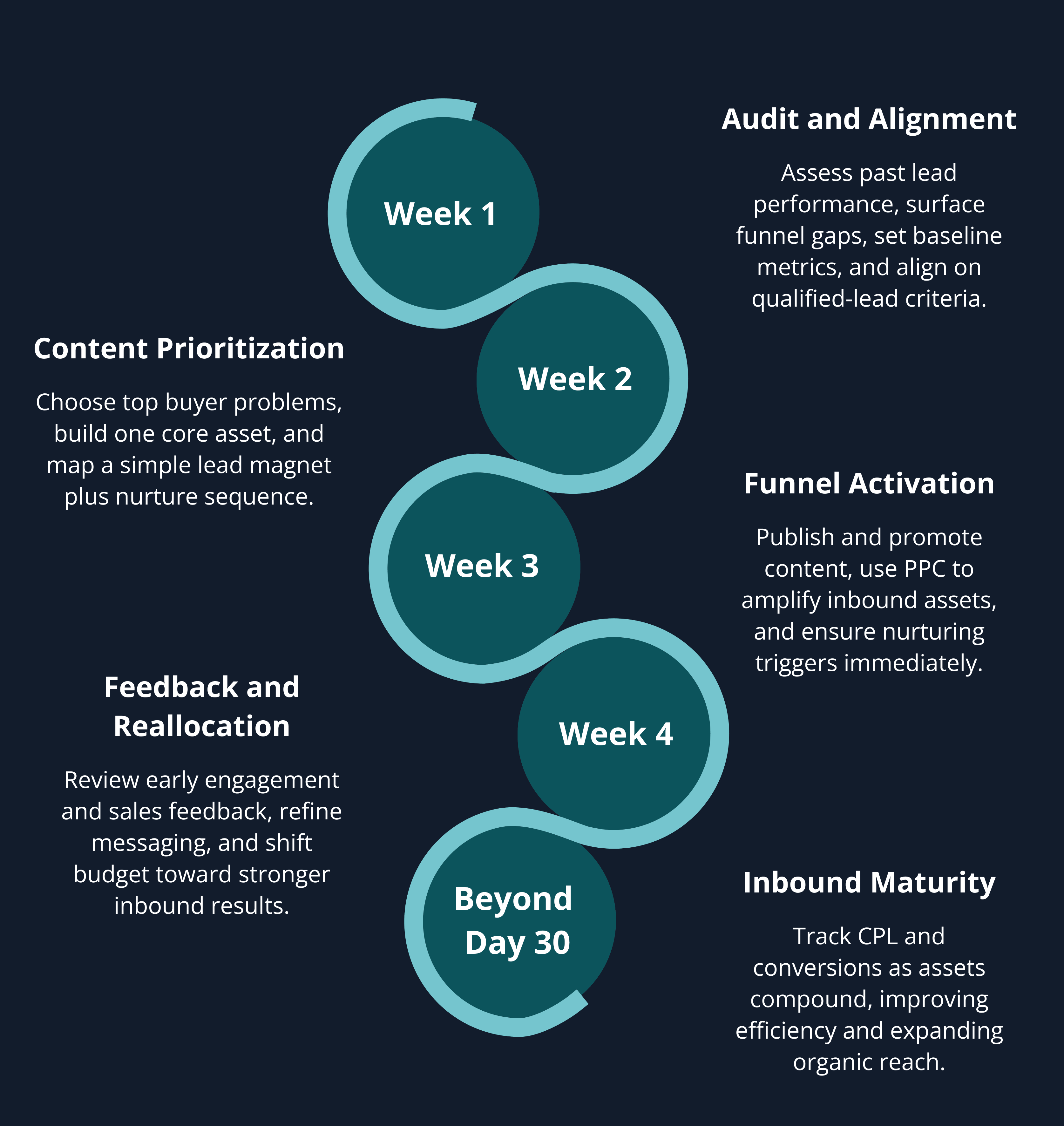
Week 1: Audit and Alignment
Review lead generation performance from the past quarter. Identify lead sources, PPC contribution, associated costs, and conversion outcomes.
Evaluate existing inbound assets and note gaps across the funnel. Establish baseline metrics such as cost per lead, conversion rate, and pipeline contribution.
Align marketing and sales on a shared definition of a qualified lead.
Week 2: Content Prioritization
Select one or two high-impact buyer problems based on audit findings. Create one core content asset addressing a priority issue.
Plan a simple lead magnet if appropriate and outline a nurture email sequence to support follow-up.
Week 3: Funnel Activation
Publish and promote the new content. Use PPC selectively to drive traffic to inbound assets instead of standalone landing pages.
Ensure email nurturing is active so new leads receive timely follow-up.
Week 4: Feedback and Reallocation
Review early performance data, including engagement metrics and feedback from sales on lead quality.
Adjust messaging where certain pain points show stronger responses. Begin reallocating budget toward tactics showing stronger inbound-led performance.
Beyond Day 30: Inbound Maturity
Continue monitoring cost-per-lead and conversion trends. As inbound assets gain traction, efficiency should improve.
Scale organic reach to support continued engagement and trust-building.
Time to Take Action
Moving from PPC-only lead generation does not require an immediate shift. Start by reviewing current performance and identifying where inbound can strengthen results. Each inbound asset adds durable value and supports sustained engagement.
FAQs
Inbound marketing attracts buyers who are already looking for answers to their problems. These people interact with helpful content instead of being interrupted by ads, so they are more likely to match your ideal customer. Inbound leads usually show more interest, make sales conversations easier, and convert at higher rates. On the other hand, PPC often brings in visitors who are less interested or less qualified.
PPC still has a role; it is still useful, but it works best for specific goals rather than being your primary way to generate leads. Paid ads give you quick visibility, help with remarketing, and can promote important resources while your inbound content gains traction. For long-term growth, building organic reach, creating content, and earning trust are key. PPC cannot match inbound in these areas.
Inbound marketing takes time to build up. Most companies notice early results in 60 to 90 days, and returns grow as you add more content. Unlike PPC, which stops working when you stop paying, inbound content keeps bringing in leads for months or even years. This makes inbound a more sustainable and affordable option.
B2B buyers need different information at each stage of their decision process. At the start, blogs, guides, and educational articles help build awareness and interest. As buyers get closer to a decision, webinars, whitepapers, and case studies offer more in-depth details. In the final stage, tools like ROI calculators, product demos, and customer testimonials help support their purchase. A strong inbound strategy provides the right content for every step of the buying journey.
Start by assessing your current situation and identifying your buyers' primary challenges. Create a key piece of content and set up a simple nurture sequence to go with it. Use PPC in a targeted way to send traffic to your inbound content instead of just to landing pages. As your organic reach grows, move more of your budget to inbound channels that give steady, affordable results.
Related Posts