Choosing the Best Website CMS for B2B E-Commerce
For companies selling business-to-business online, these popular website eCommerce platforms offer pros and cons.
 12 Min Read
B2B e-commerce involves added layers of complexity compared to B2C. You’re dealing with longer sales cycles, bulk orders, negotiated pricing, account hierarchies, and the need to integrate with ERP and CRM systems. These demands shape how your website functions and what the CMS must support.
This guide explains how to select a CMS that meets these requirements and supports long-term scalability.
Why It Matters
Your CMS is the digital foundation of your online business. It controls product data, customer portals, pricing logic, and marketing automation. The right CMS supports integrations with ERP and CRM systems, manages extensive catalogs, and enables personalized buying experiences. It also affects cost, workflow efficiency, and how quickly you can adapt as your business grows.
Choosing the wrong CMS introduces limitations that slow teams down and add long-term expense.
Decision Framework
Before comparing platforms, understand your internal priorities. IT will focus on security and integrations. Marketing cares about flexibility and SEO. Sales needs an ordering experience that supports how buyers work.
Assessing Options
- List core requirements such as multi-site support, account management, and custom pricing.
- Compare platform types, for instance, open-source and proprietary.
- Shortlist CMS options that align with business needs and available resources.
- Pilot your top choice with a small proof-of-concept.
A structured evaluation helps reduce risk and aligns stakeholders before committing.
Factors to Consider
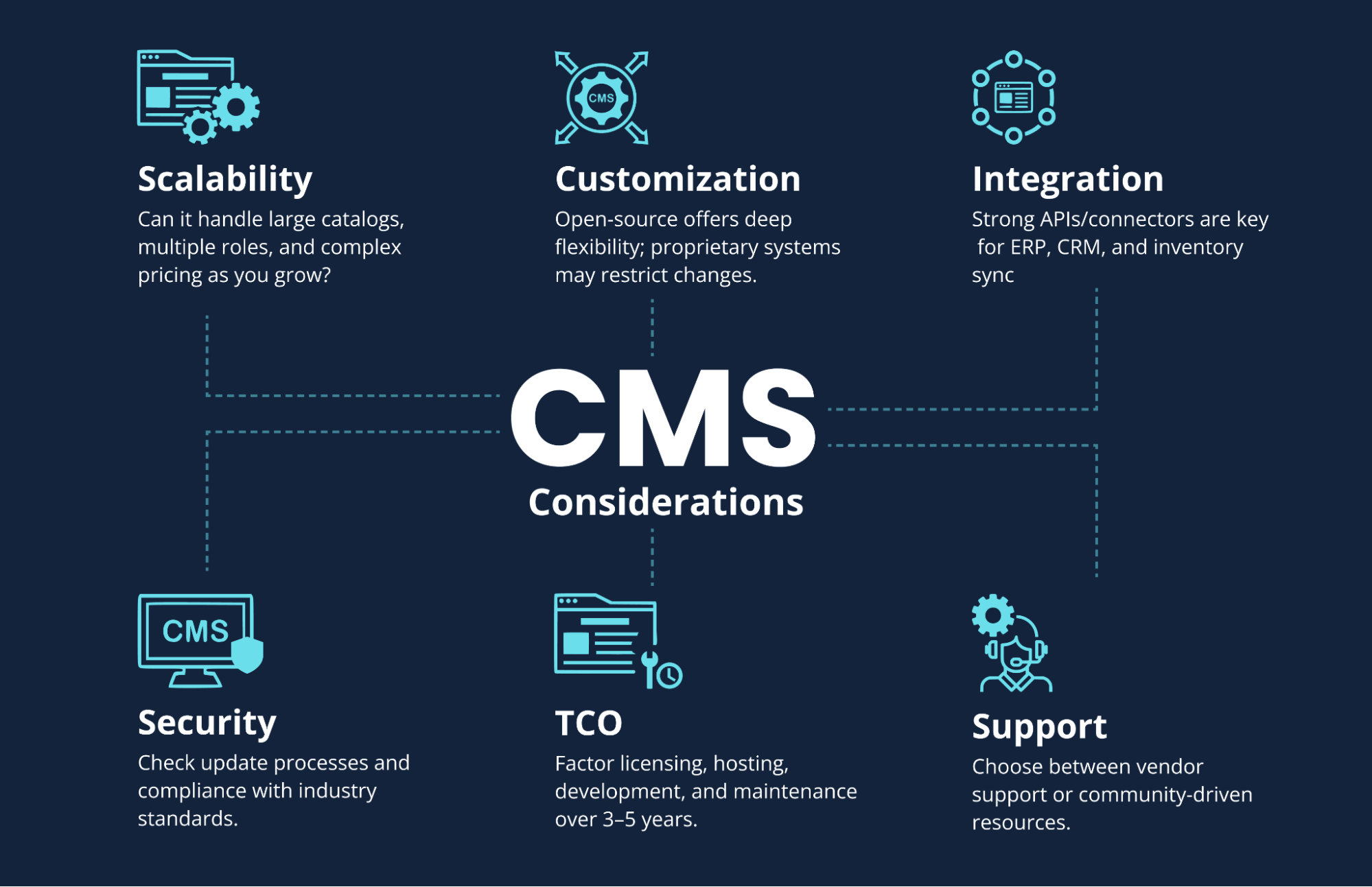
Choosing a CMS for B2B e-commerce means balancing technical requirements with long-term usability. Focus on these features and functions:
- Scalability. Can the platform support large catalogs, multiple user roles, and complex pricing as you grow?
- Customization and flexibility. Open-source platforms allow deep customization. Proprietary systems may limit how much you can modify.
- Integration capabilities. Strong APIs or connectors are essential for ERP, CRM, and inventory sync.
- Security and compliance. Review how updates are handled and whether the platform meets industry regulations.
- Total cost of ownership (TCO). Consider licensing hosting, development, and maintenance for a 3–5 year span.
- Support and community. Decide whether you prefer vendor support or community-driven resources.
Open-Source CMS Options
An open-source CMS offers flexibility and no licensing fees, making them well-suited for teams with strong technical resources. Here’s a high-level comparison of the pros and cons of popular B2B ecommerce platforms:
Platform |
Advantages |
Disadvantages |
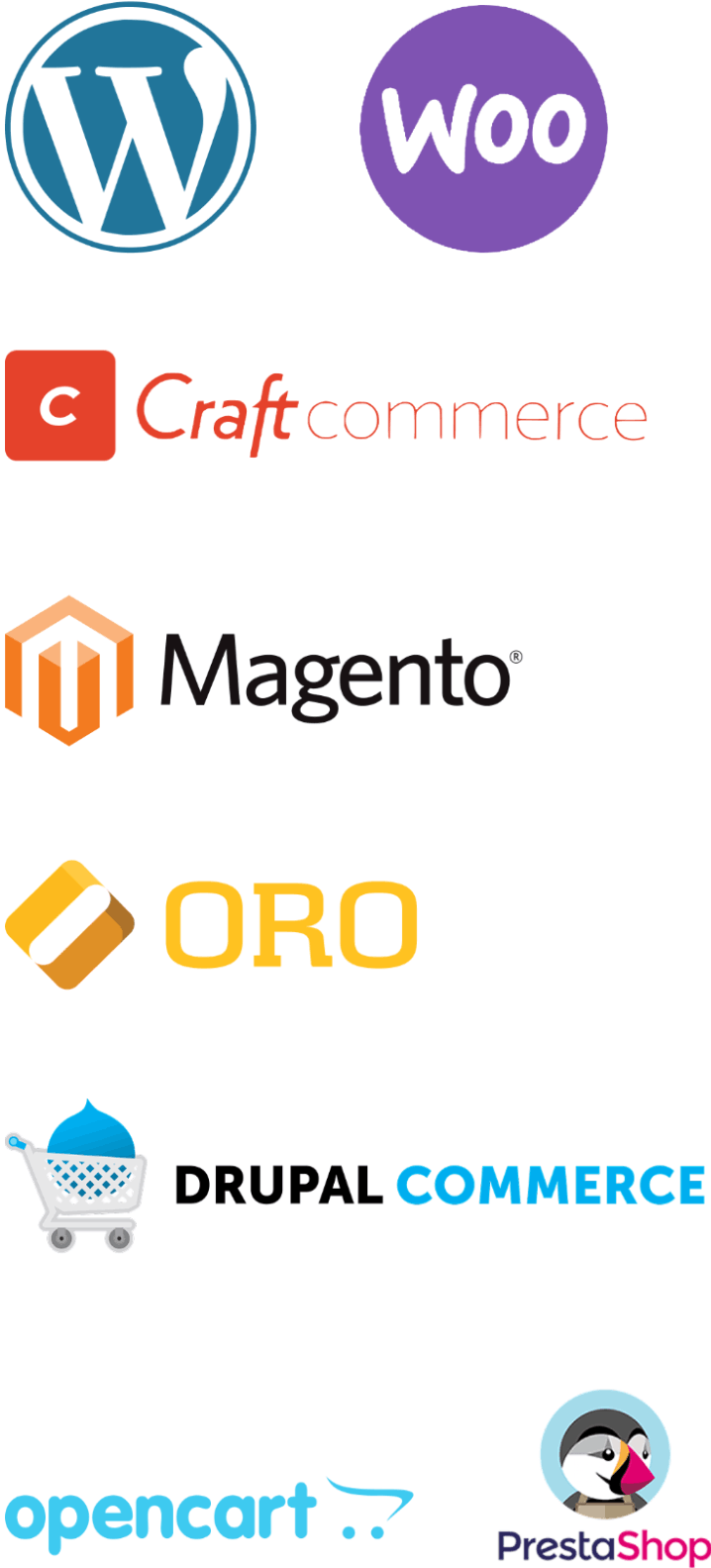
| WordPress with WooCommerce | Large plugin ecosystem and easy admin for small to medium sites. | Needs careful performance tuning and relies on plugins for advanced B2B features. |
| Craft Commerce | Developer-friendly and modular, good for content-driven brands. | Smaller (but growing) dev community, fewer built-in/off-the-shelf e-commerce tools. |
| Magento Open Source | Feature-rich and scalable with strong B2B capabilities. | Heavy, extensive setup requirements and high resource needs. |
| OroCommerce | Built especially for B2B with powerful workflow tools. | Steeper learning curve and a smaller dev community, so more technical expertise is needed to maintain. |
| Drupal Commerce | Secure, flexible, and multilingual with strong content integration. | Complex setup and longer launch timelines. Not considered as user-friendly as popular alternatives. |
| OpenCart and PrestaShop | Lightweight platforms that are quick to start. | Limited built-in B2B features and scalability constraints. |
Summary: Open-source CMS gives you control and flexibility, but implementing enterprise-grade B2B features requires skilled developers and ongoing maintenance.
Proprietary (Licensed SaaS) CMS Options
Proprietary platforms are hosted by vendors on a subscription model. They focus on ease of use, support, and predictable maintenance, but come with the trade-off of less backend control. Here are standard options for B2B e-commerce.
Shopify Plus
Fast to deploy and simple to manage, with enterprise support. It now includes features like customer-specific catalogs, tiered pricing, and account management.
Consideration: You give up a degree of backend control and pay higher ongoing fees.
BigCommerce Enterprise
A scalable SaaS platform with built-in B2B tools and high uptime. It also offers a headless-friendly architecture.
Consideration: Being fully hosted limits server-level access, and pricing increases with usage.
Adobe Commerce (Magento Commerce Cloud)
The enterprise cloud version of Magento, with advanced personalization, AI-driven marketing, and deep integration with Adobe tools.
Consideration: It requires a higher budget and brings added complexity.
Enterprise Solutions, such as Salesforce, SAP, and Oracle
Salesforce Commerce Cloud, SAP Commerce, and Oracle CX Commerce offer global scalability, security, and complete enterprise support.
Consideration: These involve long implementations and are best suited to large B2B operations with substantial budgets.
Summary: Proprietary platforms prioritize stability, security, and vendor support. They can reduce IT overhead and speed up deployment, though recurring fees and limited flexibility are the primary considerations.
Open-Source vs. Proprietary: Key Differences
This comparison helps teams evaluate which CMS platforms align best with business goals and technical capacity.
Criteria | Open-Source Systems | Proprietary Systems |
|---|---|---|
| Cost | Low or no license fees. Costs relate to hosting and development. | Ongoing subscription or license fees that increase as your usage grows. |
| Customization | Full flexible with direct code access. | Customization depends on the vendor’s framework and available APIs. |
| Ownership | You control the code and data. | Vendor-hosted with reliance on provider controls. |
| Maintenance | Handled by your internal team or agency. | Vendor manages updates and fixes. |
| Scalability | High scalability with the right infrastructure. | Scales reliably within limits of your plan. |
| Integration | Open APIs allow broad integration possibilities. | Integrations are limited to vendor-supported connectors. |
| Security | Security patches depend on your team and update cadence. | Vendor pushes managed updates and security patches. |
| Support | Community forums and agency support. | Official vendor teams and dedicated support channels. |
| Best For | Teams needing advanced customization. | Businesses wanting a streamlined setup and predictable support. |
Designing and Developing Your Site
Your CMS choice shapes design flexibility, performance, and user experience. Open-source tools offer complete front-end control, whereas proprietary systems use structured themes or builders for faster deployment. Regardless of the platform, prioritize clear navigation, quick loading, and robust mobile performance.
Many B2B brands consider headless architecture for added flexibility.
Headless CMS
A headless CMS separates the content backend from the front-end display. Think of it as a warehouse that stores content in an organized way, while your developers build any storefront or interface they want. The CMS provides content through APIs to websites, apps, kiosks, or partner portals.
This separation provides teams with more control, enhances performance, and facilitates the easy publication of content across multiple channels without requiring duplicate work.
Aligning Your CMS with Business Goals and Growth
Choosing a CMS is ultimately about aligning technology with your business processes and long-term plans. As your organization grows, the platform should scale smoothly and adapt to change.
Before making a decision, run pilots or proofs of concept with your top choices. Involve stakeholders and compare long-term ownership cost, feature fit, as well as the effort required for the initial build.
B2B Ecommerce Solutions
See how our work helps you increase B2B online sales.
FAQs
A: B2B transactions are typically larger, involve multiple decision-makers, and require custom pricing and catalogs. B2B sites require features such as account hierarchies and corporate accounts. They also often integrate closely with ERP/CRM systems to sync data. In contrast, B2C e-commerce is geared toward individual consumers with fixed prices and quick checkouts.
A: The CMS powers your product catalog, pricing logic, and customer portal. A suitable CMS streamlines content updates and order workflows. If the CMS lacks key B2B features, teams spend more time on workarounds. The right platform accelerates growth; the wrong one creates inefficiencies and missed sales.
A: If your company is tech-savvy and needs a highly customized solution, open-source offers flexibility at low upfront cost. If you prefer a managed solution with quick setup and vendor support, a proprietary platform may fit, despite higher fees. Consider factors like development resources, budget, required features, and total cost of ownership.
A: Key factors include scalability, customization, and integration. Can the CMS handle a large product range and high traffic? Does it allow custom B2B workflows? How easily does it connect to your ERP/CRM? Also factor in security, ease of use for marketers, and ongoing support. A good evaluation covers both functionality and total ownership cost.
A: Yes. Shopify Plus offers a B2B channel with features for volume discounts and corporate accounts. BigCommerce’s B2B Edition includes company accounts, quote management, and custom catalogs. Both platforms initially focused on B2C but now also support key B2B needs. Evaluate whether their built-in B2B features match your requirements or if you need additional apps.
A: Magento is a popular B2B choice. Even the free Open Source edition has extensions for B2B needs. Adobe Commerce adds native B2B tools. It’s highly flexible for complex workflows, but it requires a skilled team or agency to implement and manage effectively.
A: A headless CMS decouples content management from the website’s front-end. You store products and content in the CMS and deliver them via APIs to any frontend. This can improve performance and flexibility. B2B brands consider headless setups when they need omnichannel delivery or custom front-end frameworks. A hybrid CMS can offer a traditional editing experience along with API-driven delivery, blending the best of both approaches.
A: Look for platforms with robust API support or pre-built connectors for your ERP/CRM. For example, many systems sync product catalogs, pricing, and inventory from the ERP into the CMS. Some vendors or middleware services specialize in linking e-commerce to back-end systems. Plan your data flows to ensure the CMS remains in sync with your business data.
A: It depends on your resources. A specialized agency brings experience in B2B user experience, integrations, and development. They can build advanced features faster than an inexperienced team. If you have in-house developers, you might handle the tech work, but an agency can still provide strategy and best practices to avoid pitfalls.
A: This guide is for anyone planning or managing a B2B e-commerce site. Business owners, e-commerce managers, marketers, and IT leads will all benefit. If you are evaluating platforms for complex wholesale or B2B sales channels, this guide will help you understand the key decision points and options.
Related Posts