Local vs. Niche: Choosing the Best Manufacturing Web Agency
How manufacturers can evaluate local vs. niche digital agencies to build websites that drive leads, streamline operations, and support long‑term growth.
 15 Min Read
Modern manufacturing websites have evolved from static online brochures into lead-generation engines. No longer limited to an “About Us” page and product gallery, manufacturing sites now integrate request-for-quote (RFQ) forms, ERP connections, and AI-enabled customer support.
Buyer behavior is drifting through this shift, with nearly all B2B buyers researching online before speaking to sales.
Mid-market manufacturers planning a website redesign must therefore choose their web agency carefully.
Do you work with a local team for convenience, or a niche manufacturing digital agency for specialized expertise? This article breaks down that decision.
Modern Manufacturer’s Digital Imperative
Decision-makers need websites that reinforce credibility, give sales and operations visibility into the pipeline, and automate time-consuming processes. By 2026, of majority of manufacturers plan significant “smart operations” digital investments.
If your website isn’t helping streamline operations or support revenue generation, it becomes a liability instead of an asset. Manufacturers are projected to spend roughly 5% of revenue on digital technologies, underscoring the urgency of getting this right.
Understanding the Two Agency Models
When choosing a manufacturing web agency, most companies weigh local agencies against niche industry specialists. Each option presents trade-offs for mid-market manufacturers.
Local Agencies: Proximity and Practicality

Local manufacturing web agencies are typically regional firms serving a wide range of businesses within a specific geography.
They prioritize accessibility, in-person collaboration, and execution speed over deep industry focus.
| Pros | Cons |
|
|
Niche Agencies: Industry-Focused Expertise

Niche manufacturing web agencies specialize exclusively in industrial and B2B digital environments.
Their teams are built around manufacturing workflows, long sales cycles, and complex technical requirements.
| Pros | Cons |
|
|
Real-World Examples
 Niche Agency Example – DBS Interactive
DBS Interactive specializes in ERP-integrated manufacturing websites with custom RFQ systems and technical SEO built for industrial buyers.
Its manufacturing-first approach has delivered measurable conversion lifts and operational efficiency gains that generalist agencies often struggle to match.
 Local Agency Example – Orbit Media Studios (Chicago)
Orbit Media Studios works closely with regional businesses, offering general web design, content strategy, and regional SEO, with the added benefit of in-person collaboration.
While strong in design and marketing fundamentals, they may not deliver manufacturing-specific integrations out of the box.
Role-Specific Perspectives
The local-versus-niche decision is rarely evaluated the same way across leadership teams. Each function approaches the choice through its own priorities, even when the end goal is shared.
At the executive level, the focus is on growth, credibility, and ROI. Budget remains a consideration, especially if past agency engagements felt disproportionate to results, but leadership also recognizes that the website signals competence and scale to the market.
Specialized expertise can justify higher investment when it aligns with long-term competitiveness.
Marketing leaders view the site through the lens of pipeline and visibility. The expectation is not just traffic, but qualified leads.
Agencies with deep B2B SEO and conversion experience often stand out, though a capable local partner may suffice when demand is primarily regional or scope is limited.
Operations teams tend to see the website as part of the system instead of a standalone channel. Integration with quoting, inventory, and ERP workflows is critical, and manual processes quickly become liabilities.
Technical depth matters here, as gaps can introduce downstream inefficiencies.
Those managing the site day to day balance ease of execution with durability. Familiar platforms and close coordination can make local agencies appealing, but there is often awareness that simpler builds may need replacement sooner.
More scalable, modular approaches reduce friction as requirements evolve.
Choosing Your Best-Fit Agency
Ultimately, the choice between local and niche agencies should align with your company’s specific needs and objectives. The following considerations can guide an ROI-driven decision.
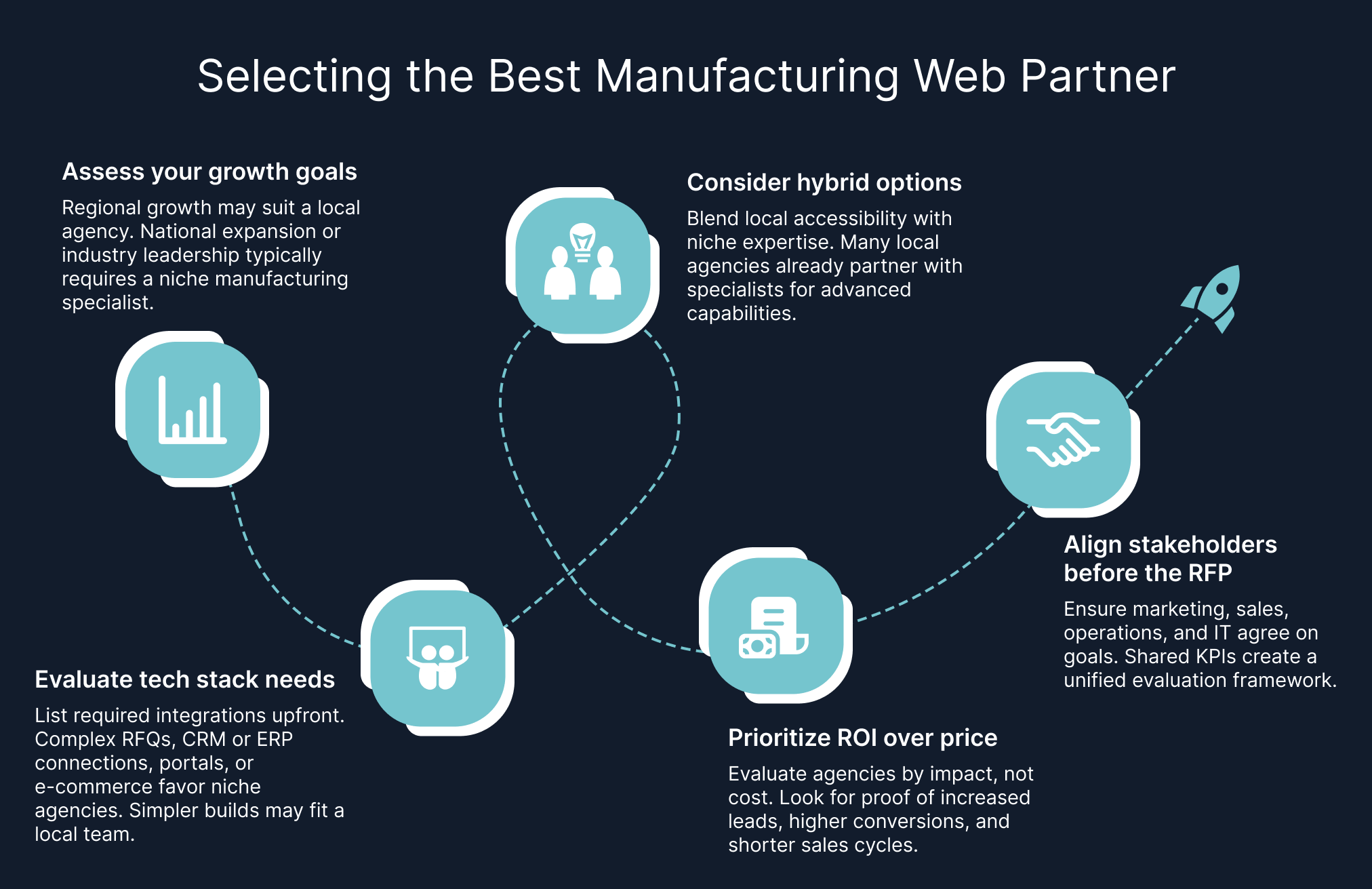
ROI Benchmarks to Expect
Based on recent industry benchmarks, mid-market manufacturers should target the following outcomes from a successful redesign.
|
Higher conversion rates A realistic target is a 35% lift. While manufacturing sites often average around a 2.2% conversion rate, well-optimized experiences can reach 3–5%. |
More RFQs and inbound leads Improved UX and RFQ functionality can drive 50% more submissions. One digital tool provider reported up to a 50% increase in inbound RFQs after introducing instant quoting. |
Shorter sales cycles Automating early-stage interactions can reduce sales cycles by roughly 15–30%. Digital sales room research shows that buyer self-qualification accelerates serious sales conversations. |
12-Month Post-Launch Plan
To measure ROI accurately, track performance for a full year post-launch. Key metrics include cost-per-lead, RFQ-to-order conversion rate, quote velocity, and pipeline attribution.
Track how web-generated opportunities contribute to revenue
Choosing the Right Web Agency Is a Revenue Decision
Both local and niche agencies have a role, and the right choice depends on your context.
Local agencies can deliver quick wins for straightforward redesigns, mobile improvements, and regional SEO. Niche agencies tend to be better equipped for long-term scale, complex integrations, and measurable pipeline impact.
As manufacturers continue investing in smart digital operations, the website increasingly functions as a commercial asset rather than a marketing expense.
Related Posts