Interactive Content Strategies for B2B Lead Generation
Interactive content is a powerful tool for driving conversions and leads through your website and other digital channels.
 18 Min Read
Interactive content works because people learn best by doing. Walk into a children’s museum, a science center, or EPCOT, and you’ll see it in action. Visitors don’t just read–they build, test, and explore. That hands-on experience sticks.
That’s what makes it memorable.
Business audiences aren't much different. Think about it: B2B buyers receive what feels like thousands of marketing messages daily. It's easy to ignore links to blogs and whitepapers, especially when they feel generic or AI-generated (we're all noticing it now, right?).
What buyers want is valuable content that helps them solve problems. Imagine that!
This article explores how interactive content drives inbound lead generation for B2B companies. The article covers high-performing formats, a quick scoring grid of effort vs. impact, how to map interactivity to your marketing funnel, real-world examples, and tips to get started. Let’s dive in.
Why You Need More Than Static Content
Think of static content as a billboard. It’s there, but it doesn’t ask much of the viewer. Interactive content is more like a conversation. It invites input, delivers tailored insights, and drives action. That’s why it converts nearly twice as well.
Studies show that interactive experiences significantly outperform static ones. One found that interactive content converts leads at an average rate of 70% vs. just 36% for static content.
Why the gap?
Static content doesn’t adapt to each reader. It offers the same generic info to everyone, regardless of their unique needs.
The Disadvantages of Static Content
- Low Intent Signals: A whitepaper download or blog view doesn’t tell you much about a prospect’s specific pain points or urgency. There’s no feedback loop or direct input from the reader.
- Limited Engagement: Static formats are easy to ignore or skim. Think about how many PDF ebooks sit unopened. By contrast, interactive content doubles engagement on average because it requires action. Readers become users.
- Harder to Segment: With static assets, your marketing team gets few data points, an email address from a form fill. You can’t see what the reader found most relevant. Interactive tools capture choices and answers that segment leads by interest, need, or fit in real time.
- No B2B content personalization: Static content is one-way and one-size-fits-all. It can’t adjust or respond to a CEO vs. a technical analyst. Interactive content, on the other hand, can present different outcomes or follow-up questions based on user input, creating a personalized path for each prospect.
- Commodity Status: Let’s face it, pumping out static blogs has become easy. Everyone is doing it. Simply having a blog isn’t a competitive advantage in 2025. B2B marketers, CEOs, and sales leaders see diminishing returns from generic articles. In fluid, dynamic markets, purely static content often isn’t enough to educate and convert savvy buyers.
What Makes Interactive Content Strategic, Not Gimmicky
Interactive content isn’t just a flashy tactic. It’s a strategic system for qualification, personalization, and conversion. Here’s why leading B2B marketers invest more in dynamic content experiences than ever (55% of B2B marketers have increased spend on interactive tools).
1. Captures Zero-Party Data for Personalization
Unlike third-party data, zero-party data is information that prospects volunteer themselves. An interactive assessment or quiz, even a friendly “survey” or self-diagnostic, lets users input their preferences, challenges, budget, etc.
This data is a goldmine. It’s explicit and current. You can feed it directly into your CRM or marketing automation to trigger personalized follow-ups. Interactive content doubles as a data collection tool, empowering accurate targeting and automated personalization from the start.
2. Qualifies Leads While Educating Them
Good interactive content doesn’t feel like an interrogation, yet it achieves what a sales rep’s discovery call might. The content provides value and qualifies the lead, educating the prospect, e.g., showing them an ROI estimate, or giving them a “score” on some readiness scale.
Marketers have used these tools to uncover prospects’ pains, challenges, and goals in a scalable way and vastly improve lead scoring and funnel velocity.
A busy CTO or healthcare executive will gladly answer a few quick questions if the output helps them understand how to solve their problem. In doing so, they’re essentially qualifying themselves.
3. Feeds CRM with Segmented Insights
Every click or response in an interactive experience is an intention signal. For example, if a manufacturing prospect in the aerospace sector uses your product configurator and consistently selects “high precision” options, you’ve learned something critical about their priorities.
Modern interactive content can sync these responses into your CRM or MAP via webhooks or integrations. Each lead is enriched with profile data before salespeople speak to them.
Your sales team can prioritize and tailor outreach based on these insights, and your nurturing campaigns can branch intelligently. It’s lead segmentation on autopilot.
4. Aligns with the CustomerFocusTM (Buyer as Hero)
The CustomerFirst FocusTM model positions customers as the hero, not the audience. Interactive content makes that happen. When users answer questions and get personalized recommendations, they’re in control. Your brand becomes the guide, helping them move forward. That shift—from vendor to advisor—is what builds trust.
5. Supports the Future of Search (AI and Conversational Search)
As search engines evolve with AI, content that provides direct value and engagement will likely stand out. Interactive content often leads to longer dwell times and higher user satisfaction, signals that search algorithms notice.
Moreover, interactive tools can be optimized for search by including crawlable sections and schema markup, making them SEO-friendly. For instance, a well-structured interactive page can rank like a blog and earn rich results.
Looking ahead, if AI search tools cite “linked sources” for answers, companies with unique interactive data or tools could earn those mentions. In short, interactive content is forward-compatible with how search and content discovery are changing.
6. Differentiates Your Brand
Most B2B content, such as PDFs, whitepapers, and monolithic blocks of text, drowns in a sea of sameness. Interactive tools stand out and invite buyers to engage.
Being memorable is a challenge in crowded B2B markets. An engineering firm that provides an ROI calculator or a SAAS company with a personalized assessment tool immediately feels more modern and helpful.
It shows you’re willing to go beyond the minimum.
This kind of content is also more shareable. People share cool calculators or quizzes with colleagues, extending your brand reach. The result is often a higher recall and a positive impression of your company as a tech-forward, customer-centric leader.
7. Creates Intent Signals and Insight Loops
With static content, you’re often left guessing what resonated. Did the reader find page 4 of your whitepaper helpful or not? With interactive content, you see what users do. Which question do most CMOs answer “yes” to on your assessment? Which feature do manufacturing prospects configure most often in your tool?
These interaction patterns inform lead follow-up and broader marketing strategy. They answer “what does my audience really care about?” in real time. You can double down on what works and refine what doesn’t, creating a continuous feedback loop.
Debunking Myths About B2B Interactive Content

It’s worth dispelling a few myths that still deter some B2B teams from embracing interactive content. Unlike the mythological Pegasus, majestic yet imaginary, the results of interactive content are very much real, and their impact is measurable.
Despite its proven ability to boost engagement, qualify leads, and deliver tangible value, misconceptions persist, often rooted in outdated assumptions or one-off bad experiences that no longer reflect today’s tools or outcomes.
Myth #1: “It’s just a gimmick.”
Some assume interactive experiences are all sizzle and no steak.
Reality: When done strategically, interactive content produces concrete results. It’s not just about fancy graphics. It’s about engaging prospects more deeply to drive outcomes. For example, 82% of B2B buyers prefer interactive content like assessments or calculators when researching, because it provides value. And as noted, it often converts better and yields higher-quality leads than static content. Hardly a gimmick, it’s a performance booster.
Myth #2: “Our audience won’t use it.”
There’s a notion that busy CEOs or technical B2B buyers only want straight info, not “quizzes” or interactive tools.
Reality: The key is utility. A manufacturing operations director might not play a silly quiz. Still, they will eagerly use a Production ROI Calculator that saves them time or an interactive guide that diagnoses their process bottlenecks.
Myth #3: “It’s too costly or complex to create.”
Yes, interactive projects typically require more effort than writing a blog post. You might need designers, developers, or specialized software.
Reality: It’s more accessible than you think. Many interactive content platforms like Outgrow, Typeform, Ceros, and others let you build quizzes, calculators, and interactive infographics without heavy coding.
Myth #4: “Interactive content isn't SEO-friendly.”
Some worry that search engines can’t properly index interactive or dynamic content, limiting its visibility in organic search results or AI-generated answers.
Reality: If built following best practices, e.g., ensuring text is indexable, using progressive loading, interactive pages can rank just as well as static pages. In fact, because interactive content keeps visitors on the page longer and engages them, it can improve user experience signals that search engines reward.
Interactive Content Types & Value
Interactive content isn’t one-size-fits-all. Different formats serve different roles across the buyer journey, from sparking initial interest to driving bottom-funnel (BOFU) conversions. What they share is the ability to engage users actively, deliver personalized insights, and capture meaningful data. Below are some of the most effective types used in B2B marketing and the value they bring to buyers and sales teams.
ROI Calculators

These mid- to bottom-funnel tools let prospects input data and instantly see a calculated result.
For example, they could see how much money they could save with your solution or how quickly an investment will pay back.
Value: When a CFO lands on your site, they scan for numbers. ROI calculators deliver exactly that—clear financial justification for a purchase. They also collect valuable inputs that reveal how serious the buyer is. In sectors like industrial automation or software, where ROI matters most, these tools often double conversion rates compared to standard landing pages.
Polls, Surveys, and One-Question Quizzes
 Quick polls or micro-quizzes embedded in blog posts or emails can be a simple starting point for interactivity.
Tip: Having question-and-answer content on your site is a good way to optimize it for search engines and AI platforms that can detect and cite your content in search results or AI-generated responses for prompts related to the topic.
Interactive Assessments
 These questionnaires deliver a personalized result or “score” at the end. They often sit at the top or middle of the funnel.
For example, a “Digital Maturity Assessment” might ask 10–15 questions and then grade the prospect’s readiness for a specific technology, with recommendations.
Value: Assessments educate the prospect about their situation while gathering zero-party data. You learn their pain points and level of need. They know something useful and get a tailored recommendation.

Product Configurators & Selectors
 A configurator allows users to build or choose a product or service package that fits their requirements. For instance, a machinery company might let a user configure a custom equipment setup, or a tech company might have a solution finder tool. This is typically a mid- to bottom-funnel content piece, aimed at prospects already considering solutions.
Value: Configurators signal extremely high intent. Someone who spends time specifying what they need is likely close to buying. These tools also provide sales teams detailed lead info such as exact specs or preferences. They shorten the sales cycle by clarifying exactly what the prospect wants. And from the buyer’s perspective, it’s a helpful preview of how your offering can be tailored to them.
Interactive Infographics & Visualizations
 These are lighter-weight interactive pieces often used at the top of the funnel for engagement and awareness.
An interactive infographic might let users click on different data points to reveal information, filter a chart by industry, etc.
Value: They capture attention and convey complex information. While they might not collect as much data as a calculator or quiz, they increase time on page and brand recall. They’re also highly shareable on social media and can earn backlinks due to their novelty.
Value: These require minimal effort from the user and can boost engagement on otherwise static pages. They also provide instant feedback – e.g., “80% of your peers answered X”- adding a community feel. While a single poll answer won’t qualify as a lead, it can be the first step to deeper interaction.
Case Studies or Solution Finders
 Instead of a long PDF case study, imagine a web page where users can choose their industry or pain point and see relevant mini-stories or results.
That’s an interactive case study. Similarly, a solution finder might ask a couple of questions and then return a case study or testimonial most applicable to the user.
Value: This personalizes your social proof. Busy executives can quickly find proof points that matter to them. From your perspective, you get to see which stories or product areas the prospect cares about.
Webinars
 Interactive webinars combine live or on-demand video with embedded polls, Q&A, and clickable CTAs.
They’re typically mid-funnel educate, build authority, and engage prospects in real time or asynchronously.
Value: Webinars let subject matter experts shine while giving prospects a chance to interact. Polls and Q&A reveal buyer priorities, while CTAs drive next steps. They’re especially effective for complex solutions where education and trust are key. Bonus: on-demand versions extend shelf life and ROI.
Demos
 An interactive demo or product tour lets users click through a simulated experience of your platform or solution.
These are bottom-funnel tools designed for high-intent prospects evaluating functionality and fit.
Value: Demos deliver clarity. Instead of waiting for a sales call, prospects can explore your offering on their own terms. This accelerates decision-making and reduces friction. For SaaS and tech buyers, it’s often the final step before conversion.
Persona Selector
 A persona selector helps users self-identify their role, challenge, or industry to receive tailored content.
It’s typically used at the top or middle of the funnel to improve relevance and guide the customer journey, which looks very different for B2B buyers compared with B2C customers.
Value: Buyers don’t want to dig for what’s relevant—they want it served up. Persona selectors increase engagement by making content feel personalized from the start. They also help marketers segment traffic and trigger targeted nurture flows.
Interactive Timeline
 Timelines visualize a process, transformation, or implementation journey.
They’re often used at the top of the funnel to explain complex or long-cycle solutions in a digestible format.
Value: Timelines reduce cognitive load. They help prospects understand what to expect, when, and why it matters. For solutions with multi-phase rollouts or long-term impact, timelines build confidence and clarity early in the journey.
Chatbots with Logic Trees
 An AI or rule-based chatbot on your site that asks questions can also be considered interactive content.
When done right, a chatbot can function like a 24/7 qualifier or concierge.
Value: Chatbots can handle common queries, route visitors to the right content, or collect lead info conversationally. For lead gen, a chatbot might ask “What are you looking for today?” and based on input, guide the visitor (e.g., “I need help choosing a product – okay, let’s narrow down; what’s your budget?”). This is interactive and can integrate with your CRM to log responses. It’s not a replacement for human sales, but it can accelerate lead qualification by engaging visitors when they show interest.
Tip: Not every interactive project needs a huge budget. Repurpose what you already have. Turn a blog into a decision tree, or a benchmark PDF into a calculator. Use SaaS tools and templates to simplify development and focus on delivering value.
Funnel Fit Matters
To maximize impact on engagement and lead quality, align each interactive content type to its stage in the buyer journey.
- Top of Funnel: Use engaging formats like interactive infographics, polls, or quizzes to attract and educate a broad audience.
- Middle of Funnel: Deploy assessments, calculators, and configurators to qualify leads and guide them toward solutions.
- Bottom of Funnel: Leverage solution finders, ROI tools, and personalized case studies to reinforce value and drive conversion.

Getting Started with Interactive Content
Feeling inspired but a bit overwhelmed? You’re not alone. Many B2B teams love the idea of interactive content but aren’t sure where to begin. The good news: you don’t need to reinvent your entire strategy overnight. With a focused approach, you can launch high-impact experiences quickly, often by building on assets you already have. This roadmap gets you going.
- Identify a High-Impact Use Case: Don’t try to overhaul everything. Pick one vertical, product, or customer pain point. Often, a good starting point is an area where your current content isn’t converting as well as you’d like. Choose a use case where interactivity can answer a question or simplify a decision for your audience.
- Repurpose Existing Content: Turning an existing piece into an interactive format saves time on content research and lets you leverage material you know resonates. For instance, if you have a checklist or a step-by-step guide, that could become an interactive assessment.
- Assemble the Right Team and Tools: Interactive content is cross-disciplinary. Pull in the necessary talent. This might include a content strategist, writer, designer, and developer. If your team is small, consider using an interactive content platform that provides templates for calculators, quizzes, etc., reducing the need for heavy dev work. If you need outside help, there are also agencies like DBS Interactive that specialize in creating these experiences.
- Plan Data Capture and Integration: Before you launch, decide what data you want to collect and how you’ll use it. This ensures your interactive content supports lead generation, not just fun. For example, if you’re building an assessment, will you ask for the user’s email to send their results at the end? Or maybe you’ll make the tool ungated but use it to drive a consultation call CTA at the end, and behind the scenes, you’ll pass the responses into your CRM for any known contacts.
- Test, Launch, and Iterate: Start with a soft launch or A/B test. Monitor how users interact: Where do they drop off? Which questions confuse? Use analytics. Many interactive marketing tools have built-in analytics showing engagement. Consider a screen recording tool or user testing to see how real people navigate. Collect feedback from your sales team too. Are they receiving more qualified inquiries? As you gather data, iterate on the experience. You should shorten the assessment from 15 questions to 10 to boost completion, or add an explainer tooltip for a question that people misunderstand. The beauty of digital content is that you can refine it continuously. Once it’s working well, promote it heavily.
- Measure Impact on Leads: After a few weeks or months, analyze the impact. Are you seeing an increase in Marketing Qualified Leads (MQLs) from this content? Are those leads moving faster or converting at a higher rate than your average? Track these metrics and attribute pipeline or revenue where possible. This will help prove ROI to leadership. Often, early successes create momentum to expand interactive experiences across other campaigns and landing pages.
Interactive Content Examples and Inspiration
Interactive content often looks good on paper, but the real test is how it performs in the wild. These B2B examples show how companies across industrial, tech, and manufacturing sectors turn static assets into lead-generating tools. From calculators to configurators, here’s how interactive formats drive engagement, qualification, and conversion.
Mighty Small Homes
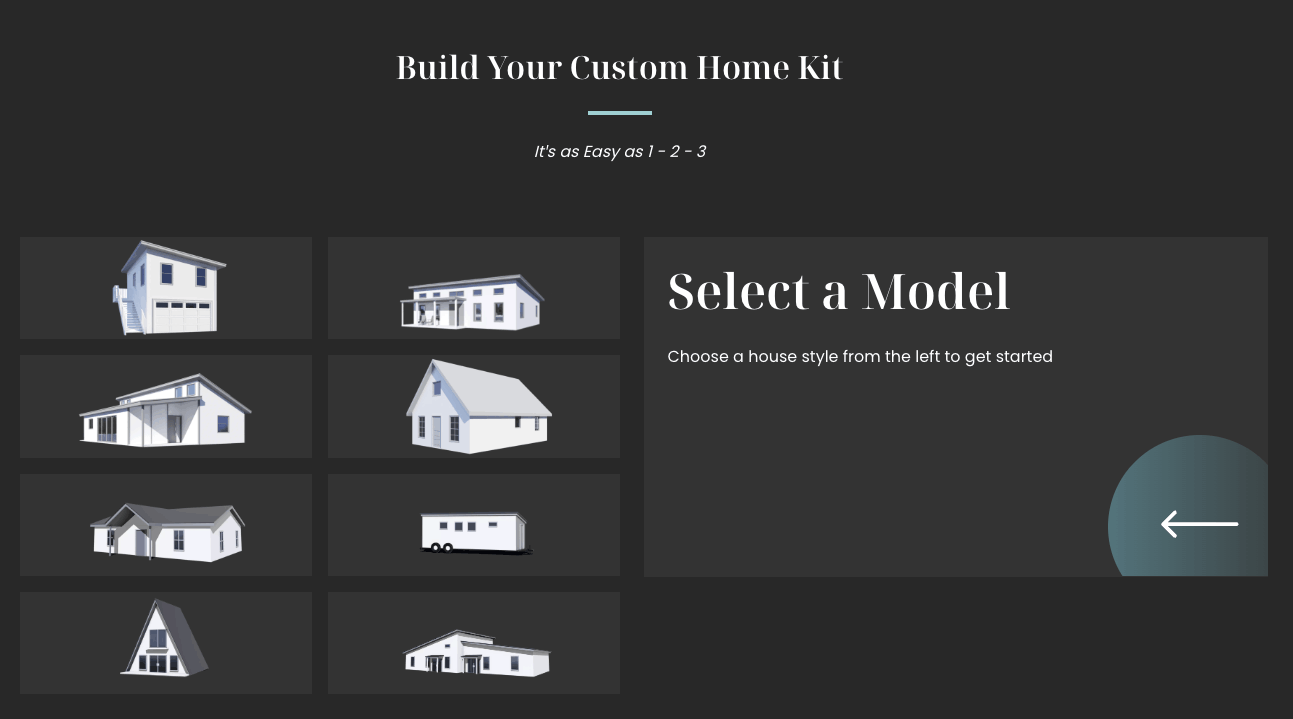
“Build Your Custom Kit” Selector: Mighty Small Homes offers an interactive home kit builder on its website. Users can select a house model, choose options and upgrades, and enter their timeline and location for instant pricing. The tool invites users to submit their info to discuss the project with an expert. This turns what used to be a static product catalog into a personalized experience.
DBS Interactive
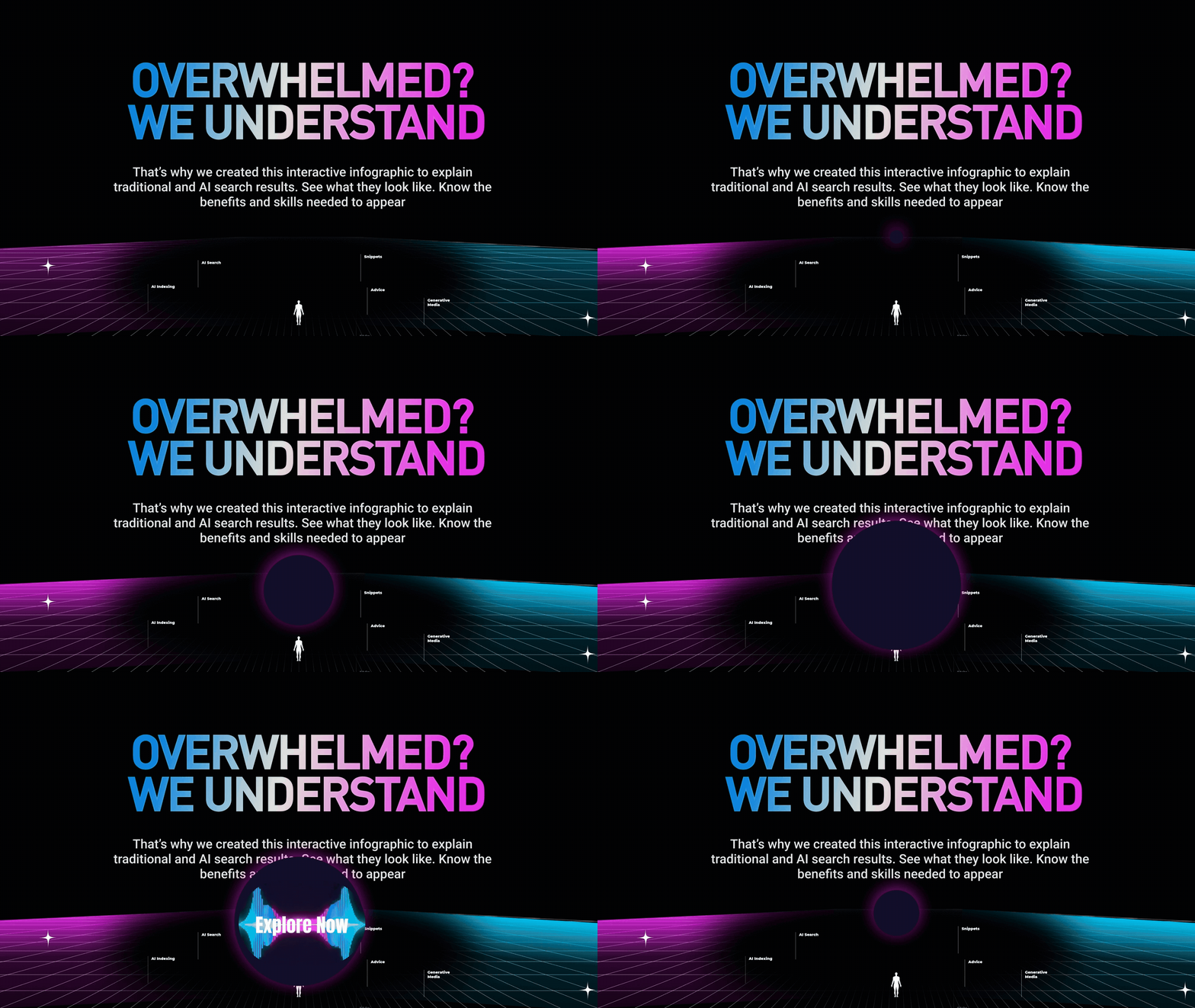
AI Search Visibility Interactive Guide: To educate marketing leaders about AI's impact on SEO, our team at DBS created an interactive content experience about AI-powered search. Instead of a plain blog post, it’s presented as a dynamic infographic guide where users can explore how AI chatbots and Google’s AI results change content strategy.
Methods Machine Tools
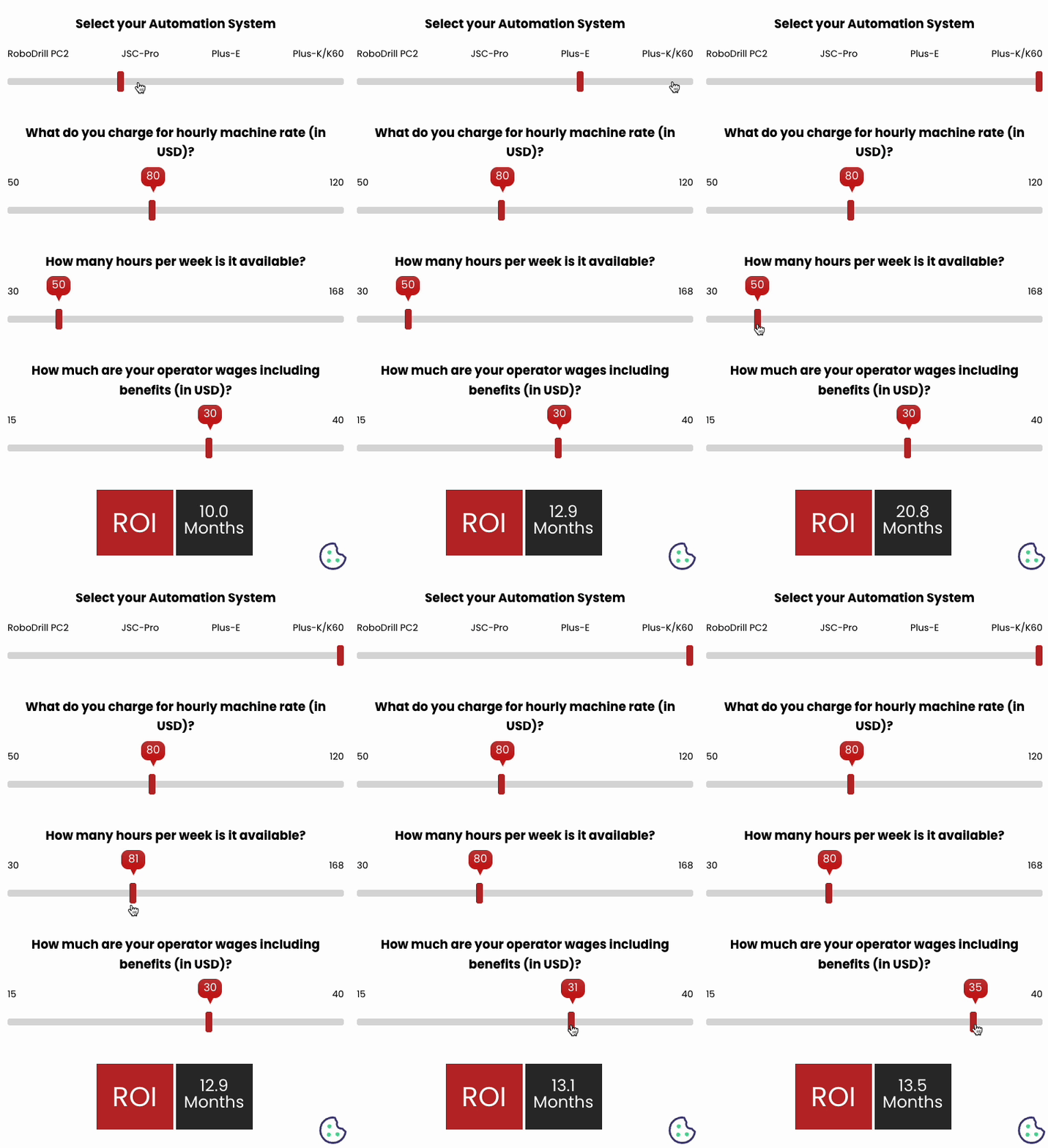
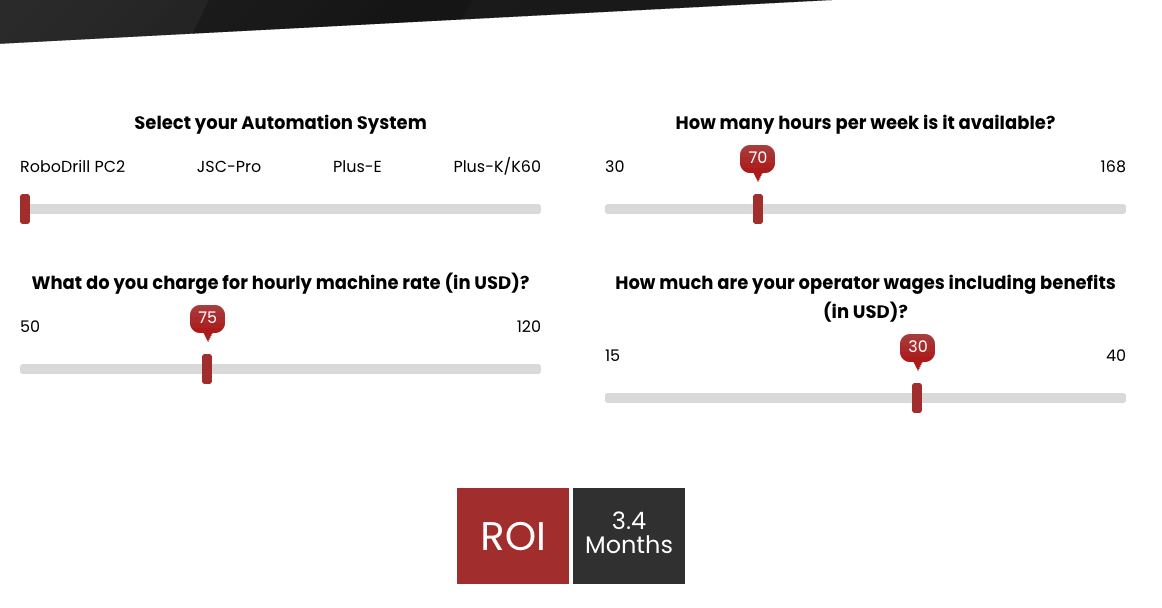
Automation ROI Calculator: Methods Machine Tools, a manufacturing equipment distributor, implemented an online ROI Calculator for automation investments. Prospects in the industrial automation space can input variables like current labor costs, machine hourly rates, and the automation system they’re considering. The calculator instantly outputs the estimated payback period. Once users see their ROI result, it prompts them to request more info from a local rep.
Blue Diamond Attachments
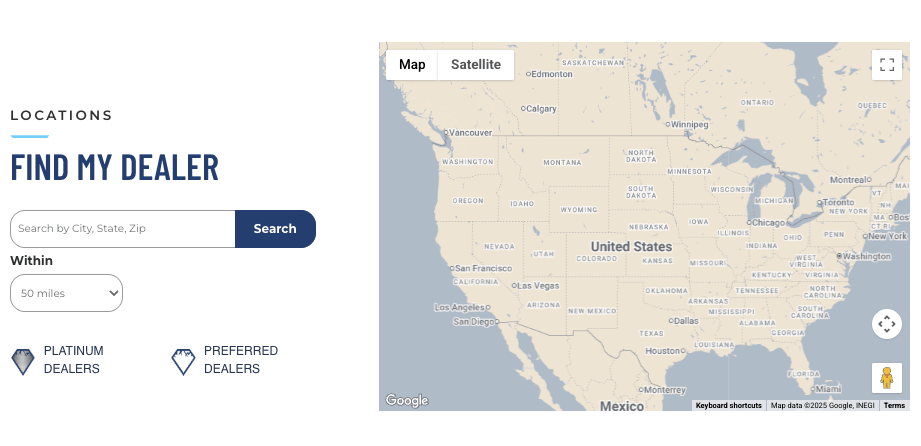
“Find My Dealer” Interactive Map: Blue Diamond, a B2B manufacturer of heavy equipment attachments, created a Find My Dealer web tool for prospective buyers. Users simply enter their city or ZIP code to see a map of local authorized dealers for Blue Diamond’s products. While a dealer locator might seem more useful than marketing, it significantly improved lead conversion for the company.
Kao Collins
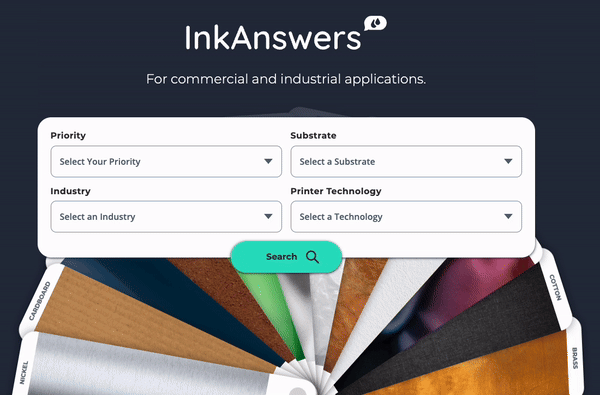
“Ink Answers” Solution Finder: Kao Collins, an industrial ink manufacturer, launched Ink Answers, an interactive microsite that helps businesses find ink options for their specific printing needs. The tool asks users a series of guided questions: industry, printing technology, materials they need to print on, performance requirements, etc. As the user narrows selections, Ink Answers produces recommended ink formulations or products that match those criteria.
These aren’t just inspiring examples. They’re tools designed and developed by DBS Interactive for forward-thinking B2B clients. From ROI calculators to solution finders, our team combines strategy, UX, and development to turn static content into high-performing lead engines. If you're ready to activate interactive content that delivers measurable results, we’re here to help you build it.
From Static to Strategic
Ready to elevate your B2B lead generation with interactive content? Even small interactive elements can make a big difference in capturing qualified leads. Let's talk if you want to go beyond static content and generate better leads through interactive experiences. Our team at DBS has helped B2B companies in manufacturing, healthcare, and tech craft interactive content strategies that drive results.
From concept to launch, we can guide you in creating content that truly interacts with your audience and converts them into customers.
FAQs
Interactive content marketing uses content that requires active audience participation, like quizzes, polls, or calculators, to engage users. It turns passive content consumption into a two-way experience, making marketing more memorable and effective.
Interactive content works because it doesn’t just inform—it engages prospects in a way that feels personalized and useful. By inviting participation, it captures attention, surfaces buyer intent, and delivers insights that static assets can’t. These formats help prospects see immediate value while giving your team richer data to qualify and nurture leads.
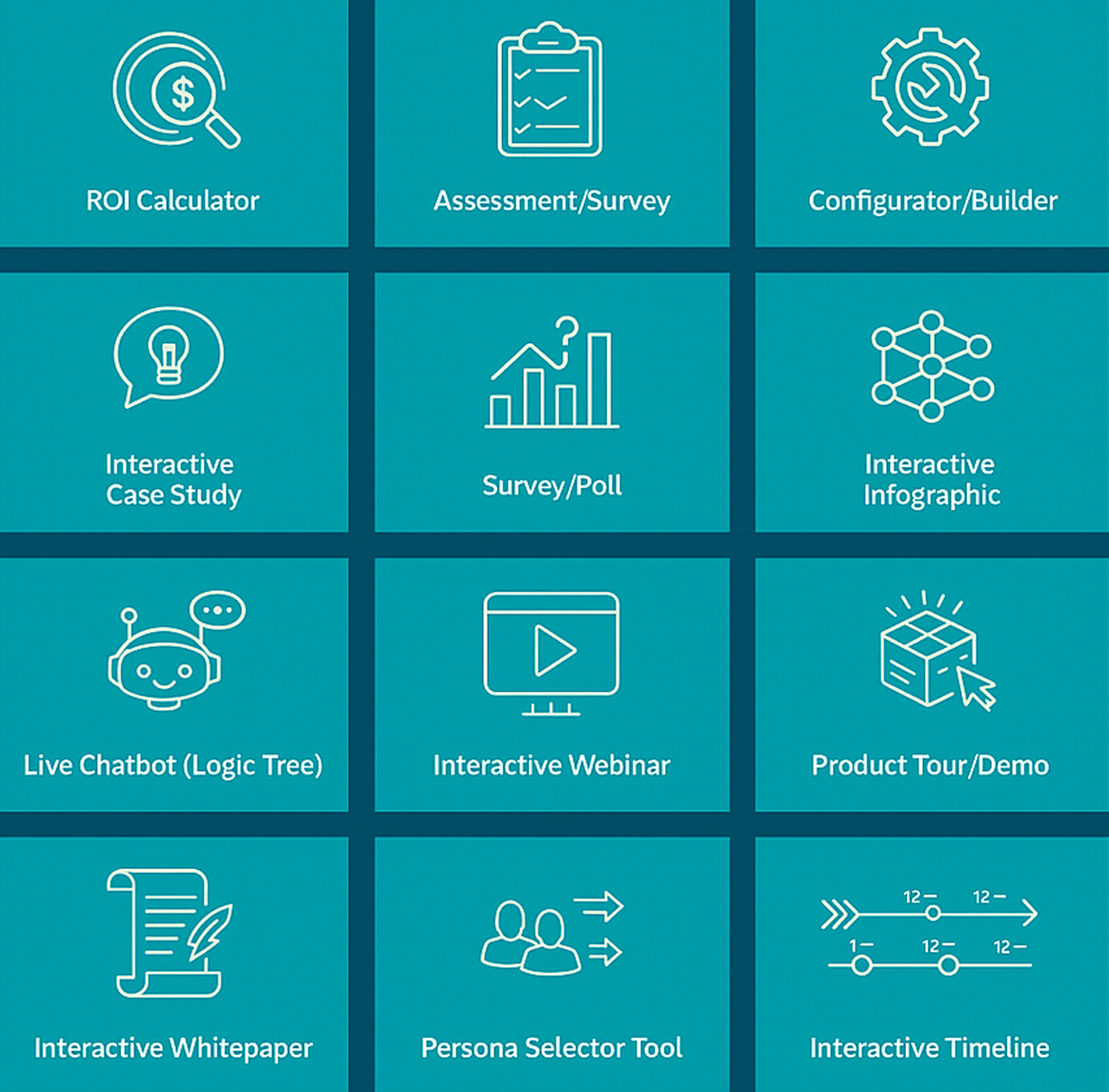
- ROI Calculator
- Assessment
- Configurator
- Interactive Case Study
- Survey
- Interactive Infographic
- Live Chatbot
- Interactive Webinar
- Demo
- Interactive Whitepaper
- Persona Selector Tool
- Interactive Timeline
Yes, interactive content can accelerate B2B lead conversion. Engaging prospects with personalized, interactive experiences, like calculators or quizzes, it helps build interest and trust faster than static content.
It includes selecting interactive content types (quizzes, calculators, infographics, etc.) that engage your target audience and align with each stage of the buyer’s journey. A solid strategy also sets clear goals and metrics to measure success from these interactive efforts.
It varies, but content that educates and builds trust works best. Case studies and whitepapers provide credibility, and interactive content (like calculators or quizzes) actively engages prospects, making these formats highly effective in B2B marketing.
Focus on your target audience’s needs and create content that offers valuable insights or solutions to their problems. Include clear calls to action and consider using interactive elements or gating high-value content (like an eBook or whitepaper) to capture leads.
Increase B2B lead generation by sharing high-quality, relevant content on channels where your audience is active, e.g., LinkedIn, industry forums, and email. Pair this with engaging tactics like interactive content or webinars to capture interest and convert more prospects into leads.
- Interactive quizzes or self-assessments
- ROI calculators and cost estimators
- Interactive infographics and data visualizations
- Polls and surveys
Product configurators or interactive demos
One myth is that interactive content is only for B2C, or another is that it’s too expensive to create. In reality, many affordable tools exist, and B2B audiences engage with interactive experiences when they find them valuable—proving it’s not just a gimmick.
Related Posts