
Wrong Buyer, Wrong Website
Generalist agencies follow a casual buyer model. The result is a site that misses technical requirements and loses qualified prospects early.
Every critical piece of equipment on your floor was justified by what it produces. Your website deserves the same standard. Built right, it ranks in search, prepares buyers before they call, and generates qualified leads without ongoing paid spend. That is not a cost. That is infrastructure.

Industrial websites fail when built for general audiences rather than technical buyers. AI platforms expect the same clarity and structure. Competitors that invest in a solid foundation gain visibility and capture demand early. When critical questions go unanswered, buyers move on, and conversations never start.
Generalist agencies follow a casual buyer model. The result is a site that misses technical requirements and loses qualified prospects early.

Competitors gain ground by answering technical questions clearly. Buyers find them first, long before the effect shows up in your pipeline.

When important information is missing, sales teams are forced to educate early-stage buyers. Momentum slows, and time moves away from high-value conversations.

Buyers assess operational strength through your site. A dated experience introduces doubt early and influences every conversation that follows.
Our clients lead with operational strength and premium capabilities. Their sites needed to reflect that. These examples show the measurable impact of making those capabilities visible.



year-over-year increase in qualified leads
year-over-year growth in conversions
monthly organic lead generation
six-month increase in top three Google keywords
increase in Google page 1 rankings over 6 months
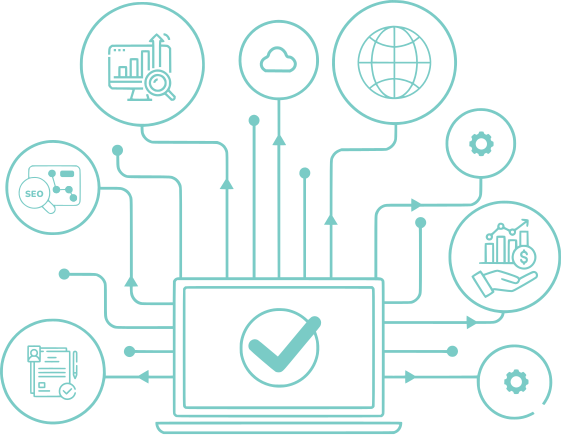
Industrial websites underperform when disconnected efforts create friction. Design, user experience, and technical infrastructure must work together. We build the full system so your site performs reliably, ranks consistently, and stays stable under load.

Design
UX and visual structure that build trust, present complex information clearly, and guide technical buyers toward the next step.

Development
Fast, secure platforms your team can manage, with accessibility and performance engineered into the foundation.

Search Infrastructure
Technical SEO, structured data, and accessibility signals built into the code so search engines and AI systems interpret content correctly.

Accessibility
WCAG compliance supports AI interpretation, improves visibility, and meets enterprise and government requirements.
Most industrial web projects break down before launch. Design moves in one direction, development in another, and SEO is added too late. A single team closes those gaps. Your project stays coordinated, performance is engineered in from the start, and your team owns the platform at launch.

Technical audit, Lighthouse baseline, content review, platform and integration inventory, and stakeholder discovery. A lucid, shared view of current performance
and future requirements.

Strategy, UX, architecture, and search infrastructure developed together. Buyer roles shape content. Performance and compliance are built in early.

Launch‑ready performance. Organic visibility from day one. A site your sales team relies on and your internal team can manage independently.
Performance shows up in your pipeline, in sales conversations, and in how leadership talks about digital. Here’s what changes when your site performs the way it should.
 Leads arrive informed
Sales teams spend time closing, not educating.
Digital presence matches reality
No more explaining the website.
Platform stays stable
Routine updates don’t require outside vendors.
Compliance stays current
Government and enterprise eligibility stays intact.
Organic traffic compounds
Growth continues without ongoing paid spend.
The site becomes a sales tool
Reps use it first in outreach and preparation.
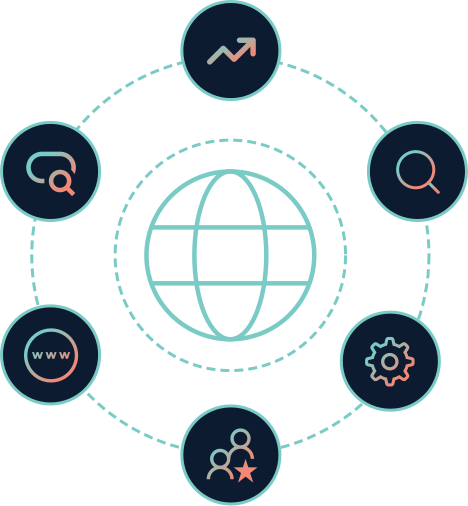
An underperforming site does not hold position. It loses visibility to competitors who are investing, and the cost accumulates in ways that are easy to miss until they are difficult to reverse.
Lost Search Share
Competitors investing in SEO and AEO gain visibility
Weakened Buyer Perception
An outdated site lowers confidence
Higher Sales Overhead
More senior time per deal raises acquisition cost
Compliance Exposure
Privacy, security, and accessibility gaps limit access to high‑value accounts
Performance Drag
Slow, unstable pages reduce visibility and increase future remediation costs
A direct conversation about what your site should be doing and what it takes to get there.
A standard business site presents a brand. A high‑performance industrial site functions as a business development system. It needs content architecture built for complex buyer journeys, technical SEO baked into the structure, fast and stable performance, compliance with accessibility and data standards, and a platform your team can manage. Design matters, but it’s one layer in a system that must function end‑to‑end.
Clear signals include flat or declining organic traffic, inbound leads that require heavy education, a sales team that rarely uses the site, and Lighthouse scores below 90.
Additional indicators include leadership apologizing for the site, a CMS that requires outside help for routine updates, and a digital presence that doesn’t match the company’s operational quality.
Separate vendors create gaps. SEO requirements are added after design. Development decisions drift from the original intent. No one owns the outcome.
A single team working from a unified brief closes those gaps and delivers a site built from coordinated decisions.
Accessibility, privacy, and data handling standards are now common procurement requirements. Government, enterprise, and institutional buyers expect WCAG compliance and clear documentation. Building to these standards from the start reduces long-term cost and improves usability for all visitors.
With proper technical architecture, clean performance, and structured content, early organic improvements typically appear within 60–90 days. Competitive primary keywords take longer, often 180–365 days, depending on domain authority and market conditions. Sites built correctly compound in the long run.
Discovery establishes the factual baseline, including a technical audit, Lighthouse benchmarks, organic position review, stakeholder alignment, content inventory, and platform assessment. The output is a shared brief that guides decisions and reduces rework throughout the project.